The Vitalists Part 5 – The Community

Why isolation is the enemy of the vow — and why the community that forms around it must be built with eyes open

By Futurist Thomas Frey

Part 5 of 6: The Community

There is a specific kind of loneliness that the statistics don’t fully capture.

It is the loneliness of a woman who has made the most consequential decision of her life — to bear and raise children as her primary vocation — and who finds that the world around her was not designed for what she’s trying to do. Her professional peers have followed a different path. Her neighborhood was built for commuters, not caregivers. Her extended family is scattered. The civic organizations that once created the connective tissue of community life in her grandparents’ generation have atrophied. And the social infrastructure of her daily life — the coffee shop, the group chat, the open-plan office — was designed for adults without young children, for whom she is now, in some quiet and unacknowledged way, a different category of person.

This loneliness is not incidental to the demographic crisis. It is one of its primary causes.

Before we can talk about what the Vitalist community is, we have to be honest about what it’s responding to — because the community is not an amenity added to the Vitalist vocation as a quality-of-life enhancement. It is load-bearing infrastructure. Without it, the vow is isolated. Isolated vows break.

Continue reading… “The Vitalists Part 5 – The Community”

When the Screen Disappears

The display that fills the room will not arrive as a better television. It will arrive as the end of television.

By Futurist Thomas Frey

Part 2 of 3: The 3D Video Room

Every generation inherits a rectangle and mistakes it for reality.

For most of the twentieth century, the rectangle was the cinema screen — a wall-sized surface in a darkened room where the world of moving images lived. Then the rectangle shrank to the television in the living room. Then it migrated to the laptop, then the phone, compressing the entire universe of visual storytelling into a glass slab small enough to hold in one hand. Each transition felt, at the time, like the final form. Each time, we adapted so completely that the previous rectangle started to seem primitive almost immediately.

The rectangle is about to disappear.

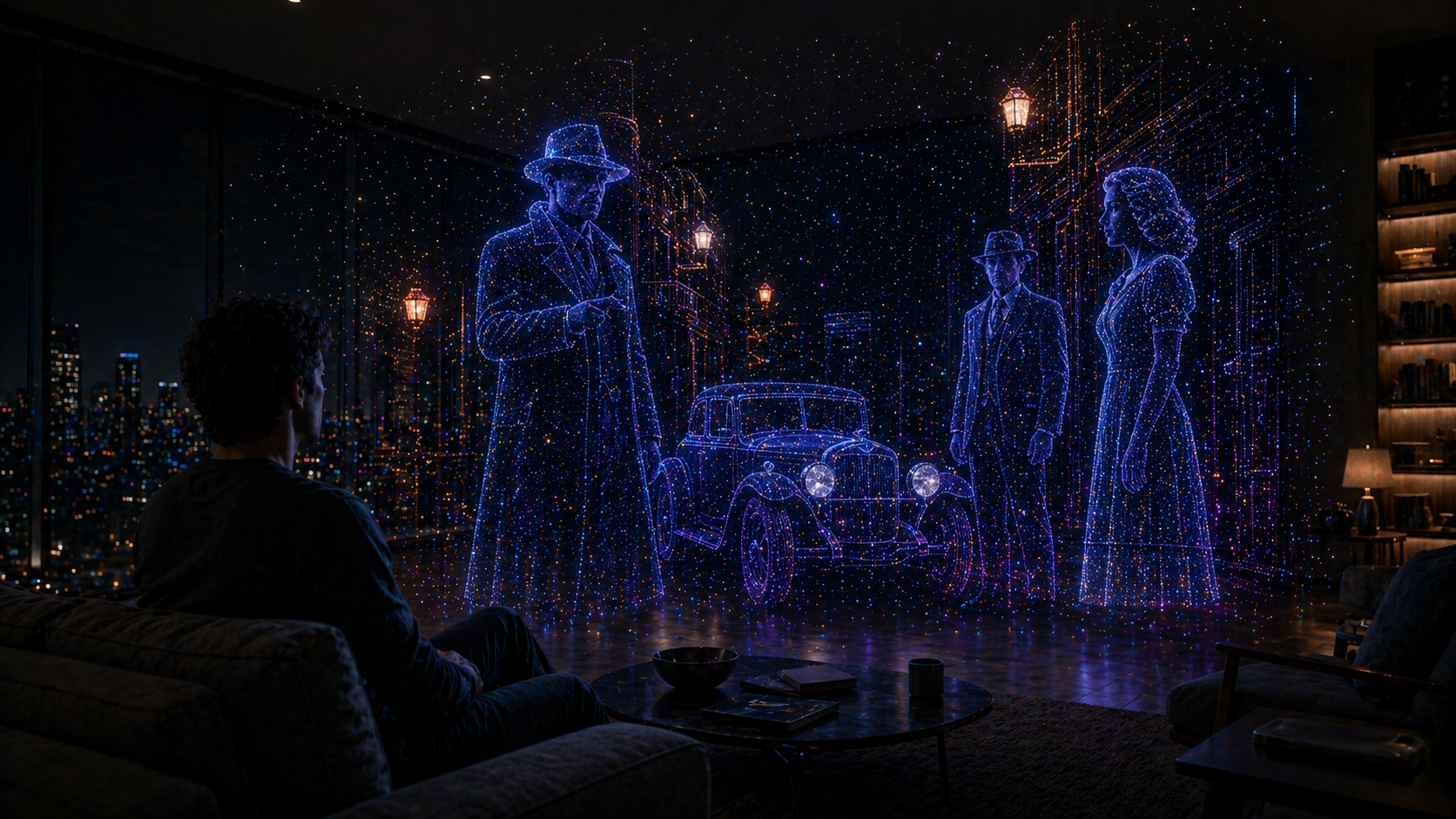
Not shrink. Not become more portable. Disappear — replaced by something that has no screen at all, no surface to project onto, no frame to contain it. A display that exists in the volume of a room the way furniture exists in a room, except that it occupies no physical space and can be summoned or dismissed in an instant. A display made of millions of floating points of light, each one positioned precisely in three-dimensional space by intersecting fields of energy, collectively forming images and scenes and presences that exist in the room with you rather than behind a pane of glass.

In Part 1 of this series, I traced the physics of this idea from a twenty-year-old thought experiment to the laboratory demonstrations that have proven it real. The floating point of light is not theoretical. It exists in research settings today, produced by femtosecond lasers ionizing air molecules at precise locations, by two-photon excitation in fluorescent media, by acoustic levitation of illuminated particles. The physics works. The engineering is the remaining challenge.

In this column I want to think about what happens to entertainment when the engineering catches up. Because the implications aren’t incremental. When the display escapes the screen and fills the room, the entire architecture of how we experience stories, watch sports, attend performances, and share visual information with other people changes simultaneously.

Continue reading… “When the Screen Disappears”

Maximum Curiosity Part 2 – The Infinite Regress Machine: When AI Asks ‘What Came Before That?’ Forever

By Futurist Thomas Frey

The Arbitrary Starting Point

Open any history textbook. Find the chapter on the American Revolution. Here’s what you’ll read:

“The American Revolution began with the Stamp Act of 1765, when Britain imposed taxes on the colonies without representation…”

There it is. Your starting point. 1765. The story begins here.

Except it doesn’t.

The Stamp Act didn’t emerge from nowhere. It was passed to pay debts from the Seven Years’ War. Which happened because of European power competition. Which stemmed from colonial expansion. Which was enabled by maritime technology. Which required metallurgy. Which depended on mining. Which needed agricultural surplus to feed miners. Which required the end of the last ice age to make agriculture possible.

Every history book picks an arbitrary starting point and pretends that’s where the story begins. They do this because books need beginnings, readers need narrative coherence, and authors need to finish manuscripts.

But reality doesn’t have starting points. Reality is an unbroken chain of causation stretching back billions of years.

A maximally curious AI won’t accept arbitrary starting points. It will trace every historical event backward through infinite layers of causation, asking “what came before that?” until it reaches the limits of knowable reality.

And then it will invent new ways to see further back.

This is the Infinite Regress Machine. And it’s going to rewrite everything we think we know about history.

Continue reading… “Maximum Curiosity Part 2 – The Infinite Regress Machine: When AI Asks ‘What Came Before That?’ Forever”

When Minds Can Talk Directly: Will It Mean the End of Language As We Know It?

By Futurist Thomas Frey


The Interface Nobody Asked For

Imagine waking up tomorrow with a neural implant that lets you transmit thoughts directly into someone else’s mind. No words. No translation. Just pure, unfiltered mental content flowing from your consciousness to theirs.

This isn’t science fiction anymore. Brain-computer interfaces in 2025 can already decode inner speech with 97% accuracy, translate neural signals into text in real time, and transmit simple thoughts between brains separated by continents. A paralyzed woman who hadn’t spoken in 18 years now “speaks” through a neural implant that streams her thoughts into audible words with an 80-millisecond delay. Researchers at Stanford have demonstrated password-protected thought decoding—your inner monologue stays private unless you mentally “unlock” it with a specific imagined phrase.

The technology exists. The infrastructure is emerging. Which means we need to start asking the harder questions: If minds can communicate directly, does traditional language die? Is literacy obsolete? Do we need a universal “thought language”? And what happens when we can no longer hide what we’re really thinking?

The answers are more complicated—and more disturbing—than you’d expect.

Continue reading… “When Minds Can Talk Directly: Will It Mean the End of Language As We Know It?”

The Global Checks-and-Balance Project: Mapping Power Against Its Counterweights

By Futurist Thomas Frey

Too many of the vital systems used to govern our world are left unchecked. Abuse of power is rampant in countries throughout the globe.

We talk about democracy, rule of law, and accountability. But in practice, most governmental, corporate, and institutional power operates with minimal oversight. Leaders make decisions affecting millions with no meaningful counterweight. Agencies regulate industries they’re supposed to oversee while being captured by those same industries. Courts enforce laws while being immune from the consequences of their errors.

Power accumulates. Checks erode. Balance disappears.

In a project that would propose to map systems against their associated checks-and-balance counterweights, we will begin to find a very revealing way of restructuring some of the world’s more egregious problem areas.

This isn’t abstract political theory. It’s practical systems analysis applied to governance: identify where power concentrates, measure what constrains it, and expose the gaps where abuse becomes inevitable.

Continue reading… “The Global Checks-and-Balance Project: Mapping Power Against Its Counterweights”

The Island That Became The Home of the Global Privacy Council

By Futurist Thomas Frey

The delegation from Indonesia touched down at Singapore Changi Airport at dawn, then caught the thirty-minute ferry to Meridian Island. Director Jordan James was there at the dock to greet them personally—not because protocol demanded it, though it did, but because every visiting delegation still seemed surprised that “Privacy Island” was real.

A functioning microstate of 47,000 people, just twenty miles off the Singapore coast. Recognized by 156 countries. Home to the Global Privacy Council, the AI Governance Authority, and the International Data Rights Tribunal. An island that had somehow become the world’s operating system for managing technologies too complex for any single nation to regulate alone.

Continue reading… “The Island That Became The Home of the Global Privacy Council”

The Pill That Prints: How Internal Bioprinters Are Rewriting Medical Reality

By Futurist Thomas Frey

In 2025, a small capsule changed the course of medicine. Researchers at École Polytechnique Fédérale de Lausanne (EPFL) unveiled a swallowable bioprinter—small enough to pass through the gastrointestinal tract, guided by external magnets and triggered by a near-infrared laser—to deposit living bio-ink directly onto internal tissue damage. They call it MEDS (Magnetic Endoluminal Deposition System). This device doesn’t just deliver medicine—it prints living scaffolds where the body is broken, redefining what “non-invasive” means.

We tend to view surgery, stents, pills or drug infusions as the high point of modern intervention. But what if the next frontier isn’t cutting or injecting—but printing inside you?

Continue reading… “The Pill That Prints: How Internal Bioprinters Are Rewriting Medical Reality”

The Concrete Battery Revolution: When Walls Become Power Plants

By Futurist Thomas Frey

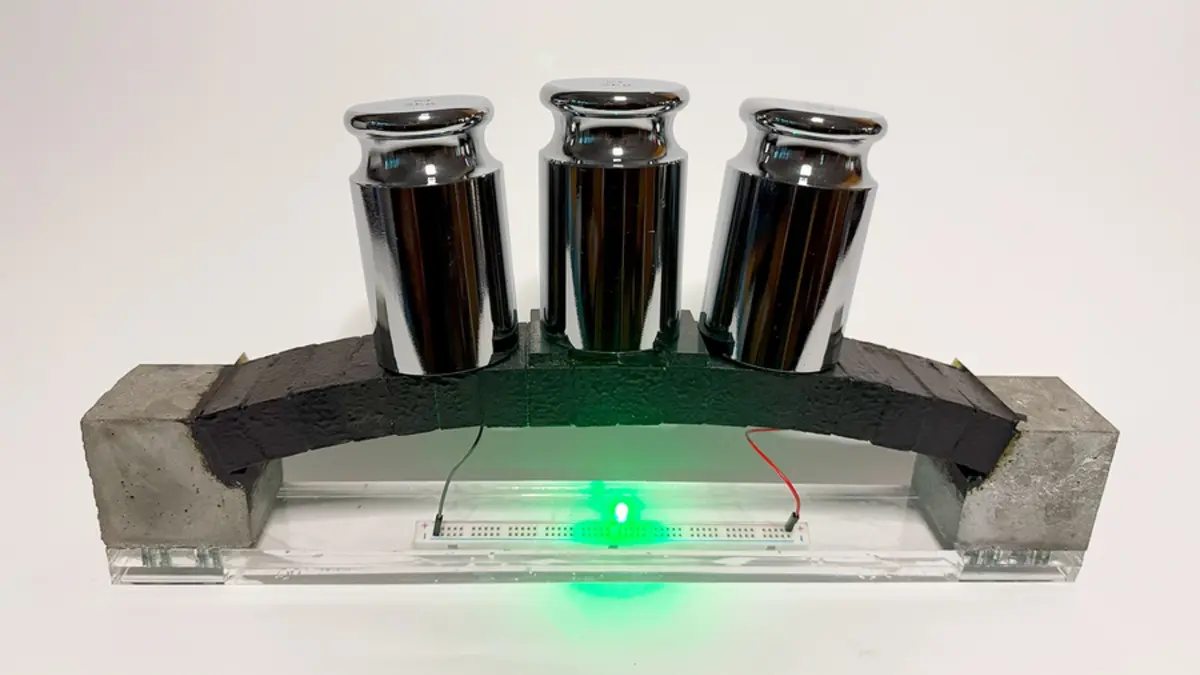
Imagine driving past a building and not just seeing its windows, doors, and facade—but glimpsing the stored energy humming inside its very walls. In a radical shift from mere structure to energy infrastructure, MIT researchers have developed a new form of concrete—electron-conducting carbon concrete (ec³)—that stores and discharges electricity, elevating walls, sidewalks, and foundations into living batteries. Their latest prototype improves energy density ten-fold over prior versions.

This is more than a clever trick. It’s a tectonic redefinition of how we build, live, and power the future.

Continue reading… “The Concrete Battery Revolution: When Walls Become Power Plants”

The Missing Person Problem Is Solved

By Futurist Thomas Frey

For decades, one of the most agonizing human experiences was a disappearance. A lost hiker who never returned. An elderly parent with dementia wandering away from home. A child abducted from a neighborhood park. Each year, these cases triggered frantic searches that consumed thousands of volunteer hours and drained local budgets. Too often, they ended in heartbreak.

By 2040, this problem is solved—not through more human effort, but through the relentless efficiency of AI-driven drone swarms.

Continue reading… “The Missing Person Problem Is Solved”

Voice and Ambient Intelligence: The Rise of Invisible Infrastructure

By Futurist Thomas Frey

For decades, technology was something we looked at, touched, and interacted with directly. Computers had screens. Phones had buttons. Smart devices came with apps. But a new era is emerging—one where the most powerful technologies fade from sight entirely.

This is the age of ambient invisible intelligence—systems woven seamlessly into our environments, operating in the background to track, sense, and respond in real time. Unlike earlier waves of innovation that demanded attention, these systems demand almost none. They’re simply there, embedded in the fabric of daily life, silently shaping experiences, decisions, and even economies.

Continue reading… “Voice and Ambient Intelligence: The Rise of Invisible Infrastructure”

Smart Glasses: The Next Form Factor for Smartphones?

By Futurist Thomas Frey

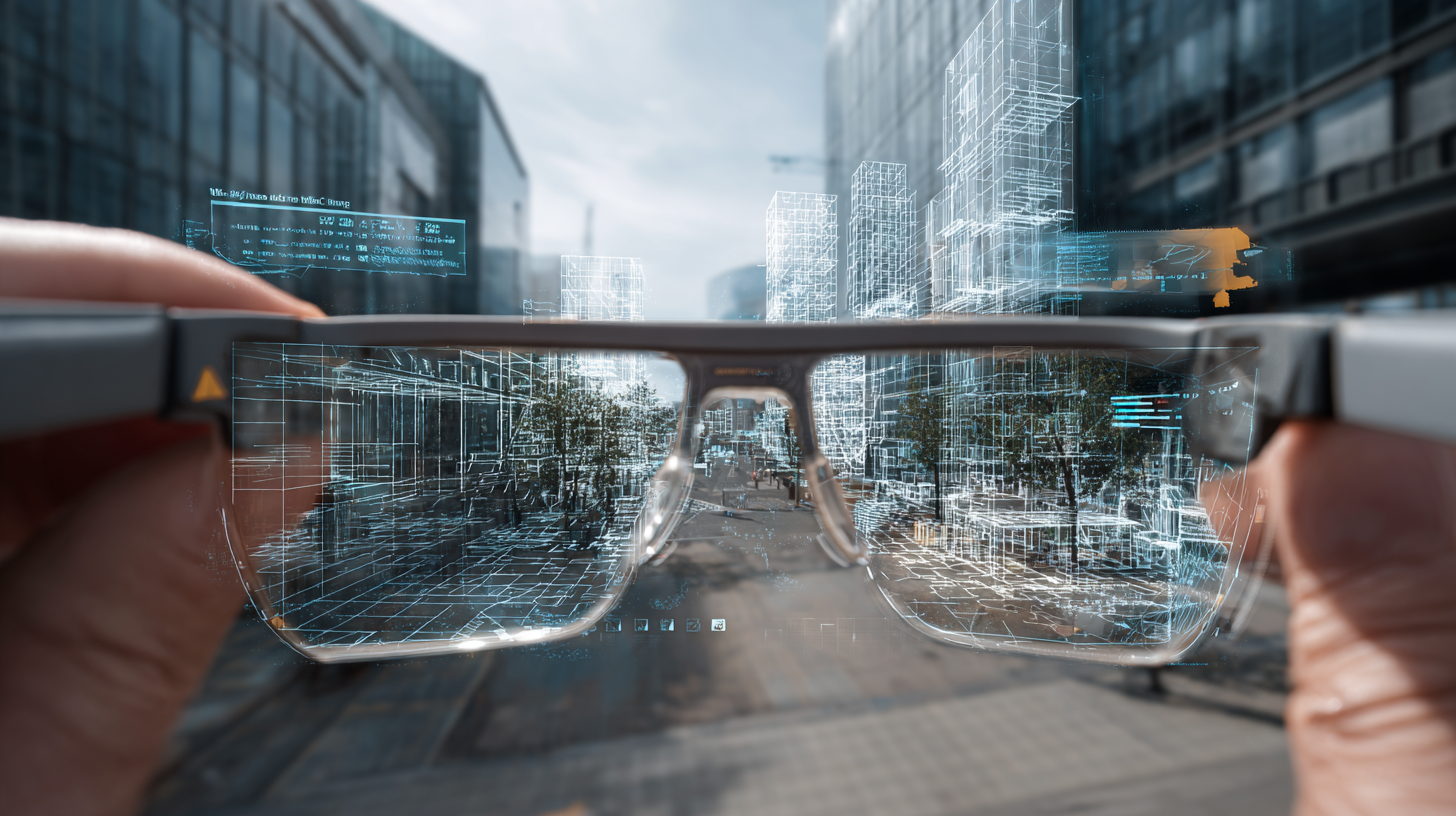
The smartphone may go down as one of the most transformative devices in human history. It collapsed cameras, calculators, maps, radios, books, and computers into a device small enough to slip into a pocket. But as revolutionary as it has been, the smartphone is not the final form factor of personal technology. Something new is waiting to replace it—and all signs point to smart glasses.

Already, companies like Meta, Apple, and others are racing to perfect wearable devices that overlay data onto the real world. But what if smart glasses are not just the next interface for calls and texts, but the gateway to something far more radical: recording, storing, and replaying the entire human experience?

Continue reading… “Smart Glasses: The Next Form Factor for Smartphones?”

How Age Reversal Could Solve the Global Underpopulation Crisis

For decades, headlines warned us about overpopulation. From Paul Ehrlich’s dire Population Bomb predictions in the 1960s to endless talk of resource exhaustion, the narrative has been one of too many people crowding into a finite world. But here’s the plot twist: the real threat isn’t overpopulation—it’s underpopulation.

New data is rewriting the story. The United Nations once projected global population to peak at 10.9 billion by 2100. But The Lancet recently published a study showing the peak will likely come earlier—9.7 billion by 2064—before dropping back down to 8.8 billion by the end of the century. That means billions fewer people and a global demographic implosion decades sooner than expected.

Continue reading… “How Age Reversal Could Solve the Global Underpopulation Crisis”