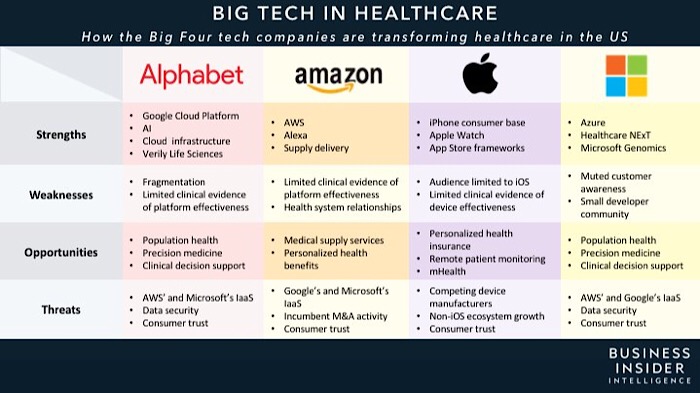
How Alphabet, Amazon, Apple, and Microsoft are shaking up healthcare — and what it means for the future of the industry

220D3A2B-47CC-42B8-895E-A985B8DADBA1

The healthcare industry is undergoing a profound transformation. Costs are skyrocketing, consumer demand for more accessible care is growing rapidly, and healthcare companies are unable to keep up.

Health organizations are increasingly turning to tech companies to facilitate this transformation in care delivery and lower health expenditures. The potential for tech-led digital health initiatives to help healthcare providers and insurers deliver safer, more efficient, and cost-effective care is significant. For healthcare organizations of all types, the collection, analyses, and application of patient data can minimize avoidable service use, improve health outcomes, and promote patient independence, which can assuage swelling costs.

Continue reading… “How Alphabet, Amazon, Apple, and Microsoft are shaking up healthcare — and what it means for the future of the industry”

The father of the internet wants to save the web from itself

0BFAAF52-9FC3-49BE-9336-1750CB3068BE

Tim Berners-Lee, the father of the Internet, sits in front of a 1994 computer displaying his creation.

Twenty-nine years ago, as the architect behind the web’s first browser and server, Tim Berners-Lee built the internet. ”I imagined the web as an open platform that would allow everyone, everywhere to share information, access opportunities, and collaborate across geographic and cultural boundaries,” he wrote in a 2017 open letter. But, he says, he’s become “increasingly worried” about new online trends, like lack of privacy, the spread of misinformation, and lack of transparency in online political advertising. Over the last decade, Berners-Lee’s focus has become saving the internet from itself, and now he’s recruiting companies, governments, and citizens to join his cause.

Berners-Lee’s non-profit the World Wide Web Foundation studies internet accessibility and usage, and details the barriers to a free and open internet, like harassment, privacy infringement, and cost. For instance, a recent study found that over 2 billion people live in places where internet is prohibitively expensive to access. And today, Berners-Lee announced a “Contract for the Web,” which lays out principles for using the internet ethically and transparently for all participants.

Continue reading… “The father of the internet wants to save the web from itself”

The future of cities

pic_the_future_of_cities_main

Cities may occupy just 2 per cent of the earth’s land surface, but they are home to more than half of the world’s population and generate 80 per cent of all economic output. And their dominance is growing: by 2045, an extra 2 billion people will live in urban areas.

At Pictet, we think it will put pressure on infrastructure, resources and the environment.

Encouragingly, those responsible for planning and building the urban centres of the future are up to the challenge. Worldwide, authorities are working ever more closely with the private sector in an effort to make our cities safer, more sustainable and better connected.

That’s good news for the planet.

Continue reading… “The future of cities”

The healthiest people in the world don’t go to the gym

pedestrians-400811_1920-e1541525675910

If you want to be as healthy as possible, there are no treadmills or weight machines required. Don’t just take my word for it—look to the longest-lived people in the world for proof.

People in the world’s Blue Zones—the places around the world with the highest life expectancy—don’t pump iron, run marathons or join gyms.

Instead, they live in environments that constantly nudge them into moving without even thinking about it. This means that they grow gardens, walk throughout the day, and minimize mechanical conveniences for house and yard work.

In fact, Blue Zones researchers determined that routine natural movement is one of the most impactful ways to increase your life span, and a common habit among the world’s longest-lived populations.

Continue reading… “The healthiest people in the world don’t go to the gym”

Artificial Intelligence will be the greatest jobs engine the world has ever seen

robot

Fears that AI will make many types of workers unemployable are unfounded.

In the past few years, artificial intelligence has advanced so quickly that it now seems that hardly a month goes by without a newsworthy AI breakthrough. In areas as wide-ranging as speech translation, medical diagnosis and game play, we have seen computers outperform humans in startling ways. This has sparked a discussion about what impact AI will have on employment.

Some fear that as AI improves, it will supplant workers in the job force, creating an ever-growing pool of unemployable humans who cannot economically compete with machines in any meaningful way. This concern, while understandable, is unfounded.

Continue reading… “Artificial Intelligence will be the greatest jobs engine the world has ever seen”

50 U.S. States ranked by how fat their people are, according to scientific data (There are some big surprises)

Screenshot 2018-11-14 00.53.40

Sorry, Mississippi.

A new study ranks all 50 states plus the District of Columbia by how fat their residents are. And there are some real surprises.

Across the United States, a staggering 70 percent of people are either overweight or obese. It’s part of what drives the $66 billion weight loss industry, which is always a good target for entrepreneurs.

But it also adds $200 billion a year to our nation’s health costs.

Continue reading… “50 U.S. States ranked by how fat their people are, according to scientific data (There are some big surprises)”

This smart toothbrush will clean all your teeth in just 6 seconds

Screenshot 2018-11-14 00.27.22

There are plenty of things in life that are a part of our routine. We’ve gotten used to them. They’re comfortable and familiar. And brushing your teeth is a perfect example. You expect to block out three to four minutes every morning and every night to brush every tooth one at a time until they’re squeaky clean.

But not anymore.

The creators of Unobrush have reinvented the way we brush our teeth. And, turns out, they’re absolutely crushing it on KickStarter., where the project is being crowdfunded.

Continue reading… “This smart toothbrush will clean all your teeth in just 6 seconds”

‘LarvalBot’ underwater drone will reseed coral reefs damaged by climate change


Since August 2018, the Great Barrier Reef in the ocean off Australia has had a special protector — an autonomous underwater drone called RangerBot that has monitored the status of the reef and protected the corals from the predatory crown-of-thorns starfish. But now researchers at Queensland University of Technology (QUT), Australia have announced that the RangerBot has a new mission: it is to be rechristened “LarvalBot” and will be repurposed to spread coral babies.

Scientists have collected hundreds of millions of coral spawn from the surviving corals of the Great Barrier Reef which have not yet succumbed to coral bleaching. These spawn are then reared into baby corals in special floating enclosures, and once they have grown large enough to survive on their own, they are delivered by the LarvalBot to a designated location in the reef. If necessary, many coral larvae can be distributed at once in a “larval cloud” that can blanket an entire damaged area of a reef. This technique is called larval restoration and may be reef’s best hope for the future.

Continue reading… “‘LarvalBot’ underwater drone will reseed coral reefs damaged by climate change”

How Bill Gates aims to save $233 billion by reinventing the toilet

Gates Foundation spent $200 million funding toilet research

LIXIL is among companies drawn to potential $6 billion market

Bill Gates thinks toilets are a serious business, and he’s betting big that a reinvention of this most essential of conveniences can save a half million lives and deliver $200 billion-plus in savings.

The billionaire philanthropist, whose Bill & Melinda Gates Foundation spent $200 million over seven years funding sanitation research, showcased some 20 novel toilet and sludge-processing designs that eliminate harmful pathogens and convert bodily waste into clean water and fertilizer.

Continue reading… “How Bill Gates aims to save $233 billion by reinventing the toilet”

Scientists develop liquid fuel that can store the Sun’s energy for up to 18 years

F8CA73E6-BD96-4042-AA10-A95CFE2C529F

No matter how abundant or renewable, solar power has a thorn in its side. There is still no cheap and efficient long-term storage for the energy that it generates.

The solar industry has been snagged on this branch for a while, but in the past year alone, a series of four papers has ushered in an intriguing new solution.

Scientists in Sweden have developed a specialised fluid, called a solar thermal fuel, that can store energy from the sun for well over a decade.

“A solar thermal fuel is like a rechargeable battery, but instead of electricity, you put sunlight in and get heat out, triggered on demand,” Jeffrey Grossman, an engineer works with these materials at MIT explained to NBC News.

Continue reading… “Scientists develop liquid fuel that can store the Sun’s energy for up to 18 years”

A growing number of people are getting rich selling T-shirts online – with no overhead, no inventory, and no investment

AAA44952-BA16-480F-9C11-3B432A44754C

Nearly every night after dinner for eight straight months, Glen Zubia brewed a cup of coffee, turned on heavy metal music, and made T-shirts.

On Mondays he did research, scouring the Internet for funny slogans, like the one where Santa Claus asks, “Where My Ho’s At?”

On Tuesdays and Wednesdays he designed in Adobe Illustrator. On Thursdays he saved his creations in the correct image format—a process that takes longer than you’d think—and on Fridays and Saturdays he uploaded them to Amazon.

Then, sending up a prayer that they’d sell, he started all over again.

Continue reading… “A growing number of people are getting rich selling T-shirts online – with no overhead, no inventory, and no investment”

Artificial Intelligence is not a technology

03799DBE-D1D5-445A-9681-393DC57F9A00

People have long dreamed of the idea of machines having the intelligence and capabilities of humans. From the early Greek myths of Hephaestus and his automatons to the Golem of Eastern European Jewish tradition to well over a hundred years of science fiction stories, novels and movies, our human imaginations have envisioned what it would be like to have sentient, intelligent, human-like machines co-exist with us. In 1920 Karel Čapek’s play R.U.R. (Rossum’s Universal Robots) first coined the word “robot” and gave us a name to give to the creations of our imaginations. In many ways, the quest for the intelligent machine lead to the development of the modern computer. Ideas by Alan Turing not only formulated the basis of programmable machines, but also the core of the concepts of artificial intelligence, with the namesake Turing Test providing a means for evaluating intelligent machines.

Continue reading… “Artificial Intelligence is not a technology”

Discover the Hidden Patterns of Tomorrow with Futurist Thomas Frey
Unlock Your Potential, Ignite Your Success.

By delving into the futuring techniques of Futurist Thomas Frey, you’ll embark on an enlightening journey.

Learn More about this exciting program.