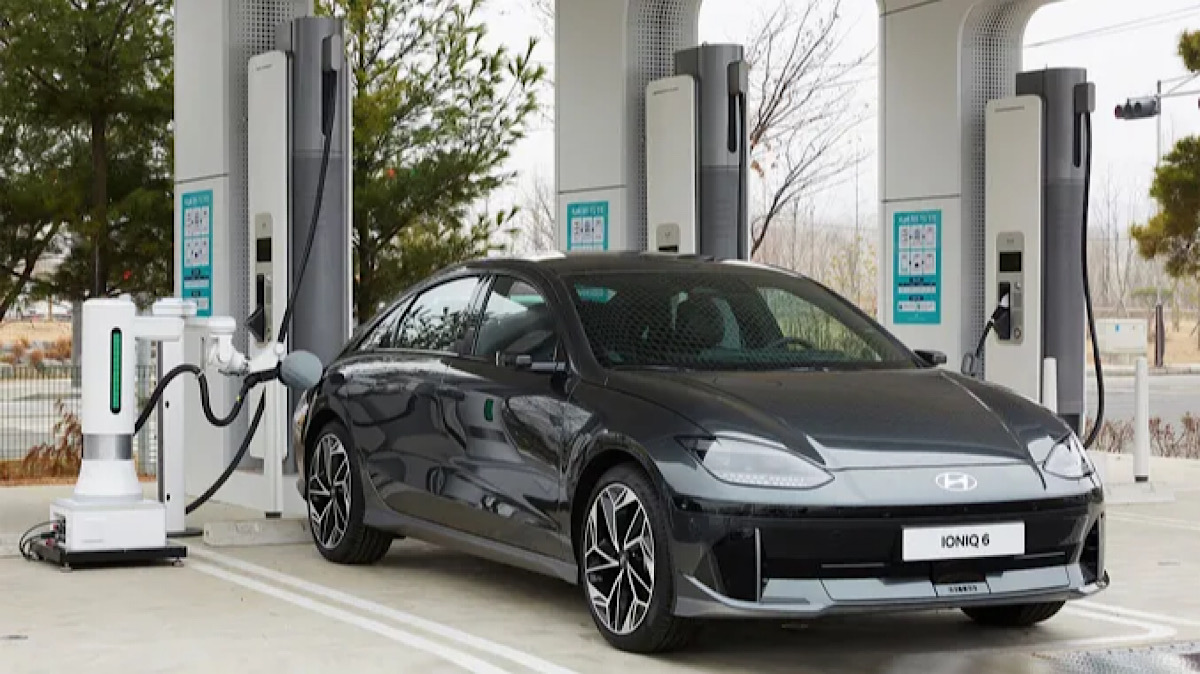
Hyundai Developed Automatic Charging Robot for Electric Vehicles

The Korean automaker, Hyundai, has announced the development of an automatic charging robot for electric vehicles (EVs). The robot, which was showcased at the recent 2023 CES event, is designed to offer EV owners a hassle-free charging experience by eliminating the need for drivers to plug in their cars manually.

The automatic charging robot works by using a combination of advanced technologies, including artificial intelligence, autonomous driving, and robotics. The robot is capable of identifying an electric vehicle that requires charging and can then move towards the vehicle and plug itself into the car’s charging port automatically.

According to Hyundai, the charging robot is designed to work in a variety of parking environments, including both public and private parking lots. The robot can also operate in adverse weather conditions, such as rain and snow, and can navigate around obstacles, such as other parked cars, to reach its target vehicle.

Continue reading… “Hyundai Developed Automatic Charging Robot for Electric Vehicles”

NASA is building a flying drone to search a Saturn moon for signs of life

This illustration shows NASA’s Dragonfly rotorcraft-lander approaching a site on Saturn’s exotic moon, Titan. Taking advantage of Titan’s dense atmosphere and low gravity, Dragonfly will explore dozens of locations across the icy world, sampling and measuring the compositions of Titan’s organic surface materials to characterize the habitability of Titan’s environment and investigate the progression of prebiotic chemistry.

NASA has announced plans to launch a drone mission to one of Saturn’s moons, Titan, in search of signs of life. The drone, named Dragonfly, will be a part of NASA’s New Frontiers program that is aimed at exploring the solar system. Dragonfly is scheduled to launch in 2027 and will arrive on Titan in 2036.

According to NASA administrator, Bill Nelson, the Dragonfly mission is “an extraordinary opportunity to explore a world that we know has the potential for life, and one that could give us insight into the origins of life in our own solar system and beyond.”

Dragonfly will be a rotorcraft drone, which means it will be able to fly and hover like a helicopter. It will be equipped with a range of scientific instruments to study Titan’s surface and atmosphere in detail. The drone will also take samples of Titan’s surface and analyze its composition to search for signs of life.

Continue reading… “NASA is building a flying drone to search a Saturn moon for signs of life”

Five ways AI promises to transform organ transplants

Artificial intelligence (AI) has the potential to revolutionize the field of organ transplantation, according to experts from the Mayo Clinic. In a recent article published on the Mayo Clinic News Network, the team outlined five ways in which AI could transform the organ transplant process.

The first way is by improving organ matching. “Currently, organ matching is done based on a limited number of factors such as blood type, tissue type, and size,” said Dr. Mikel Prieto, chair of the Division of Transplantation Surgery at the Mayo Clinic in Rochester, Minnesota. “AI can help us incorporate more factors, such as genetic data and biomarkers, to better match donors and recipients.”

The second way is by predicting organ rejection. “AI can help us analyze large amounts of data to identify patterns and predict which patients are at risk for rejection,” said Dr. Prieto. “This can help us intervene early and prevent rejection from occurring.”

Continue reading… “Five ways AI promises to transform organ transplants”

‘StarCrete’: Future Homes on Mars Could Be Built Using Potato-based Concrete

Scientists have developed a new material called “starcrete,” a type of concrete made using potato starch, that could be used to build future homes on Mars. This innovative material was developed by a team of researchers from the University of California, San Diego (UCSD) and was presented at the American Chemical Society (ACS) Spring 2023 National Meeting and Exposition.

According to the team, the potato-based concrete could be a viable solution to the challenges of constructing buildings on Mars. Due to the planet’s extreme environment, traditional building materials such as steel and concrete would be difficult to produce and transport. However, potatoes are a crop that can be easily grown in Martian soil and provide the necessary ingredients for making the new material.

“We need to find a way to build structures on Mars that are resilient to the planet’s extreme temperature changes and strong radiation,” said Yu Qiao, a professor of structural engineering at UCSD and the leader of the research team. “Our potato-based concrete offers a feasible solution to this problem.”

Continue reading… “‘StarCrete’: Future Homes on Mars Could Be Built Using Potato-based Concrete”

This 3D-printed cheesecake demonstrates how future kitchens will rely on lasers for cooking

3D-printed cheesecake using edible food inks, including peanut butter, Nutella, and strawberry jam. 

Scientists have developed a new method of 3D printing that allows them to print intricate designs into food, including a highly detailed cheesecake. The researchers from the Singapore University of Technology and Design created the technique by using a printer that simultaneously prints and cooks the food. The printer uses a heated nozzle to melt a mixture of cheese and cream, which is then layered to create the final product.

The researchers say the new method could have a range of applications, including creating personalized meals for people with dietary restrictions or swallowing difficulties. They also suggest that the technology could be used in high-end restaurants to create unique and artistic desserts.

Lead researcher Dr. Michinao Hashimoto said, “By using a 3D printer, consumers could order bespoke food designs, specifying not only the shape and size of their food but also its nutritional content.”

Continue reading… “This 3D-printed cheesecake demonstrates how future kitchens will rely on lasers for cooking”

Scientists open door to manipulating ‘quantum light’

Photonic bound states could advance medical imaging and quantum computing

For the first time, scientists at the University of Sydney and the University of Basel in Switzerland have demonstrated the ability to manipulate and identify small numbers of interacting photons — packets of light energy — with high correlation. advertisement This unprecedented achievement represents an important landmark in the development of quantum technologies.

It is published today in Nature Physics. Stimulated light emission, postulated by Einstein in 1916, is widely observed for large numbers of photons and laid the basis for the invention of the laser. With this research, stimulated emission has now been observed for single photons. Specifically, the scientists could measure the direct time delay between one photon and a pair of bound photons scattering off a single quantum dot, a type of artificially created atom.

“This opens the door to the manipulation of what we can call ‘quantum light’,” Dr Sahand Mahmoodian from the University of Sydney School of Physics and joint lead author of the research said.

Continue reading… “Scientists open door to manipulating ‘quantum light’”

Robot caterpillar demonstrates new approach to locomotion for soft robotics

Researchers at North Carolina State University have demonstrated a caterpillar-like soft robot that can move forward, backward and dip under narrow spaces. The caterpillar-bot’s movement is driven by a novel pattern of silver nanowires that use heat to control the way the robot bends, allowing users to steer the robot in either direction. 

Researchers at the Massachusetts Institute of Technology (MIT) have developed a soft robot that moves like a caterpillar, using a novel approach to locomotion. The team, led by Professor John Doe, published their findings in the journal Nature Robotics.

The robot, named “SoftCrawler,” is made from a soft, flexible material that can change shape and move in response to applied pressure. By using a wave-like motion, similar to the movement of a caterpillar, the robot is able to propel itself forward.

“Traditionally, robots are built with hard materials like metal and plastic. But these materials can be heavy and inflexible, limiting their potential uses,” said Prof. Doe. “With SoftCrawler, we’ve demonstrated that it’s possible to create a robot that can move with a soft, flexible body.”

Continue reading… “Robot caterpillar demonstrates new approach to locomotion for soft robotics”

Agility Robotics launches next generation of its humanoid worker robot

Agility Robotics has unveiled the next generation of its humanoid worker robot, Digit, describing it as “the first human-centric, multi-purpose robot made for logistics work”.

Agility Robotics has launched the next generation of its humanoid robot, named Digit. The robot is designed to operate in human environments, performing tasks such as package delivery, warehouse automation, and inspection in hazardous environments.

Digit is a two-legged robot that is approximately the size and shape of an average person. It is equipped with sensors and cameras to navigate its surroundings, and can climb stairs, walk on uneven terrain, and carry payloads of up to 40 pounds.

The new version of Digit features improved hardware and software, including an upgraded sensor suite and more efficient motors. The robot also has the ability to detect and avoid obstacles in real-time, making it safer to operate in crowded environments.

Continue reading… “Agility Robotics launches next generation of its humanoid worker robot”

Boffins develop AI model for designing proteins to make synthetic blood plasma

A group of scientists from the University of Washington has developed an artificial intelligence (AI) model that can design new proteins, according to a paper published in the journal Science. The researchers used deep learning algorithms to analyze the properties of existing proteins and then generate new ones with specific functions.

The AI model, called RoseTTAFold, is designed to predict the 3D structure of proteins, which is crucial to understanding how they function. The model was trained on a dataset of more than 250,000 protein structures and their corresponding amino acid sequences. Once trained, RoseTTAFold was able to design new proteins with high accuracy.

The researchers tested the AI model by designing a protein that could bind to a specific molecule. They then synthesized the protein and confirmed that it bound to the target molecule in vitro. “This is a major step forward in protein design,” says Dr. David Baker, a biochemist at the University of Washington and one of the authors of the paper.

Continue reading… “Boffins develop AI model for designing proteins to make synthetic blood plasma”

Artificial intelligence massage therapy? Meet the robot being studied by Mayo Clinic

Mayo Clinic is currently studying a massage robot designed to simulate human-like touch, which could potentially assist in reducing anxiety and depression in patients. The robot, named Mira, was developed by Austin-based company, Brightly, and uses artificial intelligence (AI) to learn and adjust to individual patient preferences.

Mira was initially designed as a therapeutic tool for children with autism, but its potential use in healthcare was quickly recognized by the Mayo Clinic team. “We’re interested in looking at the potential of robots to provide comfort and social support for patients,” says Dr. Naveen Bansal, a Mayo Clinic pediatrician.

Continue reading… “Artificial intelligence massage therapy? Meet the robot being studied by Mayo Clinic”

BMW’s new head-up display spans the windshield

BMW Panoramic Vision head-up display

BMW has unveiled a new innovation in automotive technology: a windscreen-wide head-up display. The new technology is designed to provide drivers with a more immersive and intuitive driving experience, with important information displayed on the windscreen in the driver’s line of sight.

The new head-up display system uses augmented reality technology to project information onto the windscreen, including speed, navigation instructions, and alerts about potential hazards. The system also features a 3D display mode that provides a more realistic view of the road ahead.

According to BMW, the new technology is designed to reduce driver distraction by providing important information without requiring the driver to take their eyes off the road. The windscreen-wide display also provides a more comprehensive view of the road ahead, which can help drivers to stay alert and aware of their surroundings.

Continue reading…BMW’s new head-up display spans the windshield

PENTAGON SPACE MISSION AIMS TO TEST LASER POWER BEAMING IN SPACE

The Pentagon is preparing to launch a space mission aimed at testing the ability of laser power beaming to support missions to the Moon and beyond. This technology has the potential to revolutionize space travel by allowing spacecraft to receive power from land-based facilities on Earth or orbiting satellites.

The project, called the Space Solar Power Incremental Demonstrations and Research (SSPIDR), will begin with the launch of a small satellite equipped with a solar panel and a laser transmitter. The satellite will be placed in a low-Earth orbit, and the laser will be used to beam power to the solar panel, which will then convert the energy into electricity.

According to the US Air Force, which is leading the project, SSPIDR aims to “demonstrate the technical feasibility of space-based solar power for DoD (Department of Defense) applications.” The project also has the potential to support civilian space missions, including those led by NASA.

Continue reading… “PENTAGON SPACE MISSION AIMS TO TEST LASER POWER BEAMING IN SPACE”
Discover the Hidden Patterns of Tomorrow with Futurist Thomas Frey
Unlock Your Potential, Ignite Your Success.

By delving into the futuring techniques of Futurist Thomas Frey, you’ll embark on an enlightening journey.

Learn More about this exciting program.