By Futurist Thomas Frey
We stand at a peculiar threshold. As artificial intelligence, robotics, and automation reshape the employment landscape, forcing millions into career transitions, a counterintuitive truth emerges: our hunger for human connection will only intensify. The question isn’t whether people will venture out—they will. The question is: what will draw them out?
The experiences that thrive in the next decade won’t simply survive automation; they’ll offer something automation fundamentally cannot replicate. They’ll serve as social anchors in turbulent times, providing the very things that make us human: connection, spontaneity, and the irreplaceable texture of being physically present with others.
The Rise of Participatory Everything
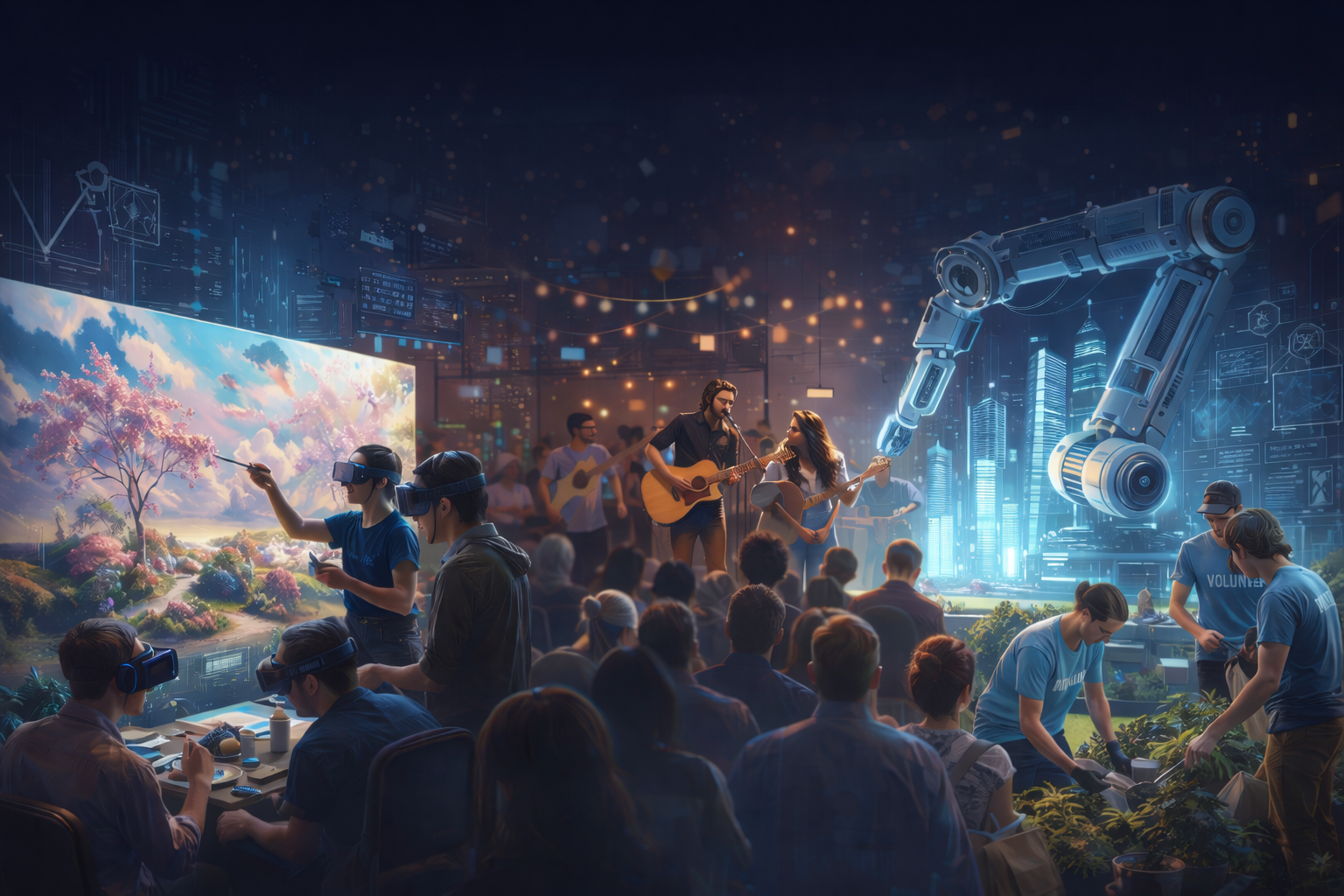
Passive entertainment is dying. The future belongs to experiences where you’re not just a spectator but a participant. Escape rooms hinted at this shift, but we’re about to see it explode across categories. Immersive theater productions where audiences shape outcomes, interactive art installations that respond to human presence, and social gaming venues that blend physical and digital play will multiply.
Cooking classes, pottery studios, and maker spaces represent the bleeding edge of this trend. People don’t just want to consume—they want to create alongside others, guided by human expertise that AI can inform but never truly replace. The act of learning something tactile, something that leaves flour on your hands or clay under your fingernails, becomes a form of resistance against an increasingly digital existence.
The Experience Economy Goes Hyperlocal
As career disruption creates economic uncertainty, we’ll see a flowering of micro-experiences—affordable, neighborhood-based offerings that don’t require significant travel or expense. Pop-up performances, community gardens, local sports leagues, and neighborhood walking tours will proliferate. These aren’t grand destinations; they’re woven into the fabric of daily life.
Coffee shops and third spaces will evolve beyond mere caffeine delivery systems into curated community hubs, hosting everything from board game nights to skill-sharing sessions. The successful ones won’t compete on efficiency—they’ll compete on belonging.
Wellness as Social Infrastructure
The wellness industry will fundamentally reorient around communal experience. Solo meditation apps will give way to group breathwork sessions, sound baths, and movement classes that emphasize collective energy. Fitness boutiques already understand this: people pay premium prices not for equipment but for the motivation that comes from working out alongside others, with a human instructor reading the room’s energy.
Mental health support will similarly shift toward group formats—not just therapy circles, but creative workshops designed around emotional processing, men’s and women’s circles, and intergenerational dialogue sessions. As career transitions strain mental health, these communal spaces will serve as pressure valves and support systems.
The Resurgence of Live Performance
Live music, comedy, theater, and spoken word will experience a renaissance. In an era where AI can generate perfect, personalized content on demand, the imperfection and spontaneity of live performance becomes precious. You can’t replicate the electricity of a room full of strangers laughing at the same joke or the collective breath-holding during a dramatic moment on stage.
Smaller venues will thrive particularly well—intimate spaces where performers and audiences feed off each other’s energy. The experience isn’t just the performance; it’s being in a room with others who’ve also chosen, that night, to be present for something ephemeral.
Retail That Offers Discovery and Curation
Retail survives not by competing with Amazon’s efficiency but by offering what algorithms cannot: serendipitous discovery and trusted human curation. Bookstores, record shops, and boutique retailers that emphasize knowledgeable staff and unexpected finds will hold steady. The successful ones will host events, offer classes, and create reasons to linger.
Farmers markets represent the platonic ideal: they’re nominally about buying vegetables, but they’re really about seeing neighbors, sampling offerings, chatting with growers, and feeling connected to the source of food. This model—retail as social ritual—will expand into other categories.
The Wild Card: Shared Purpose Experiences
Perhaps most significantly, we’ll see growth in experiences organized around collective action and shared purpose. Community restoration projects, citizen science initiatives, neighborhood improvement efforts, and volunteer-driven events tap into our need to feel useful and connected to something larger than ourselves.
As automation challenges our sense of economic purpose, these opportunities to contribute meaningfully to our communities will become psychologically essential. They’re entertainment only in the broadest sense—they’re really about answering the question that haunts every major transition: what am I for?
The Thread That Connects
What ties these seemingly disparate trends together is authenticity and presence. The experiences that will draw us out are those that can’t be replicated by technology precisely because they depend on the beautiful inefficiency of human beings gathering in physical space, with all our unpredictability and warmth.
As we navigate the great transition, these social anchors won’t just be nice to have. They’ll be essential infrastructure for collective resilience—the places where we remember, amid all the disruption, what it means to be human together.
Related Articles:
The Coming Job Exodus: 2 Billion Jobs to Disappear by 2030
Why the Experience Economy is the Future of Retail
The Third Place Revolution: Reimagining Community Spaces for the Digital Age