
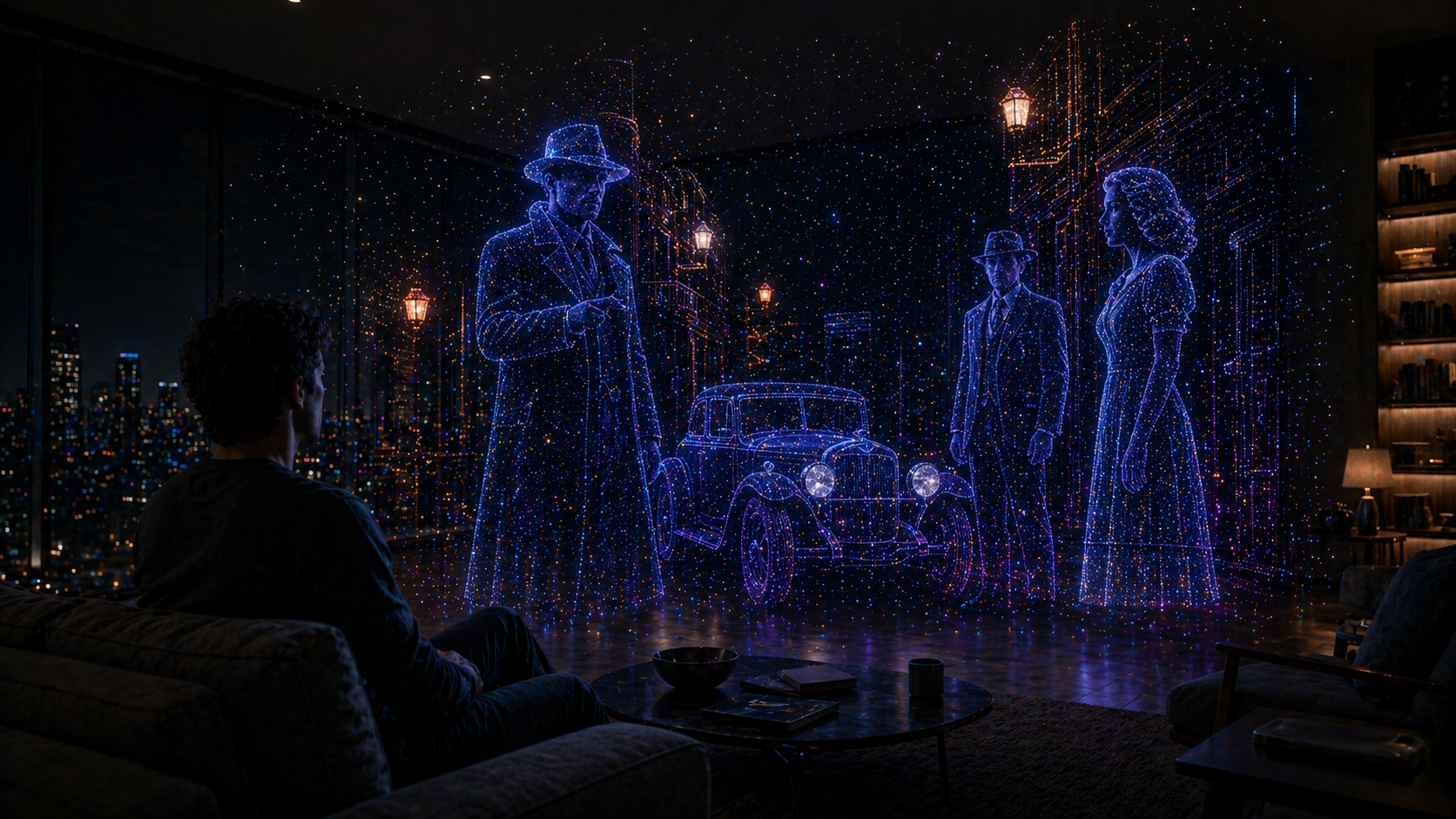
The display that fills the room will not arrive as a better television. It will arrive as the end of television.
By Futurist Thomas Frey
Part 2 of 3: The 3D Video Room
Every generation inherits a rectangle and mistakes it for reality.
For most of the twentieth century, the rectangle was the cinema screen — a wall-sized surface in a darkened room where the world of moving images lived. Then the rectangle shrank to the television in the living room. Then it migrated to the laptop, then the phone, compressing the entire universe of visual storytelling into a glass slab small enough to hold in one hand. Each transition felt, at the time, like the final form. Each time, we adapted so completely that the previous rectangle started to seem primitive almost immediately.
The rectangle is about to disappear.
Not shrink. Not become more portable. Disappear — replaced by something that has no screen at all, no surface to project onto, no frame to contain it. A display that exists in the volume of a room the way furniture exists in a room, except that it occupies no physical space and can be summoned or dismissed in an instant. A display made of millions of floating points of light, each one positioned precisely in three-dimensional space by intersecting fields of energy, collectively forming images and scenes and presences that exist in the room with you rather than behind a pane of glass.
In Part 1 of this series, I traced the physics of this idea from a twenty-year-old thought experiment to the laboratory demonstrations that have proven it real. The floating point of light is not theoretical. It exists in research settings today, produced by femtosecond lasers ionizing air molecules at precise locations, by two-photon excitation in fluorescent media, by acoustic levitation of illuminated particles. The physics works. The engineering is the remaining challenge.
In this column I want to think about what happens to entertainment when the engineering catches up. Because the implications aren’t incremental. When the display escapes the screen and fills the room, the entire architecture of how we experience stories, watch sports, attend performances, and share visual information with other people changes simultaneously.
What a Million Points of Light Actually Means
Before the entertainment implications, let’s be precise about what the technology actually produces at room scale.
A volumetric display built from floating light points doesn’t work like a projector casting images onto a surface. It works like a sculpture made of light — each point in the display volume can be independently addressed, independently colored, independently brightened or dimmed. The display has no front or back. You can walk around it. You can look at it from above. You can, depending on the technology pathway, walk through it.
Researchers have confirmed spatiotemporal resolutions of up to 200,000 dots per second using femtosecond laser systems, with the size of the working volume scalable depending on the optical devices and their setup. That resolution, in a cubic centimeter demonstration volume, produces images of remarkable clarity. Scale the volume to a cubic meter — a display you could reach into — while maintaining comparable voxel density and you’re describing a system capable of rendering human figures at recognizable detail. Scale to a room and you have a display that can fill your entire living space with imagery you can walk through.
The color range is full RGB. The update rate is fast enough for fluid video. The images are visible from any angle without the glasses, the head-tracking, or the viewing-angle restrictions that have plagued every previous attempt at “3D” display.
This is not better television. It is a different category of sensory experience.
The Sports Event That Fills Your Living Room
Start with the application that will drive the first wave of consumer adoption, because it always comes down to sports.
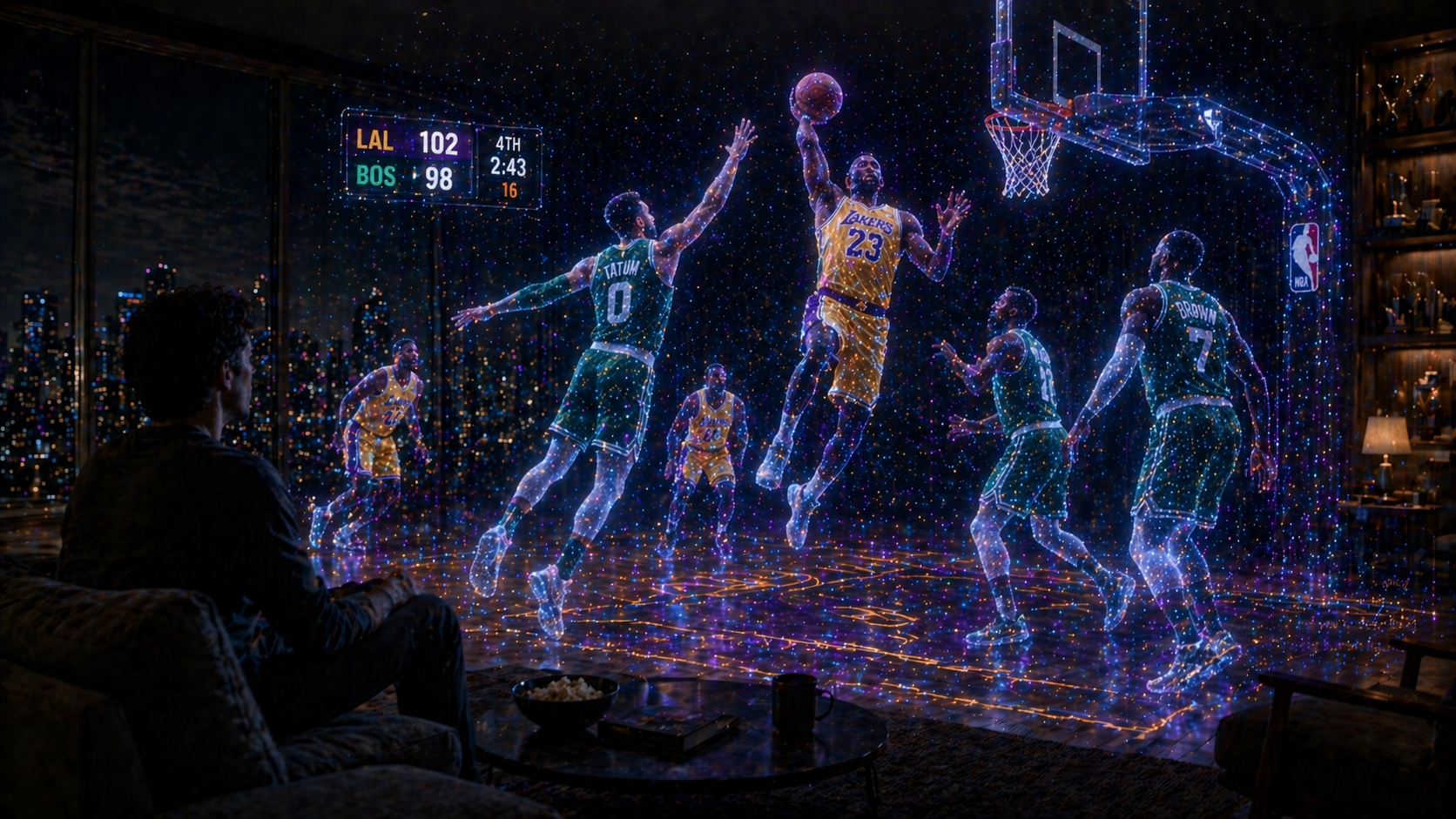
Imagine placing a football field — scaled to fit your living room — on your living room floor. Not on a screen. On the floor. The players moving at real-time, their positions in three-dimensional space rendered by a system that maps the broadcast data to a volumetric display refreshing sixty times a second. You watch the play develop from above, from the sideline, from behind the quarterback. You zoom in on a specific player by adjusting your viewing position relative to the display. You see the hole in the coverage that the quarterback saw. You see the defensive backfield rotating in a way that the TV broadcast camera never shows because it’s always stuck at field level.
The NFL has been gathering positional tracking data on every player, every play, in real time, since 2014. The NBA has the same. Soccer leagues worldwide have it. Every major sport is already producing the data stream that a volumetric display needs to render the game in three-dimensional space. The broadcast infrastructure exists. The data exists. What hasn’t existed until now is the display.
You wouldn’t need a stadium ticket. You wouldn’t need a massive television. You would sit in your living room and watch the game happen at whatever scale the space allows — a tabletop version the size of a board game, a floor version the size of a coffee table, or eventually a full-room version where the players move at human scale through your actual living space.
The economics of live sports — built entirely around the scarcity of physical presence, the premium on the ticket, the broadcast rights that replicate that scarcity at a remove — would need to be rebuilt from scratch.
The Performer in the Room
The music industry lost its physical product when streaming made recordings free to access. It rebuilt its economics around live performance — the one thing that remained scarce, that couldn’t be perfectly replicated by a digital file. The volumetric display threatens to replicate that too.
Not perfectly. The presence of another human body in a physical space carries something that no display technology can fully replicate, for the same reasons that a video call isn’t the same as a face-to-face meeting. But the gap between a flat-screen concert broadcast and a volumetric rendering of a performer in your room is not like the gap between a video call and a meeting. It is a genuinely different category of presence.
A volumetric concert broadcast — the performer rendered at human scale in three dimensions in your living room, addressable from any angle, displaying the light and motion and physicality of a live performance — changes what it means to “attend” a show. The audience of a single performance could simultaneously be everywhere in the world. The geography of music, which live performance partially restored after recordings made geography irrelevant, becomes irrelevant again.
Artists and labels will resist this. They resisted streaming too, and then adapted to it. The adaptation will involve new economic models — volumetric broadcast rights, premium access tiers, the same creativity the industry applied to streaming royalties — and new forms that only the volumetric medium makes possible. Performances designed specifically for the intimate scale of a living room display. Concerts where the “set design” is volumetric light architecture that doesn’t exist in physical space at all. Interactive elements that the screen format could never support.
The Movie That Surrounds You
The cinema screen exists to create immersion through scale — to overwhelm peripheral vision with imagery large enough that the brain accepts it as an environment rather than a representation. IMAX is the logical endpoint of that approach: make the screen so large and the sound so enveloping that the physical theater disappears.
The volumetric display achieves immersion differently. Not by filling your visual field with a flat surface but by placing the story in the same physical space you inhabit. The characters exist at your scale, in your room, occupying the same three-dimensional space you do. You’re not watching them through a window. You’re in the room with them.
This changes everything about how stories are structured.
The camera shot — the fundamental unit of cinematic storytelling — exists because cinema is a directed medium. The director chooses where to point the camera, and the audience has no choice but to look where they’re told. Every decision in a screenplay, every edit, every framing choice is built on the assumption that the audience’s gaze can be controlled.
In a volumetric display, the audience’s gaze cannot be controlled. The viewer can look anywhere. They can focus on the background action while the foreground scene plays out. They can follow the secondary character the director didn’t intend as the primary focus. The story has to work from every angle simultaneously, the way a stage play works from every seat in the theater — except that the audience isn’t limited to their seat. They can move.
This will not replace cinema. The directed, framed, edited film is its own art form with its own aesthetic logic, and the constraint of the frame is part of what makes it work. But volumetric storytelling is a new medium with its own possibilities, and the stories that are written for it will be fundamentally different in structure from the stories written for the screen. They’ll be closer to theater, or to installation art, or to something that doesn’t have a name yet because the medium doesn’t yet exist at consumer scale.
The writers and directors who figure out the grammar of volumetric storytelling early will have the same advantage that the first filmmakers had over the theatrical tradition they came from — and will be equally incomprehensible to their predecessors.
The Meeting That Has No Location
Before this column focuses exclusively on entertainment, it’s worth noting that the implications extend to every domain where human beings currently use screens to communicate.
The business meeting conducted around a physical conference table exists because it was, for most of history, the only way to have all relevant parties looking at the same physical information simultaneously. Video conferencing partially replicated that — badly, in the flat, eye-contact-destroying, spatial-relationship-erasing way that anyone who has spent time in Zoom meetings has learned to tolerate. Volumetric presence is different. The participants appear in the room at human scale, in three dimensions, positioned around a shared information space that all of them can point at, gesture toward, and interact with. The information itself — the data, the document, the design — floats in the shared space between them, equally accessible to everyone regardless of physical location.
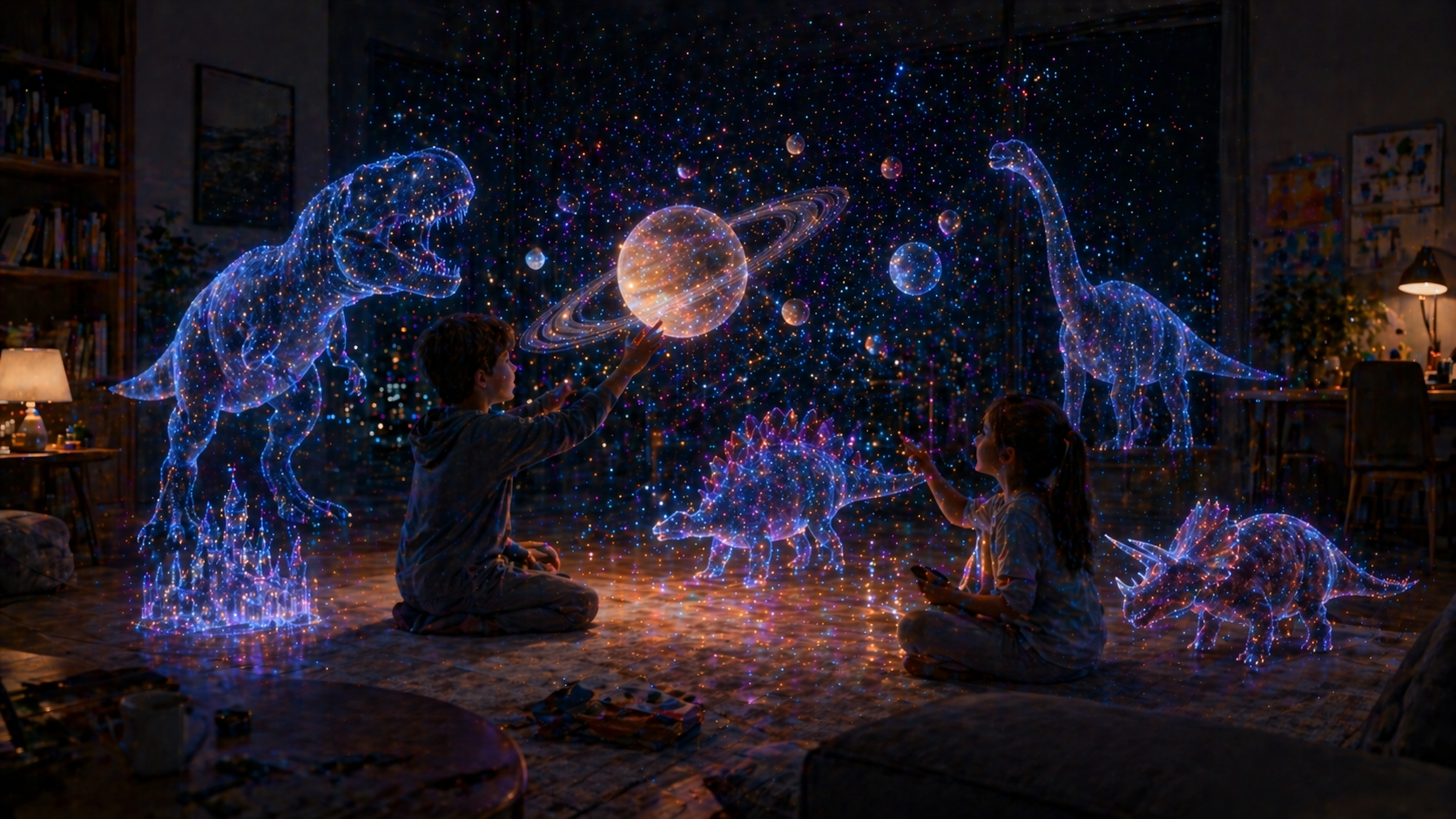
The applications extend to medicine, to education, to every domain where shared understanding of three-dimensional information matters. A surgeon previewing an operation in volumetric rendering of a specific patient’s anatomy. A student exploring a scale model of the solar system that fills the classroom. An architect walking a client through a building that doesn’t exist yet. Each of these is an entertainment application in the broadest sense — they are all about generating experience from information.
The Children Who Grow Up With This
The deepest changes from any new display technology are always in the generation that grows up treating it as normal.
Children who grew up with smartphones have a fundamentally different relationship to information, communication, and attention than the generation that adopted smartphones as adults. The smartphone shaped their cognitive habits from early childhood — the swipe, the tap, the notification, the infinite scroll. The implications of that shaping are still being worked out.
Children who grow up with volumetric displays will have a fundamentally different relationship to space, presence, and the boundary between physical reality and represented reality. The room will always have been a place where things that aren’t physically there can appear to be physically there. The boundary between the real and the rendered will always have been blurry. The three-dimensional physical world and the three-dimensional information world will always have overlapped.
What that does to perception, to social development, to architecture, to education, to the design of cities and homes — these are not questions with obvious answers. They are questions that the next generation will answer by living through them, the way every previous generation has answered the questions raised by the technologies they were born into.
What the Rectangle Leaves Behind
The rectangle isn’t going away immediately. It’s too well-established, too economically entrenched, too suited to certain specific use cases — the phone as a personal information terminal, the laptop as a work surface, the cinema screen as a directed collective experience — to disappear on any short timeline.
But its dominance over how we experience visual information, which has been absolute for a century, is ending. The volumetric display does not compete with the rectangle by being a better rectangle. It competes by making the rectangle’s fundamental premise — that visual experience lives behind a flat surface — seem as limiting as it actually is.
Twenty years ago, this was a thought experiment about a point of light hanging in empty space. The physics of that point, explored and demonstrated in laboratories over the intervening decades, turns out to be the physics of a new kind of display. And a new kind of display, at the scale of a room and the resolution of human vision, is a new kind of reality.
The entertainment industry has spent a century building infrastructure for the rectangle. The infrastructure for what comes next doesn’t exist yet.
That is both the challenge and the opportunity.
Next: Part 3 — The Projected House. When fields of intersecting energy can produce light, insulation, and physical resistance at precise points in space, the wall becomes optional. What does architecture look like when the building is made of energy rather than matter — and what does it mean to live inside a structure you can walk through?
Related Reading
The Volumetric Display: From Laboratory to Living Room
ACM SIGGRAPH 2024 — The most recent academic work on scaling volumetric laser display systems from fingertip-sized demonstrations toward human-scale rendering — the current state of the engineering gap between proof of concept and consumer product
Presence and the Future of Immersive Entertainment
Nature — Research on what creates the psychological sense of presence in virtual and mixed environments, and why volumetric displays produce a categorically stronger presence effect than screen-based alternatives regardless of resolution
The Grammar of Volumetric Storytelling: What Filmmakers Need to Know
Harvard Business Review — An early exploration of how the structural logic of screen-based storytelling fails in immersive volumetric environments, and what new narrative grammars will need to be developed for media that surrounds rather than faces the audience