
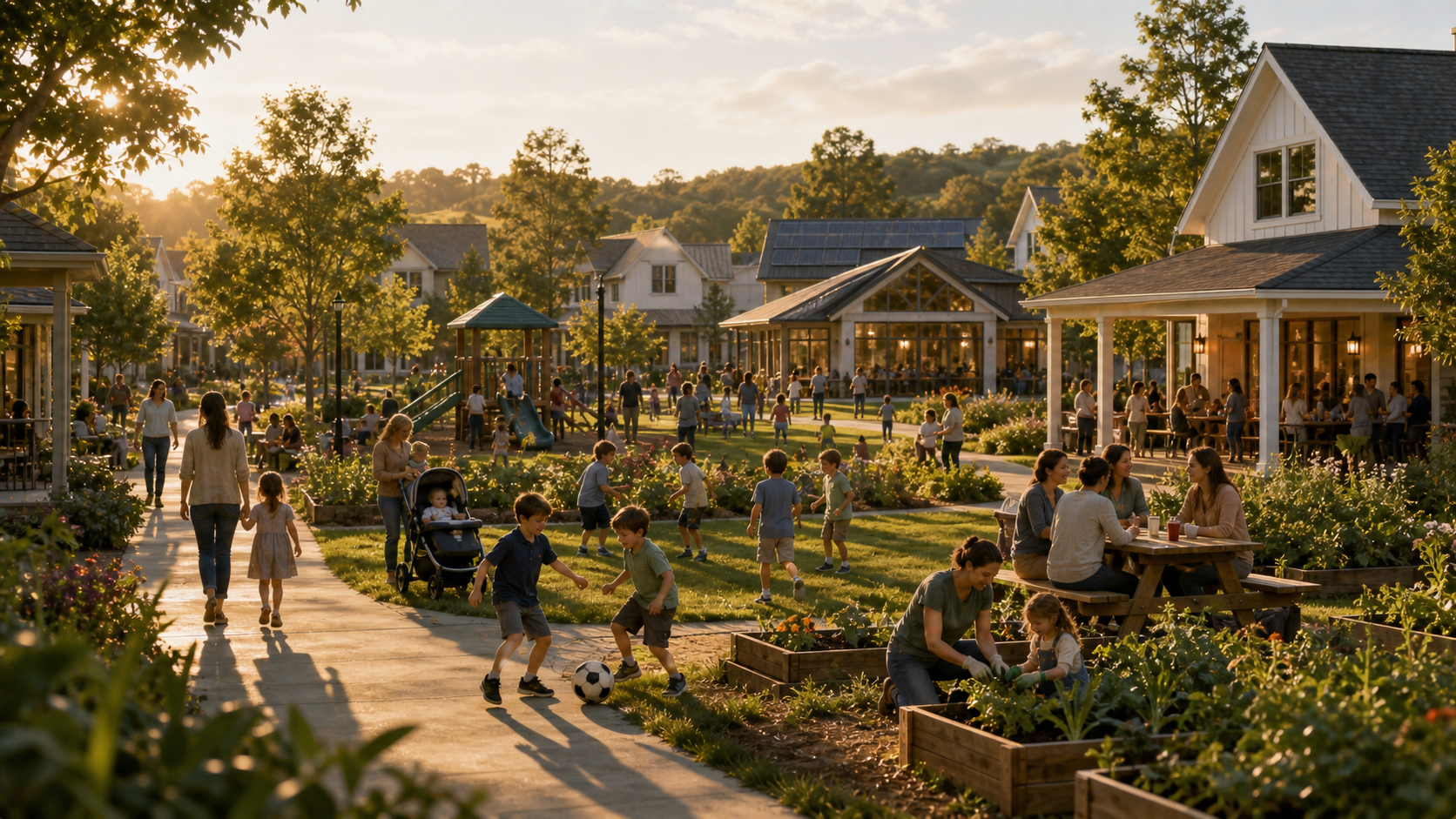
What happens when the vow becomes the neighborhood — and the neighborhood becomes the proof of concept
By Futurist Thomas Frey
Part 6 of 6: The Colony
Every transformative idea in human history has had a moment when it stopped being a philosophy and became a place.
The Puritan settlers didn’t write treatises about the ideal community and wait for governments to implement them. They built the community, in a specific geography, with specific people, under specific rules they had chosen together. The kibbutz movement didn’t lobby the Israeli government for agricultural reform before demonstrating what communal farming could produce. It built farms, on actual land, and let the results make the argument. The Shakers, the Oneida community, the Hutterite colonies, the cooperative villages of Scandinavia — whatever their specific ideology, they shared a recognition that ideas about how to live together only become real when someone actually lives together that way.
The Vitalist Colony is that moment for this series.
Not a policy proposal. Not a cultural advocacy campaign. Not an institutional framework waiting for governments to adopt it. A place — a designed, intentional, physically real community where the Vitalist vocation is the organizing principle of daily life, where the infrastructure described in the preceding five columns is built and operational, and where the results are visible and measurable and available to anyone who wants to evaluate them.
The Colony is the proof of concept. And proof of concepts, in the history of social transformation, have a track record that no amount of policy argument can match.
Why a Physical Place Changes Everything
There is a specific limitation to every idea that exists only as argument, however well-made. It can be agreed with or disagreed with, but it cannot be visited. It cannot be walked through. It cannot be experienced by a woman considering the Vitalist vocation who wants to know not what the philosophy promises but what the daily life actually feels like.
The Vitalist Colony eliminates that limitation.
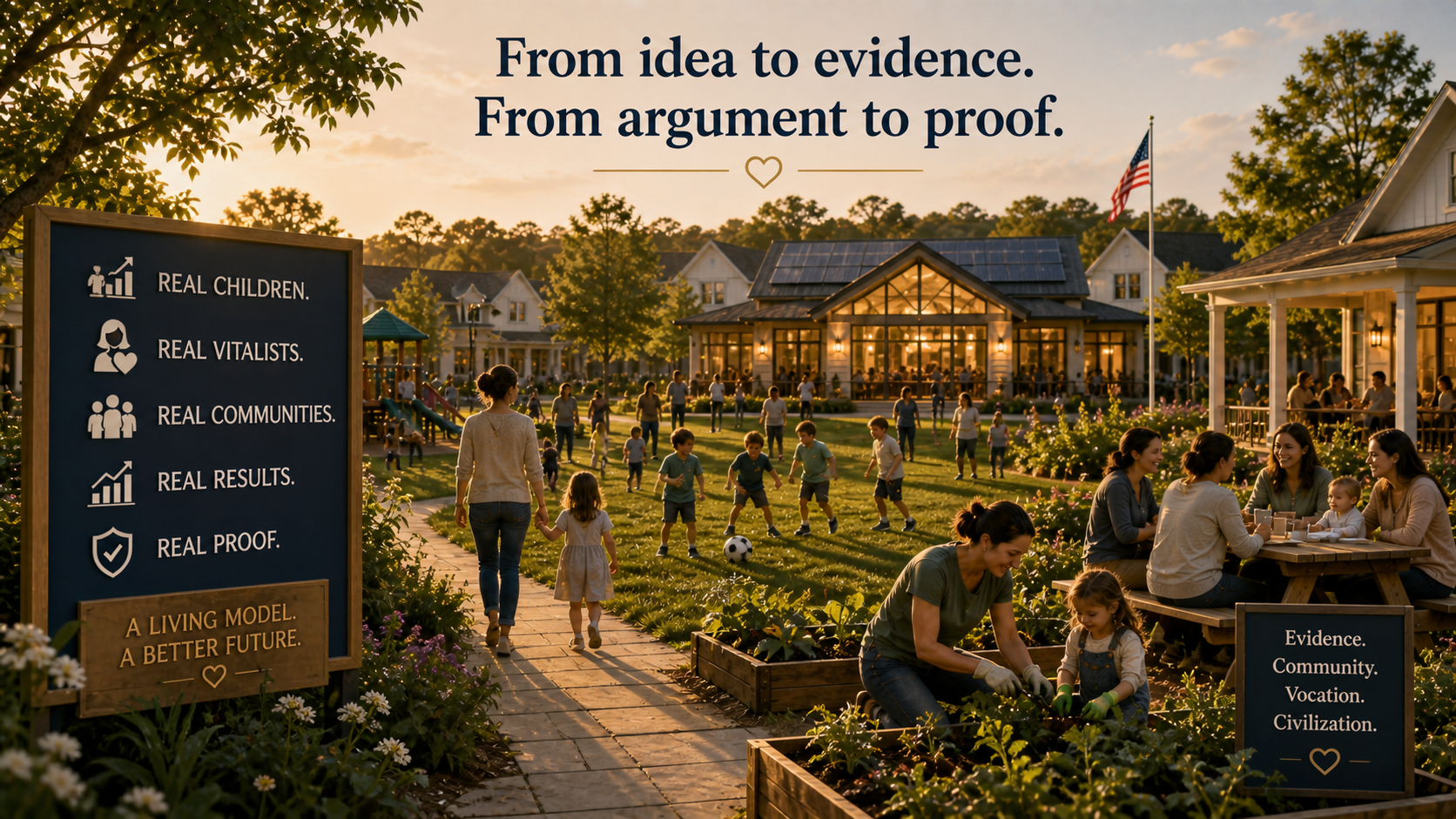
A working Colony provides something that no column, no research paper, and no policy brief can provide: evidence. Real evidence, in the form of real children with measurable developmental outcomes, real Vitalists with measurable quality of life, real communities with measurable civic health, and a real operating model with measurable economics. The kind of evidence that changes minds not through argument but through demonstration — the most powerful form of persuasion available in a skeptical world.
It also changes the nature of the risk for the women who are considering the vow but waiting for conditions to be better before committing. The Colony makes the conditions better, concretely and immediately, for the women who join it. It is not asking anyone to make a sacrifice for a future benefit that depends on policy changes that may or may not happen. It is offering a functional, supported, community-embedded version of the vocation right now, in a specific location, to a specific founding cohort of women who are ready to build something together.
That is a different proposition than any of the policy arguments in the previous columns. And it is more powerful than all of them combined.
The Design of a Vitalist Colony
Let me be specific about what a Colony actually consists of, because the specificity is what distinguishes this from the vague communal-living romanticism that serious people are right to be skeptical of.
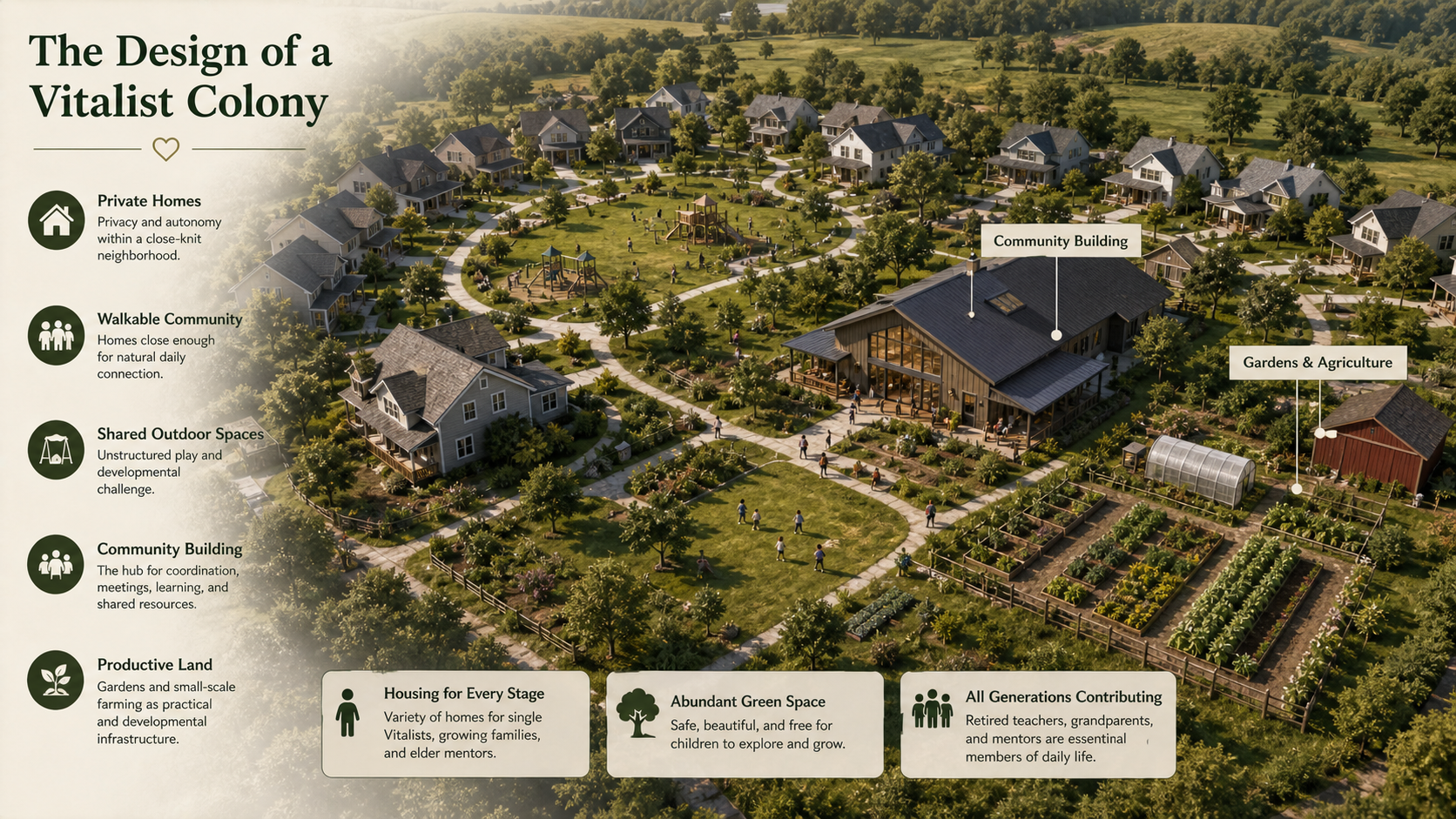
A Vitalist Colony is a planned residential community designed from the ground up around the requirements of the Vitalist vocation. It is not a commune in the countercultural sense — it does not require collective ownership of property, communal sleeping arrangements, or the dissolution of individual household boundaries. It is closer to a purpose-built neighborhood: a coherent physical environment in which individual households retain their privacy and autonomy while sharing the infrastructure that makes the vocation sustainable.
The physical design reflects what we know about the spatial requirements of raising children well. Density sufficient for genuine walkable community — households close enough that daily contact is natural rather than planned. Private outdoor space for each household. Abundant shared outdoor space for children, designed for unstructured play and developmental challenge rather than supervised recreation. A community building serving as the operational center of the Colony’s shared infrastructure — the volunteer coordination hub, the cohort meeting space, the professional development facilities, the shared equipment library, the space where the retired teachers and available grandparents and visiting mentors do their work.
The housing itself is designed for families at multiple developmental stages simultaneously, which means variety — small units for single Vitalists in the early years, larger units for established households with multiple children, accessible units for the elderly volunteers and mentors who are integral to the community’s function. The architecture is permanent and high-quality, because a Colony that looks like temporary housing communicates something about how seriously it takes its own premise.
The surrounding land — and the Colony is designed with surrounding land, not embedded in a dense urban grid — provides the agricultural component that is both practically valuable and symbolically important. A Colony with productive gardens and small-scale food production is a Colony whose children grow up understanding where food comes from and contributing to its production from an early age. The farm is not decorative. It is developmental infrastructure.
The Governance Model
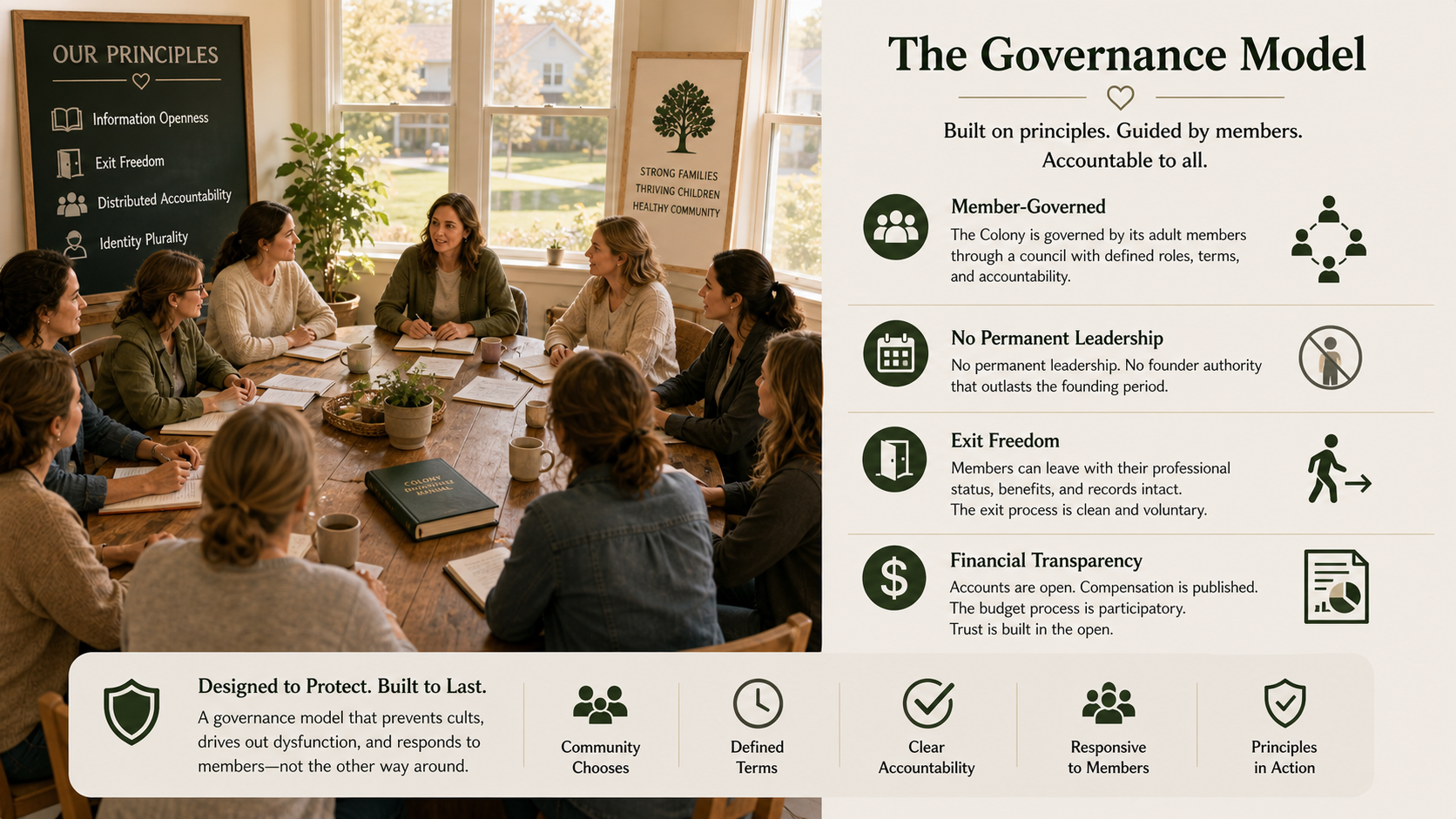
A Colony without a serious governance model is a Colony that will either calcify into a cult or dissolve into dysfunction. The governance design is as important as the physical design, and the principles articulated in the previous column — information openness, exit freedom, distributed accountability, identity plurality — must be embedded in the Colony’s governing documents from day one rather than added after problems emerge.
The Colony is governed by its adult members through a council structure with defined roles, defined terms, and defined accountability mechanisms. No permanent leadership. No founder authority that outlasts the founding period. The people in governance positions are there because the community chose them for specific roles and will replace them when those roles are complete.
Membership in the Colony is voluntary and the exit process is designed to be clean. A Vitalist who decides the Colony is not the right fit for her family can leave with her professional status intact, her pension credits preserved, her children’s developmental records transferred to whatever community or institutional structure she moves to. The Colony does not hold its members through exit costs. It holds them through the genuine quality of what it offers — and if that quality deteriorates enough that members choose to leave in significant numbers, the governance structure is designed to surface and respond to that signal rather than suppress it.
Financial transparency is non-negotiable. The Colony’s accounts are open to all members. The compensation structure for every role is published. The budget process is participatory. Money, in intentional communities, is where corruption most reliably enters, and the only effective defense against that corruption is transparency so complete that there is nowhere for it to hide.
Who Founds It — and Who Joins
Every Colony needs a founding cohort — a group of women who are committed enough to the premise to accept the specific discomforts and uncertainties of building something from scratch rather than joining something already built.
The founding cohort is not a random collection of ideologically aligned individuals. It is a deliberately composed group designed to include the range of skills and temperaments that a functioning community actually requires. The Vitalist who is primarily focused on infant care. The one who is primarily focused on educational design for older children. The one with organizational management skills who will run the volunteer coordination system. The one with financial expertise who will manage the Colony’s economics. The one with conflict resolution skills who will be needed when — not if — the community faces the interpersonal friction that all communities face.
Founding a Colony is a design exercise as much as an ideological one, and the founding cohort should approach it that way — asking not just “do we share the commitment?” but “do we have the complementary capabilities to build something that actually works?”
The joining cohort — the women who arrive after the Colony is established, who are choosing to enter something already functioning rather than building from scratch — is a different population with different needs and different contributions. The Colony needs a clear, fair, well-documented process for integrating new members that preserves the cultural coherence of the founding vision while remaining genuinely open to the new energy and new capabilities that later members bring.
The balance between cultural continuity and genuine openness is one of the hardest design problems in any intentional community, and the Vitalist Colony must grapple with it explicitly rather than assuming it will resolve itself through goodwill.
The Economics of a Colony
One of the most common objections to intentional community proposals is that they are economically unrealistic — that the cost of purpose-built community infrastructure is prohibitive and that the funding models that have historically supported such projects are not replicable at scale.
This objection deserves engagement rather than dismissal.
The Colony model is economically viable under conditions that are more achievable than the objection assumes. Land acquisition in peri-urban or rural areas — the most appropriate setting for a Colony’s spatial requirements — is substantially cheaper than urban land. The shared infrastructure that the Colony requires is more cost-effective when built as shared infrastructure from the beginning than when assembled as a patchwork of individual household expenditures. The volunteer network that each Vitalist household depends on is largely free at the point of use — the cost is coordination, not compensation. And the productivity gains from the support stack described in the second column of this series — the robotic household management, the professional nanny hours, the community coverage — translate directly into economic value through the freed time and attention of the Vitalists themselves.
The Colony is also an investable entity in ways that individual households and dispersed communities are not. A purpose-built residential community with a coherent mission, a measurable demographic outcome, and a documented developmental model is a fundable project for the growing category of impact investors, philanthropic foundations, and government pro-natalist programs that are looking for interventions with evidence behind them. The Colony, once built and operating, generates the evidence that makes the next Colony easier to fund.
This is the scaling logic: not top-down replication from a central authority, but demonstrated proof of concept attracting the resources to build the next proof of concept, in a different geography, with a different founding cohort, adapted to the specific conditions of its location. Colonies proliferating not through franchise but through inspiration and evidence — the way every successful community model in human history has actually spread.
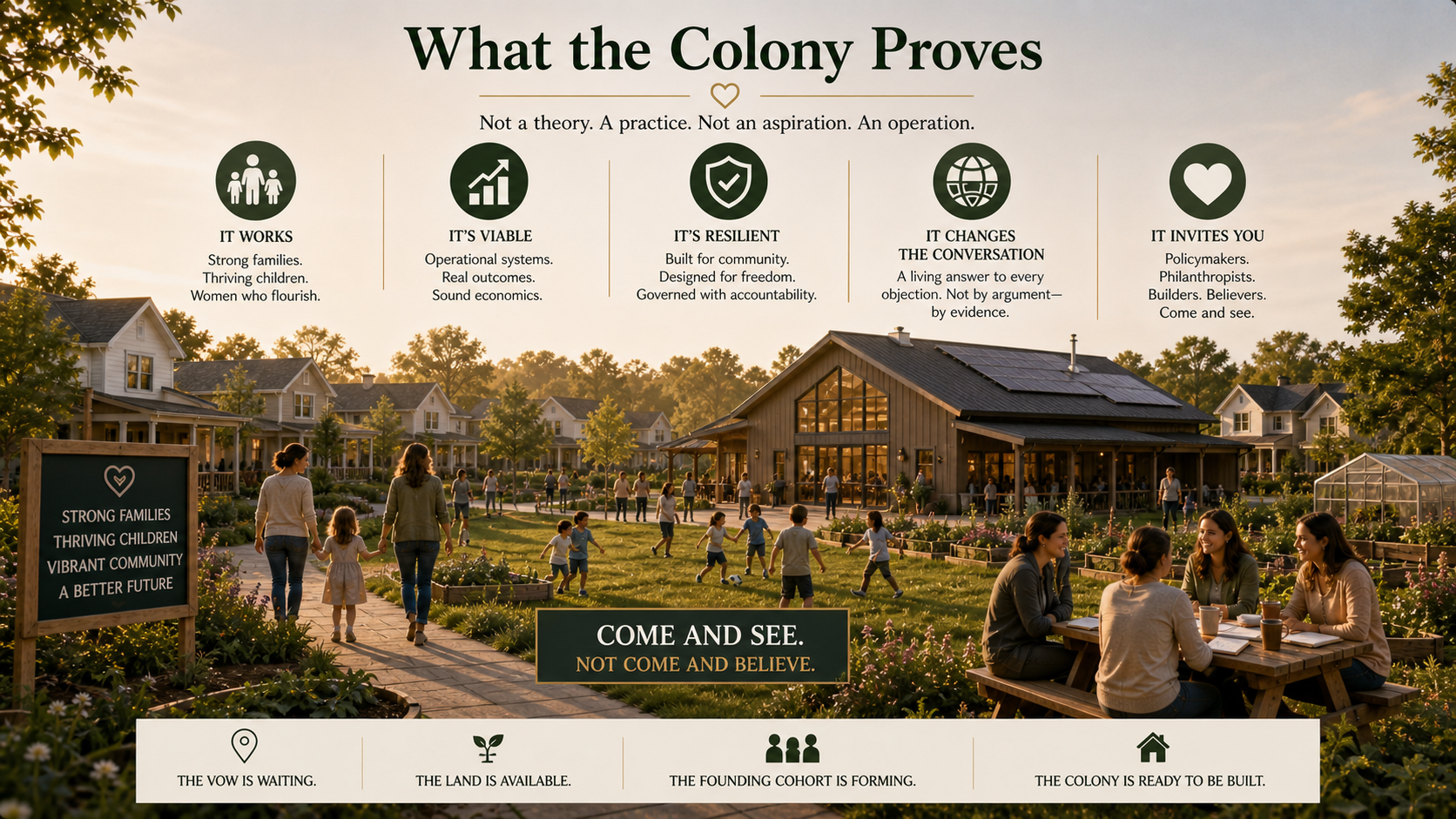
What the Colony Proves
The Vitalist Colony is not an end in itself. It is a means — the most powerful means available — of demonstrating that the Vitalist framework is not a philosophy but a practice, not an aspiration but an operation.
What it proves is not that the Colony model should be universally adopted. Most Vitalists will not live in Colonies. The vow can be made and kept outside a Colony, in ordinary neighborhoods, in ordinary housing, by women who build their own versions of the support stack and their own versions of the community. The Colony proves that the full version of the framework is viable — that the support stack is operational, that the developmental outcomes are real, that the economics work, and that women who make this choice within this structure thrive in ways that are visible and measurable.
That proof changes the cultural conversation. Not through argument but through existence. The Colony stands as a counter-example to every claim that the Vitalist vocation is impractical, isolating, or economically ruinous. It is a physical answer to a philosophical objection — the most durable kind of answer available.
And it stands as an invitation. To every woman who has read this series and felt the pull of the vow but couldn’t see how to make it real in the life she currently inhabits. To every policymaker who wants evidence before committing to the institutional changes the framework requires. To every philanthropist, investor, and civic institution looking for the place where their resources would do the most consequential possible good.
The Colony says: come and see. Not come and believe. Come and see.
That has always been the most powerful sentence in the history of civilization-building. It remains the most powerful sentence available to anyone who wants to build something that lasts.
The vow is waiting. The land is available. The founding cohort is forming.
The Colony is ready to be built.
This concludes the six-part Vitalist series. The author welcomes responses, criticisms, founding inquiries, and proposals from anyone serious about turning this framework from a series of columns into a place that exists.
Related Reading
A Pattern Language: Towns, Buildings, Construction
Christopher Alexander · Oxford University Press — The foundational text of community-scale design — Alexander’s 253 patterns for human settlement that support genuine community life, each one derived from observed human behavior rather than imposed theory, forming the architectural vocabulary that any serious Colony design should draw from
Intentional Communities: Lessons From the Longest-Running Experiments
Foundation for Intentional Community — The most comprehensive documentation of intentional community successes and failures across the last century — the empirical record that any Colony founding team should study before designing governance structures, membership processes, and exit protocols
The Economics of Community Development: From Concept to Capital
Brookings Institution — A rigorous analysis of the financing mechanisms available for purpose-built community infrastructure — impact investing, community development finance, philanthropic capital, and government partnership models — and the conditions under which each produces sustainable community economics rather than dependency