Author: admin

AI Tool Revolutionizes Brain Lesion Quantification on MRI Scans

Researchers at The University of Texas Health Science Center at San Antonio have developed a groundbreaking artificial intelligence (AI) tool capable of accurately counting brain lesions on MRI scans within seconds. This innovative tool is expected to play a vital role in helping neuroradiologists assess patients’ brain diseases at earlier stages.

Led by researcher Mohamad Habes, PhD, from the Glenn Biggs Institute for Alzheimer’s and Neurodegenerative Diseases, the team demonstrated the AI tool’s effectiveness in identifying and counting enlarged perivascular spaces (ePVS’s). These spaces, filled with cerebrospinal fluid, surround arteries and veins and serve as a marker for cerebral small-vessel disease, which can lead to stroke and dementia. The study involved a follow-up analysis of 1,026 individuals who participated in the Multi-Ethnic Study of Atherosclerosis (MESA).

Continue reading… “AI Tool Revolutionizes Brain Lesion Quantification on MRI Scans”

Soft Robotics: Revolutionizing Minimally Invasive Surgery

A recent paper published in Science delves into the world of medical robots and their application in artificial intelligence (AI). Among the groundbreaking research, Professor Kaspar Althoefer’s work stands out, exploring the potential of flexible and adaptable surgical robots to transform surgical procedures.

Robot-assisted minimally invasive surgery (RAMIS) has made significant strides in recent years, offering improved ergonomics and 3D vision to surgeons operating through small incisions. However, rigid component designs in current RAMIS platforms can pose limitations and increase the risk of tissue injuries, hindering their full potential.

Continue reading… “Soft Robotics: Revolutionizing Minimally Invasive Surgery”

Cixi Unveils Innovative E-Crankset Technology: Paving the Way for Chainless and Beltless Biking

French e-drive innovator Cixi is revolutionizing the biking world with its Pedaling Energy Recovery System (PERS), an electronic crankset system that eliminates messy and noisy bike chains. Partnering with Look Cycle, they showcased this cutting-edge technology in the Rover 45 concept speed pedelec, demonstrating its incredible potential for electric vehicles and ebikes.

The PERS technology utilizes onboard electronics controlled by custom algorithms to set resistance at the pedal. The energy from rider input is then recovered and used to propel the vehicle forward via the hub motor. This system offers various pedal effort levels, with automatic torque adjustment for hill climbs and customizable power output. Regenerative braking is integrated, effectively replenishing the battery while reducing wear on the brake pads.

Continue reading… “Cixi Unveils Innovative E-Crankset Technology: Paving the Way for Chainless and Beltless Biking”

Striking the Right Chord: Embracing the Harmony of Hybrid Work

The pandemic delivered a complex puzzle that transformed the way we work, leading researchers from Stanford University, University of Chicago, and the Instituto Tecnológico Autónomo de México to explore new insights in a white paper. This comprehensive meta-analysis delves into the world of remote and hybrid work, unveiling intriguing findings about productivity, communication, and overall efficiency.

Fully remote work, though convenient for self-motivated individuals, presented some discordant notes. Productivity stumbled, facing an 8% to 19% reduction, and challenges in communication and innovation arose, impacting the quality of output. In the cluttered kitchen of remote work, creativity struggled to shine, and employees occasionally deviated from their tasks—a phenomenon known as “shirking from home.”

Continue reading… “Striking the Right Chord: Embracing the Harmony of Hybrid Work”

Quantum Drum: A Quantum Supersensor Finding Its Way Into Our Devices

Researchers at the University of Copenhagen have developed a groundbreaking “quantum drum,” a thin vibrating membrane capable of measuring various influences with unparalleled precision. Originally requiring extreme cooling with liquid helium, the researchers have now achieved the same accuracy at room temperature, making the quantum drum feasible for practical applications, even potentially in consumer devices like smartphones.

The heart of the quantum drum lies in its ultra-fast vibrations governed by the laws of quantum physics. By reading changes in these vibrations, researchers can detect a wide range of factors, including temperature variations, gas presence, and even the presence of a single virus. Moreover, by adding tiny magnets or pieces of metal to the drum, they can measure electric and magnetic fields with exceptional accuracy.

Continue reading… “Quantum Drum: A Quantum Supersensor Finding Its Way Into Our Devices”

Unraveling the Brain’s Decision-Making with Reinforcement Learning

How does the human brain handle complex situations, like navigating through traffic in busy areas? Psychologists and neuroscientists propose that the brain creates causal models of the world, running mental simulations to plan and execute actions. This idea aligns with the concept of Reinforcement Learning (RL), a system developed by computer scientists to understand human thinking and decision-making.

In a recent study published in Neuron, researchers delved deeper into RL’s neural architecture by employing functional magnetic resonance (fMRI) to compare their algorithmic theory with real-world brain imaging. The goal was to better understand how RL plays out in the brain and potentially improve RL algorithms in artificial intelligence.

Continue reading… “Unraveling the Brain’s Decision-Making with Reinforcement Learning”

Cutting-Edge Surgical Innovation Enhances Control of Bionic Prosthetics for Amputees

Prosthetic limbs have long been the go-to solution for replacing missing limbs, but their limited manageability and reliability pose challenges. To address this, a collaborative effort between surgeons and engineers has led to a groundbreaking solution. By modifying the structure of the residual limb and incorporating sensors and a skeletal implant, the bionic prosthesis can now access a wealth of information, enabling users to command numerous robotic joints with precision.

Professor Max Ortiz Catalan, a leading figure in bionics and prosthesis development, spearheaded the research initiative at the Center for Bionics and Pain Research (CBPR) in Sweden. The team’s success lies in rerouting nerves to alternative muscle targets in a distributed and simultaneous manner, significantly enhancing prosthetic control. This approach, combined with the osseointegration technique, revolutionizes the way prosthetic limbs are attached, offering greater comfort and efficiency.

Continue reading… “Cutting-Edge Surgical Innovation Enhances Control of Bionic Prosthetics for Amputees”

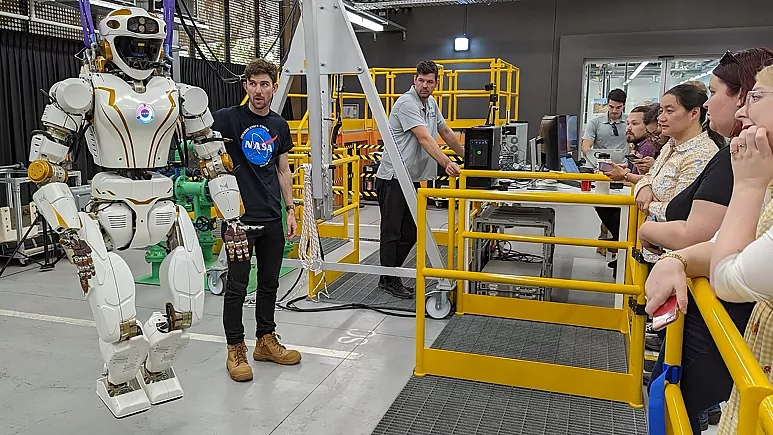
NASA’s Humanoid Robot Valkyrie Embarks on New Mission in Australia

NASA’s humanoid robot, Valkyrie, is embarking on an exciting new mission in Australia. Recently delivered to Western Australia, Valkyrie will be put to the test at Woodside Energy, an Australian energy giant based in Perth. Woodside Energy plans to utilize Valkyrie for remote caretaking of its uncrewed and offshore facilities, enhancing safety for both personnel and the environment.

Shaun Azimi, lead of the dexterous robotics team at NASA Johnson, expressed enthusiasm about the project, stating, “We are pleased to be starting the next phase of development and testing of advanced robotic systems that have the potential to positively impact life on Earth by allowing safer operations in hazardous environments. These demonstrations will evaluate the current potential of advanced robots to extend the reach of humans and help humanity explore and work safely anywhere.”

Continue reading… “NASA’s Humanoid Robot Valkyrie Embarks on New Mission in Australia”

Rocsys: The Autonomous Charging Revolution for EVs

As electric vehicles (EVs) gain traction in the mainstream market, the need for faster and more convenient charging solutions has become increasingly evident. While advancements in battery technology are promising, Dutch startup Rocsys believes that automation can significantly enhance the charging process. Rocsys has developed an AI-powered robotic arm that can convert any charger into an autonomous one, making charging easier and more efficient for both drivers and the upcoming generation of driverless vehicles.

The robotic arm, equipped with AI-powered computer vision technology, acts as a replacement for the human hand during the charging process. Once an EV pulls up, the robot’s “eyes” locate the vehicle, move the plug toward the socket, and initiate the charging process. This technology not only streamlines the charging experience for drivers but also caters to the future of driverless vehicles, eliminating the need for a human babysitter to handle the charging process.

Continue reading… “Rocsys: The Autonomous Charging Revolution for EVs”

Quadruped Robots: Paving the Way for Lunar Base Construction

Establishing a permanent lunar base on the moon is a daunting task, requiring massive logistical efforts and significant expenses. To ease the burden of transporting all necessary supplies from Earth, researchers are exploring the possibility of harvesting materials directly on the lunar surface. To accomplish this challenging feat, a team of four-legged robots may become valuable allies.

A recent study published in Science Robotics showcases the work of researchers at Switzerland’s ETH Zurich university, who conducted outdoor excursions with a trio of modified quadruped ANYmal robots. The team tested the robots on various terrains in Switzerland and at the European Space Resources Innovation Centre (ESRIC) in Luxembourg. Collaborating with the Universities of Basel, Bern, and Zurich, engineers programmed each ANYmal with specific lunar tasks: one was equipped with a microscopy camera and spectrometer to identify rock varieties, while another utilized cameras and a laser scanner to map and classify its surroundings. The third robot demonstrated the ability to identify rocks and map its environment, albeit with slightly less precision than its counterparts.

Continue reading… “Quadruped Robots: Paving the Way for Lunar Base Construction”

Elon Musk’s xAI: Pioneering AI Company Seeking to Understand the Universe

Elon Musk, renowned CEO of SpaceX and Tesla, has recently embarked on a new venture in the artificial intelligence (AI) industry with the founding of xAI. The company’s ambitious mission is to unravel the true nature of the universe. Comprising a team of distinguished experts from Google’s DeepMind, Microsoft, Tesla, and other leading organizations, xAI aims to explore cutting-edge AI technologies that can provide profound insights into reality.

Despite being a vocal critic of AI’s potential dangers to humanity, Musk recognizes its immense potential and has been advocating for greater emphasis on AI safety and transparency in the field. Previously, Musk co-founded OpenAI, an AI research organization with a focus on developing safe and beneficial AI. However, he later stepped down from its board due to divergent visions for the organization’s trajectory.

Continue reading… “Elon Musk’s xAI: Pioneering AI Company Seeking to Understand the Universe”

Light-Activated Molecular Machines Revolutionize Cellular Communication for Improved Disease Treatments

Scientists from Rice University have made a groundbreaking discovery in cellular communication by utilizing light-activated molecular machines to trigger intercellular calcium wave signals. This novel approach offers a powerful strategy for controlling cellular activity and opens up new possibilities for treating heart problems, digestive issues, and more, as reported in Nature Nanotechnology.

Traditionally, drugs have relied on chemical binding forces to initiate specific signaling cascades in the body. However, this pioneering study, led by chemistry graduate student Jacob Beckham, demonstrates the innovative use of mechanical force generated by single-molecule nanomachines to achieve similar results, heralding a new era in drug design.

Continue reading… “Light-Activated Molecular Machines Revolutionize Cellular Communication for Improved Disease Treatments”
Discover the Hidden Patterns of Tomorrow with Futurist Thomas Frey
Unlock Your Potential, Ignite Your Success.

By delving into the futuring techniques of Futurist Thomas Frey, you’ll embark on an enlightening journey.

Learn More about this exciting program.