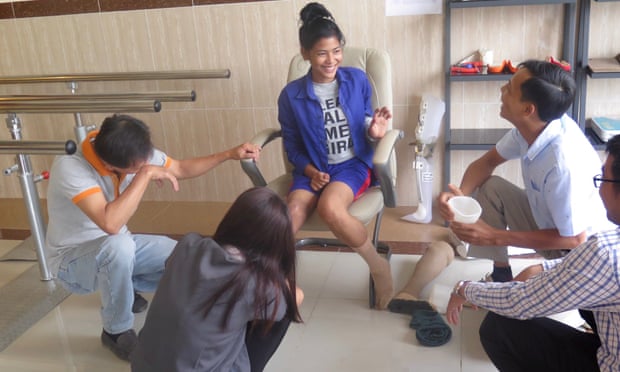
3D printing can revolutionize the medical profession

Groundbreaking 3D printing and scanning techniques are improving access to fully customisable artificial limbs

Before the vehicle that she was travelling in flipped over and trapped her right leg, Leakhena Laing was a happy teenager who enjoyed climbing trees and playing football with friends. After her limb was amputated, she could only sit and watch.

Continue reading… “3D printing can revolutionize the medical profession”

Three-parent baby technique produces world’s first baby


The world’s first three-parent baby has been born.

Scientists revealed the birth of a baby boy, now five months old, usingDNA from three parents.

Fertility experts hailed the breakthrough as “great news and a huge deal” for the future of reproduction.

But they expressed concern that it was only achieved because US scientists crossed the border to Mexico to take advantage of lax regulation.

Continue reading… “Three-parent baby technique produces world’s first baby”

Nanotech bandage: Healing wounds in days

Egyptian researchers have developed a bandage embedded with nanoparticles for the treatment of wounds using the anti-epilepsy drug Phenytoin, known for its capacity to treat skin injuries.

The bandage can heal wounds in a few days, after just one application to soft tissue. Wounds normally take several days to a few weeks to heal completely, and some may only heal after several months or up to two years.

Continue reading… “Nanotech bandage: Healing wounds in days”

Plastic Surgeons Can Now 3D Print Your Future Nose Job

Whether it’s rhinoplasty or breast augmentation, the general timeline of a cosmetic surgery consultation is relatively consistent: a patient walks in with an idea—often equipped with pictures—and a plastic surgeon outlines what they can do.

Historically, doctors have evolved from sketching proposed changes to embracing two-dimensional imaging on computers to incorporating 3D imaging. Now, some practices are adopting 3D printed models to offer patients a sort of blueprint that they can physically hold and touch with their own hands, and make the $13.5 billion cosmetic procedure industry even more accessible.

Continue reading… “Plastic Surgeons Can Now 3D Print Your Future Nose Job”

Robots perform surgery inside your eyeballs

The R2D2 is magnitudes more stable than the steadiest surgeon’s hand.

Doctors at Oxford University made medical history recently by successfully completing the first robot-assisted intraocular surgery. Robert MacLaren, Professor of Ophthalmology at the university, and his team managed to gently peel off a 1/1000th millimeter membrane from the inside of a patient’s eye. To do so, the team relied on a cutting-edge medical device known as the Robotic Retinal Dissection Device, or R2D2.

Continue reading… “Robots perform surgery inside your eyeballs”

Google’s Ray Kurzweil: The Business Of Extending Human Life Going Into “High Gear”

The futurist says that we’re getting closer and closer to “reprogramming” the human body.

Over the last many centuries, human life expectancy has very gradually lengthened with improved health and medical technologies and research. In the next 20 years, we can expect our expected life spans to be extended at a far more rapid pace than in the past.

Continue reading… “Google’s Ray Kurzweil: The Business Of Extending Human Life Going Into “High Gear””

Remote control of the brain is coming. How will it be used?

brain-remote

Controlling the minds of others from a distance has long been a favourite science fiction theme – but recent advances in genetics and neuroscience suggest that we might soon have that power for real.

Just over a decade ago, the bioengineer Karl Deisseroth and his colleagues at Stanford University published their paper on the optical control of the brain – now known as optogenetics – in which the firing pattern of neurons is controlled by light.

Continue reading… “Remote control of the brain is coming. How will it be used?”

New study: Why Latinos in U.S. live longer – they age more slowly

Latino in US

It’s long been a mystery as to why Latinos in the U.S., who suffer from worse health, actually live longer than other groups. Researchers dub it the “Hispanic paradox,” and a new study gets down to the molecular level to try and apply the findings on the rest of humanity. Continue reading… “New study: Why Latinos in U.S. live longer – they age more slowly”

Drones to start delivering blood and medicine in the US

Zip_Delivery.0.0

A startup that uses drones to deliver medicine and blood to remote areas of Rwanda is launching a similar program in the US. California-based Zipline will bring its drone delivery program to rural and remote communities in Maryland, Nevada, and Washington, including some Native American reservations. Zipline will announce its expansion at a White House workshop on unpiloted aerial vehicles (UAVs) Tuesday morning.

Continue reading… “Drones to start delivering blood and medicine in the US”

The First Artificial Wombs: Researchers grow human embryos in a laboratory

original

We all know how to get pregnant or at least should know, but despite so many tips out there boosting the chances of conceiving, the actual first 2 weeks of pregnancy remain an undetectable mystery to science.

Continue reading… “The First Artificial Wombs: Researchers grow human embryos in a laboratory”

Scientists Use Swarms of Nanorobots to Precisely Target Cancer Cells

new_version-b-low

Nanotechnology has always been something more out of the future than the present. It’s very promising tech with a variety of exciting applications that haven’t yet come to our everyday lives. Now scientists from several universities announced a breakthrough in cancer research that may truly fulfill the promise of nano tech. They developed nanorobots that can navigate through the bloodstream to precisely deliver the drug to the cancerous cells.

Continue reading… “Scientists Use Swarms of Nanorobots to Precisely Target Cancer Cells”

Out-of-Body Experiences Triggered by Synchronized Virtual Reality Heartbeat

virtual-reality-trgiggers-out-of-body-experience

New research demonstrates that triggering an out-of-body experience (OBE) could be as simple as getting a person to watch a video of themselves with their heartbeat projected onto it. According to the study, it’s easy to trick the mind into thinking it belongs to an external body and manipulate a person’s self-consciousness by externalizing the body’s internal rhythms. The findings could lead to new treatments for people with perceptual disorders such as anorexia and could also help dieters too.

Continue reading… “Out-of-Body Experiences Triggered by Synchronized Virtual Reality Heartbeat”

Discover the Hidden Patterns of Tomorrow with Futurist Thomas Frey
Unlock Your Potential, Ignite Your Success.

By delving into the futuring techniques of Futurist Thomas Frey, you’ll embark on an enlightening journey.

Learn More about this exciting program.