It’s no secret that Apple has ambitious plans for iPhone and Apple Watch in the health industry, but it’s not the only company looking for ways to integrate smartphones in the medical field. Recently, a research team from Washington State University, under the leadership of assistant professor Lei Li, developed a portable laboratory that’s powered by a smartphone and capable of detecting cancer nearly instantly…
Tech behemoths Google, Facebook, Microsoft, IBM and Amazon announced this week that they are teaming up to develop new standards for Artificial Intelligence (AI). It’s a much-needed move. Soon AI will change everything from warfare to our bodies. But we don’t want to become slaves to the robots, so how do we stop the Terminators?
Drones are used for a variety of tasks including the delivery of goods, the monitoring of areas, and now with thanks to DARPA they can even search houses. These miniature drones are so small they can be used almost anywhere and are fairly undetectable to an unsuspecting person.
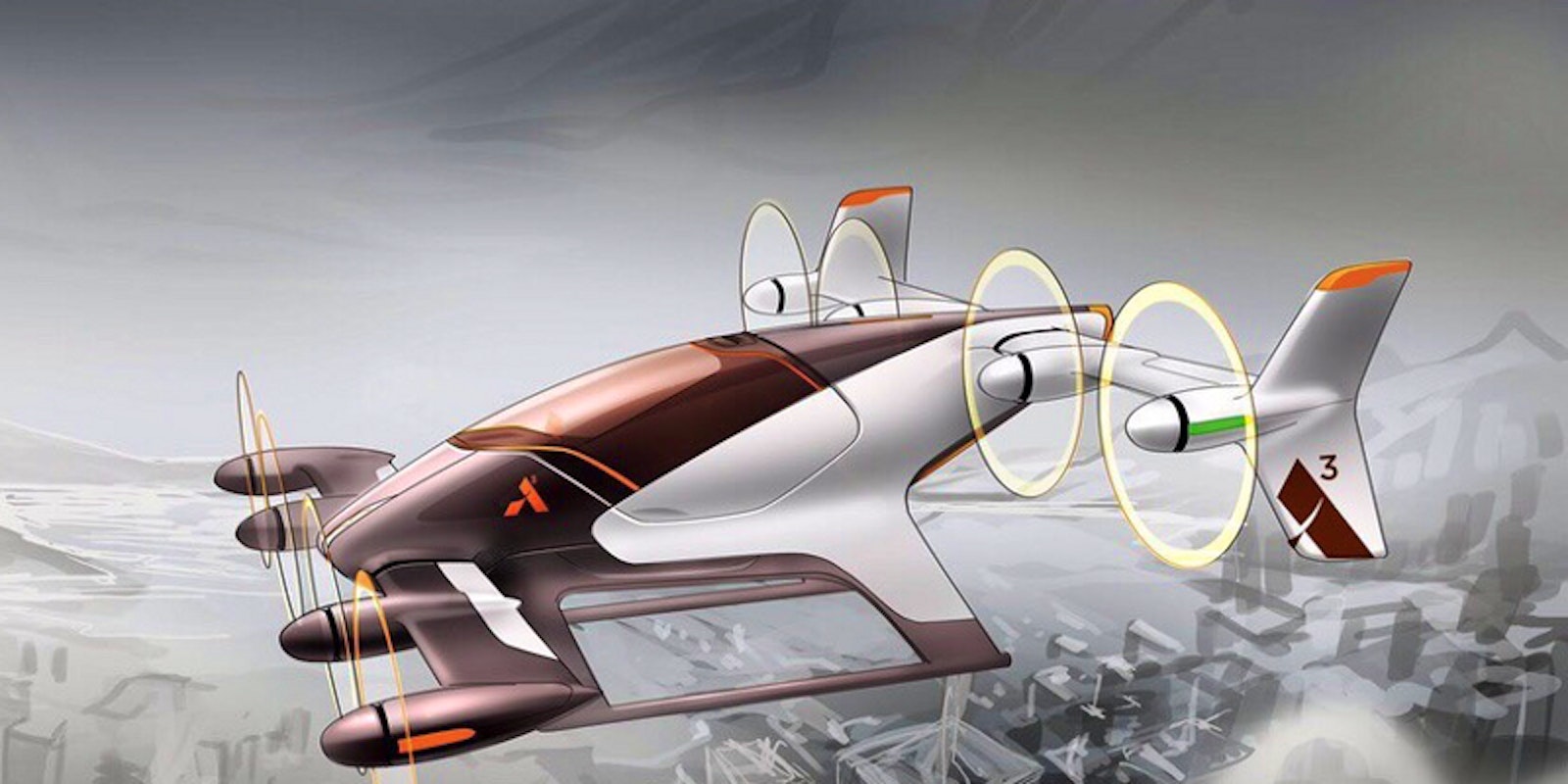
Even as self-driving cars become more and more ubiquitous, there’s one problem that Silicon Valley hasn’t solved: the traffic jam. But Airbus Group, a U.S. aeronautics and space company, thinks that it has a solution. The company’s Silicon Valley branch recently announced it’s been working on a secret project titled “Vahana,” an autonomous flying vehicle that can be used for both passenger and cargo transport.
The artificial intelligence that beat human players in Go can now learn from its own memory. Google’s DeepMind AI, according to its programmers, is now capable of intelligently building on what’s already inside its memory.
Robots are now just as good at transcribing speech as humans.
According to a paper published yesterday, a team of Microsoft engineers in the Artificial Intelligence and Research division reported their system reached a word error rate (WER) of 5.9 percent, a figure that is roughly equal to that of human abilities.
In the early morning hours of October 20th, an 18-wheeler tractor trailer pulled into Colorado Springs, Colorado, bearing 50,000 frosty cans of Budweiser beer. Normally, this would not be a noteworthy occurrence, but this truck was driving itself, marking the first time that commercial cargo was shipped by a self-driving vehicle.
Stretched, trijet 50-seat configuration to be tested by subscale supersonic demonstrator
Guy Norris Los Angeles
Boom Time
More than half a century after development of the Concorde was launched, progress toward economically viable supersonic airliners has proved elusive. But now a Silicon Valley-backed startup says the ingredients for a successful, small, faster-than-sound airliner are in place, thanks to a new wave of enabling technology and a market primed with the need for speed.
Since first unveiling plans earlier this year for a 40-seat, twin-engine, supersonic transport, Denver-based Boom Technology has revised and fine-tuned the design that will cruise at Mach 2.2 for the same ticket price as subsonic business class. The aircraft has since been stretched to seat up to 50 and is now reconfigured as a trijet to permit immediate use on long overwater routes.
A team of researchers from Belgium think that they are close to extending the anticipated end of Moore’s Law, and they didn’t do it with a supercomputer. Using an artificial intelligence (AI) algorithm called reservoir computing, combined with another algorithm called backpropagation, the team developed a neuro-inspired analog computer that can train itself and improve at whatever task it’s performing.







:format(webp)/cdn1.vox-cdn.com/uploads/chorus_image/image/51358885/KOBI_zomer.0.jpg)


