I’d like to apply for the job of man-machine team manager, please
It used to be that a job in finance would set you up for life. Steady, reliable, dependable, calculators and sweater vests. These things come to mind when you think of a career in finance.
Just like in other industries, AI and machine learning are entering the scene and causing great disruption in what used to be one of the most stable career choices. In the US, one report found that 1.3 million bank workers will lose their jobs or be reassigned due to automation. Globally, finance leaders are predicting that 50% of jobs could be lost.
As these technologies develop, which jobs will become obsolete? Will a robot be doing my taxes in the future? At the same time, what new opportunities are on the horizon?
It’s not just grown-ups that might appreciate electrified transport. Bosch has unveiled an “eStroller” system that uses dual electric motors and sensors to not only reduce the effort involved in carting your young one around, but prevent the stroller from going in unexpected directions. It’ll automatically study the road surface to help you push uphill, brake on the descent and keep it on track during lateral slopes. The technology will also bring the stroller to a halt if you lose control or battle fierce winds.
From afar, Olli resembles many of the “future is now!” electric autonomous shuttles that have popped up in recent years.
The tall rectangular pod, with its wide-set headlights and expansive windows nestled between a rounded frame, gives the shuttle a friendly countenance that screams, ever so gently, “come along, take a ride.”
But Olli is different in almost every way, from how it’s produced to its origin story. And now, its maker, Local Motors, has given Olli an upgrade in hopes of accelerating the adoption of its autonomous shuttles.
Meet Olli 2.0, a 3D-printed connected electric autonomous shuttle that Rogers says will hasten its ubiquity.
“The future is here; it’s just not evenly distributed,” Local Motors co-founder and CEO John B. Rogers Jr. said in a recent interview. “That’s something I say a lot. Because people often ask me, ‘Hey, when will I see this vehicle? 2023? What do you think?’ My response: It’s here now, it’s just not everywhere.”
I spent the last three days talking to dozens of people about pooping.
The ease with which I can discuss the act of defecation is somewhat of a paradox — because I am exceedingly bathroom shy. Silent office restrooms with stall doors that end a foot and a half off the ground are my worst enemy, while the best workspace toilet experience I’ve ever had was, oddly, at a WeWork, where the barriers were floor to ceiling, there was always music playing, and each stall came equipped with its own bottle of air freshener spray.
Yet such restrooms are rare. In the United States, at least, we’re far more likely to encounter cramped, quiet bathrooms with terrible two-ply toilet paper and dribble on the seat. Even at home, where our bathrooms are typically more comfortable than what you’ll find at the mall or an office building, we’re limited to a basic setup: a plain porcelain bowl, with maybe two flush settings, beside a roll of whatever toilet paper you’re willing to invest in. God help you if you run out.
“Imagine a world where you only need to wipe once”
But it doesn’t have to be this way! All over the world, restrooms are blessed with more humane configurations. In some places, they come equipped with hoses so the user can more easily cleanse themselves after use. In others, such as France, bathrooms have bidets which perform the same function as the hose, only hands-free. And in some regions of Asia, most notably Japan, high-tech toilets with sound effects, heated seats, several bidet functions, and air dryers are as ubiquitous as automatic faucets, as Jane, a New York-based freelance calligrapher who lived in the Kagawa region of Japan for four years and requested that only her first name be used, told me.
A new study promises new paths to research mental illness, but raises questions about whether so-called organoids could develop consciousness
Alysson Muotri was dumbfounded when the pea-sized blobs of human brain cells that he was growing in the lab started emitting electrical pulses. He initially thought the electrodes he was using were malfunctioning.
Muotri was wrong. What the cells were emitting were brain waves — rhythmic patterns of neural activity. “That was a big surprise,” he says.
The 3D blobs of brain cells, known as organoids, are commonly used in disease and drug research to replicate organs. But no “mini-brain” had ever shown signs of brain waves before.
The CRISPR technique can trigger the new material to release drugs or pick up biological signals
Is there anything CRISPR can’t do? Scientists have wielded the gene-editing tool to make scores of genetically modified organisms, as well as to track animal development, detect diseases and control pests. Now, they have found yet another application for it: using CRISPR to create smart materials that change their form on command.
The shape-shifting materials could be used to deliver drugs, and to create sentinels for almost any biological signal, researchers report in Science on 22 August1. The study was led by James Collins, a bioengineer at the Massachusetts Institute of Technology in Cambridge.
Collins’ team worked with water-filled polymers that are held together by strands of DNA, known as DNA hydrogels. To alter the properties of these materials, Collins and his team turned to a form of CRISPR that uses a DNA-snipping enzyme called Cas12a. (The gene-editor CRISPR–Cas9 uses the Cas9 enzyme to snip a DNA sequence at the desired point.) The Cas12a enzyme can be programmed to recognize a specific DNA sequence. The enzyme cuts its target DNA strand, then severs single strands of DNA nearby.
It’s a space elevator concept that could actually work.
It would be much easier to escape Earth’s gravity if you could skip the energy-intensive rockets.
That’s the idea behind the Spaceline, a newly-proposed type of space elevator that would link the Earth and the Moon in a bid drastically cut the cost of space travel.
Described in research published to the preprint server ArXiv by researchers at Columbia University and Cambridge University, the Spaceline would be tethered to the surface of the Moon and dangle down into geostationary orbit around the Earth like a plumb bob, waiting for astronauts to latch on and ride into the cosmos. The proof-of-concept paper found that the Spaceline could be constructed out of materials that exist today, raising the possibility of easier space travel and perhaps even orbital settlements.
Experts believe that with drier, hotter weather becoming the norm, even more wildfires could rage in the future. That’s why scientists are using the latest technology to monitor intentionally ignited fires.
At past midnight on a Thursday night in June, researchers in Utah are still sending excited emails, updating each other on the day’s action. The team has just finished following a huge fire that has ripped through a remote area of the Fishlake National Forest in the south of the state. And they’re still buzzing.
This was no wildfire. It was intentionally set. Early in the afternoon, ignition helicopters were sent in to start the burn. Utah University atmospheric scientist, Adam Kochanski, watched the flames unfold.
“There were two helicopters with so-called heli-torches – kind of like flame-throwers – just suspended beneath,” he recalls. “They were flying back and forth, and on top of that there were some ground crews with handheld torches and they also started fires on the ground.”
Aged rat brain stem cells grown on a soft surface (right) show more healthy, vigorous growth than similar aged brain stem cells grown on a stiff surface (left)
New research reveals how increasing brain stiffness as we age causes brain stem cell dysfunction, and demonstrates new ways to reverse older stem cells to a younger, healthier state.
…when the old brain cells were grown on the soft material, they began to function like young cells – in other words, they were rejuvenated
The results, published today in Nature, have far-reaching implications for how we understand the ageing process, and how we might develop much-needed treatments for age-related brain diseases.
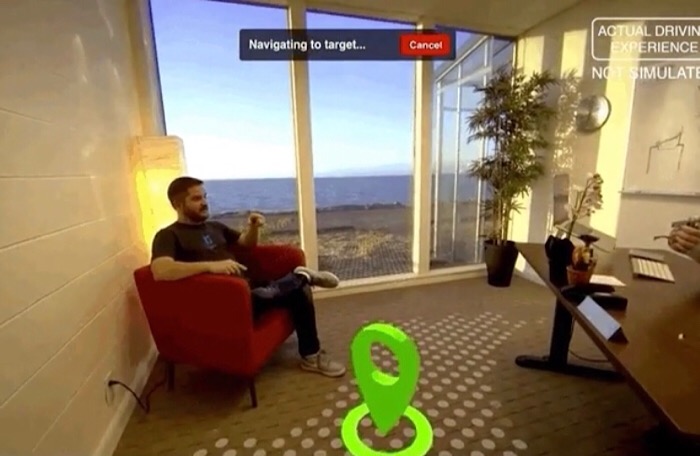
When my colleague James Vincent tried out Double Robotics’ first telepresence robot in 2015, slowly wheeling around our New York office from his London home base, he described the experience as like playing Doom, but in an office. The company’s latest version of the robot, the Double 3, adds mixed reality video to let users click on the spots they want to drive to instead of having to use a control pad, making the experience closer to controlling a Sim.
The Double 3 now has an array of 3D sensors to allow for self-driving, letting the robot move around while avoiding obstacles. The new “Click-to-drive” interface shows dots on the floor for areas the robot is able to move to, and there are two 13-megapixel cameras that let users pan and zoom around the screen. The cameras can physically tilt up and down, which comes in handy for zooming in to read papers on a desk, for example. The whole interface can be controlled from a web browser or mobile app.
China’s autonomous car market is expected to reach 1.5 million units by 2025, growing on a compound annual growth rate of 28.4%.
According to the latest study by ResearchandMarkets.com, the automotive industry is China is likely to shift into a higher intelligence level by 2025. At present, the L1 and L2 autonomous vehicles are available in the market, with total sales of 300,000 units in 2018. In the passenger car segment, 96.5% of autonomous vehicles are L1 and L2 private cars.
However, the study predicts that in the years ahead autonomous vehicle technology will see more adoption in passenger cars business segments such as public taxis and mobility service vehicles. Public taxis and other mobility service vehicles will account for a little more than a quarter or 25.6% of the passenger car market share in 2025.
Truck drivers worried about losing their jobs to robots staged a protest outside the Capitol building in Jefferson City, Missouri on Tuesday.
Their goal was to convince the government to pass a bill that would prohibit any self-driving trucks from driving on Missouri roads, KRCG reports. While there are no autonomous trucks handling shipping jobs in the state yet, the truckers see the emerging technology as a grave threat to their job security and livelihoods — unrest that signals what can happen when jobs are automated without giving thought to the displaced workers.