Hadrian X: The Revolutionary Bricklaying Robot Transforming Construction

The remarkable Hadrian X, a bricklaying robot, arrives at a construction site seemingly as an ordinary truck. However, it then extends a colossal 32-meter (105-foot) boom arm and commences the precise laying of up to 300 large masonry blocks every hour. This spectacle is truly impressive. We’ve been closely following this Australian innovation since its inception as an excavator-mounted prototype back in 2015. Even at that early stage, it could construct the brick framework for a full-sized home in just two days – a pace approximately 20 times faster than human bricklayers, as reported by Fastbrick Robotics, now known as FBR, the creator of the robot. In 2023, it has transitioned to commercial use. FBR has unveiled its first “next-gen” Hadrian-X system, and during a recent outdoor test build, it achieved a new speed record, maintaining a rate exceeding 300 masonry blocks per hour on a testing and calibration run.

When we extrapolate this impressive rate to the largest blocks the Hadrian X can handle – hefty 45-kilogram (99-pound) monsters measuring 600 x 400 x 300 mm (23.6 x 15.7 x 11.8 in) – we find that this machine has the potential to lay approximately 70 square meters (753 square feet) of vertical wall each hour, roughly equivalent to a quarter of a tennis court. Furthermore, FBR anticipates that it can become even faster, with a rated top speed of 500 blocks per hour.

Upon arriving at a site, the Hadrian X is operated via a tablet, following a CAD plan to lay bricks with precision. Workers load masonry blocks into the back of the truck by the pallet load. Then, “dehacker” robots unpack and, if necessary, cut them to size using a circular saw. Subsequently, the blocks are dispatched one by one down the central shaft of the boom arm, each coated with a special construction adhesive, which replaces traditional mortar. Within 45 minutes, they are firmly in place and dry. Notably, the Hadrian X’s telescoping boom arm is sufficiently long to construct three-story structures from street level without requiring a ladder, and it operates around the clock, even in various weather conditions.

The initial test build, as seen in the video provided, reveals some minor inaccuracies in brick placement around the 1:08 mark. However, considering that this was the very first run for the next-gen robot in a testing and calibration capacity, it’s reasonable to assume that such issues will be swiftly addressed. FBR currently has two more robots under construction, with the first and second units set to travel to the USA for demonstrations and deployment in FBR’s Florida-based “Wall as a Service” business.

The Hadrian X represents a groundbreaking advancement in the construction industry, poised to revolutionize how we approach bricklaying and construction projects.

Promising Breakthrough: New Biomarker Unveiled as Potential Target for Alzheimer’s Disease

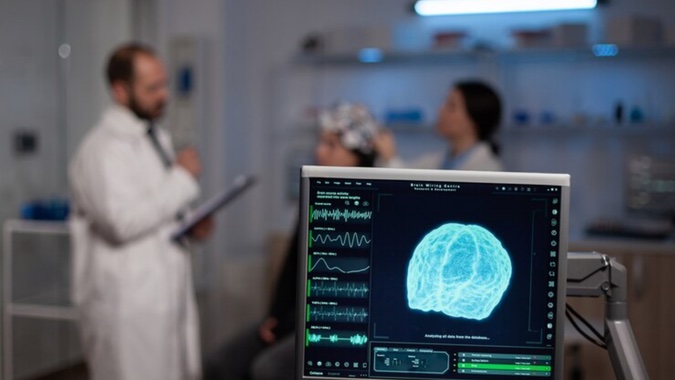
Alzheimer’s disease, a devastating neurodegenerative condition afflicting millions worldwide, has long eluded effective treatment options. Characterized by the accumulation of amyloid plaques in the brain, these plaques have been implicated in the disease’s hallmark symptoms. Despite years of research, drugs aimed at reducing plaque buildup have shown mixed results in clinical trials. However, a recent study led by researchers at Yale University may have uncovered a new biomarker and a potential therapeutic target that could change the course of Alzheimer’s disease. These groundbreaking findings were published in the journal Nature.

The research team, under the guidance of Dr. Jaime Grutzendler, the Dr. Harry M. Zimmerman and Dr. Nicholas and Viola Spinelli Professor of Neurology and Neuroscience at the Yale School of Medicine, has introduced a novel perspective. Their study suggests that it is not the amyloid plaques themselves but rather the swelling caused by a byproduct of these plaques that underlies the debilitating symptoms of Alzheimer’s.

Continue reading… “Promising Breakthrough: New Biomarker Unveiled as Potential Target for Alzheimer’s Disease”

AI in Healthcare: From Diagnosis to Surgery, A Transformative Force

Amid the COVID-19 lockdown, Courtney’s four-year-old son, Alex, began experiencing excruciating pain and stunted growth, setting off a three-year-long battle involving 17 doctors to uncover the root cause of his suffering. With no clarity on her son’s condition, Courtney turned to an unconventional source for answers: ChatGPT. “I meticulously reviewed his MRI notes and fed them into ChatGPT,” shared the determined mother. To her astonishment, the AI suggested that Alex might be grappling with a rare neurological condition known as tethered cord syndrome. Following this revelation, Alex underwent surgery to rectify his spinal issues and is currently on the road to recovery.

While ChatGPT is no substitute for medical professionals, this remarkable incident highlights the immense potential of artificial intelligence in healthcare. In October 2022, the World Economic Forum projected that India’s AI investment is set to reach a substantial USD 11.78 billion by 2025, contributing around USD 1 trillion to the Indian economy by 2035. AI has already made its mark in various sectors, and healthcare is the latest addition to this list. India, with its massive population of 1.4 billion, grapples with a shortage of medical professionals, with only 64 doctors per 100,000 people, as opposed to the global average of 150 doctors per 100,000. AI is stepping in to complement the efforts of healthcare providers.

Continue reading… “AI in Healthcare: From Diagnosis to Surgery, A Transformative Force”

South Korean Scientists Develop Groundbreaking Battery Anode for Rapid EV Charging

A team of experts hailing from South Korea’s esteemed Pohang University of Science and Technology has made an exciting claim – they have engineered a revolutionary battery anode capable of reducing electric vehicle (EV) recharge times to a mere six minutes. This breakthrough represents yet another stride in a global effort by researchers to transform EVs into dependable and cost-effective modes of transportation, regardless of geographic location.

The heart of Pohang’s innovation revolves around the replacement of the conventional graphite anode with a manganese ferrite variant. This manganese ferrite anode has proven to store an astonishing 1.5 times more lithium ions than the researchers initially anticipated, as reported by Freethink.

Continue reading… “South Korean Scientists Develop Groundbreaking Battery Anode for Rapid EV Charging”

The Impact of AI on Workplace Collaboration: Balancing Pros and Cons

Recent workplace data has ignited a discussion on the potential influence of artificial intelligence (AI) on collaboration and knowledge sharing within organizations. Content-generating robots, like ChatGPT, offer numerous valuable applications for society, but the question arises – where should the line be drawn when it comes to deploying these tools in the workplace?

SINTEF, in collaboration with Knowit consultants, conducted a recent study, which involved extensive interviews with employees in technology and digitalization-focused enterprises. The study unveiled two consistent trends in how AI is being integrated into work environments.

Continue reading… “The Impact of AI on Workplace Collaboration: Balancing Pros and Cons”

Sanctuary AI’s Phoenix Robot: Revolutionizing the Workforce and the Future of Labor

In recent years, the global dialogue surrounding robots and their impact on the workforce has experienced a remarkable transformation. Instead of the widespread concerns about robots taking jobs, the focus has shifted towards exploring how rapidly these machines can bridge the gaps in the labor market. At the forefront of this pivotal shift is Sanctuary AI, a Vancouver, B.C.-based company that has successfully secured over $100 million in Canadian dollars to bring its vision of “labor as a service” to life. The centerpiece of their innovative approach is Phoenix, a 5-foot, 7-inch general-purpose humanoid robot, equipped with an AI system called Carbon.

Geordie Rose, the CEO and co-founder of Sanctuary AI, passionately states, “The economic opportunity here, in terms of being able to both provide the labor that people want and being able to profit from it by developing a technology like this, is an opportunity unlike any that I think has ever existed. It’s way bigger than the steam engine, for example.” In an episode of the GeekWire Podcast, Rose discusses the evolving trends, the current capabilities and limitations of Phoenix, the company’s overarching strategy, and the hurdles that lie ahead.

Continue reading… “Sanctuary AI’s Phoenix Robot: Revolutionizing the Workforce and the Future of Labor”

AI and the Evolution of Work: A Balancing Act for Executives

Recent findings reveal that executives are anticipating significant disruptions in the workforce due to artificial intelligence, with around 49% of current skills predicted to be obsolete by 2025. The observations arise from a survey conducted by edX, an online education platform, which involved 800 executives and 800 employees.

The survey exposes the concerns of executives, as 47% believe their workforces are unprepared for the future, shedding light on the urgency of addressing evolving skill demands. These quick transitions are indeed noteworthy.

Moreover, the study indicates that within the next five years, organizations are expected to eliminate more than half (56%) of entry-level knowledge worker roles due to AI. In a remarkable twist, 79% of executives foresee the emergence of entirely new job roles as AI transforms the workforce landscape. Interestingly, 56% believe that AI may partially or entirely replace their own roles.

Continue reading… “AI and the Evolution of Work: A Balancing Act for Executives”

Emulating Sharks: A Glimpse into the Future of Dentistry

Sharks have held a unique fascination for centuries, not only for their oceanic prowess but also for their remarkable ability to regenerate teeth. The idea of replicating this feat in humans has long been a dream, and a dedicated team of Japanese researchers is on the verge of making it a reality.

In an era of rapid technological and medical progress, dentistry may soon experience a groundbreaking transformation. Drawing inspiration from the perfect model provided by nature—sharks—a group of researchers is exploring the potential of enabling humans to grow new teeth. A pivotal study, published in Scientific Reports, laid the foundation for this innovative approach by uncovering the role of the USAG-1 gene in controlling the number of teeth in animals. The protein synthesized by this gene showed immense promise in the field of dentistry.

Continue reading… “Emulating Sharks: A Glimpse into the Future of Dentistry”

Harnessing Limitless Energy: Artificial Photosynthesis Breakthrough

For years, the global scientific community has sought ways to unlock a sustainable, boundless energy source. The quest has explored everything from Moon crystals to boundary-defying molecules. However, recent groundbreaking research suggests that we may have discovered a means to harness energy generation, inspired by the incredible efficiency of plant photosynthesis.

This breakthrough came to light through innovative research where scientists successfully replicated the natural process of photosynthesis to create methane. This high-energy-density fuel is generated using only water, carbon dioxide, and sunlight. Their findings are documented in a newly published paper in ACS Engineering. If scaled up, this new process could revolutionize the energy landscape, potentially replacing solar panels as a primary source of clean, infinite energy—something researchers have been striving to achieve for decades.

Continue reading… “Harnessing Limitless Energy: Artificial Photosynthesis Breakthrough”

Probing the Mysteries of Our Final Moments: Insights into Dying Brain Activity

The enigmatic realm of what transpires in our minds during our final moments has been a source of fascination for centuries. Are our dying moments a vivid reel of life’s memories, a grand curtain call before the end? These existential questions have intrigued both scientists and philosophers.

In a groundbreaking study, a team led by neuroscientist Dr. Ajmal Zemmar from the University of Louisville, along with colleagues from around the world, offers a unique perspective on this age-old mystery. Their research, titled “Enhanced Interplay of Neuronal Coherence and Coupling in the Dying Human Brain,” recently published in the Frontiers in Aging Neuroscience journal, provides a remarkable glimpse into the brain activity that occurs during and after the transition to death.

Continue reading… “Probing the Mysteries of Our Final Moments: Insights into Dying Brain Activity”

Embracing AI Without Losing Human Value: The Unreplaceable Strengths

Recent reports have surfaced indicating that 35% of Americans are concerned about the possibility of artificial intelligence rendering their jobs obsolete. Although AI has already taken over some tasks, it is crucial to acknowledge and emphasize the unique value that humans bring to the table, even in an era of AI dominance.

The transformational impact of AI on the nature of work should not be mistaken for the obsolescence of human workers. AI represents the latest in a series of technological advances that have revolutionized workplaces, from the advent of word processors to computerization, mechanization, and automation. These innovations have not eliminated jobs; rather, they have made us more efficient and liberated us to engage in the creative, meaningful work we desire.

Continue reading… “Embracing AI Without Losing Human Value: The Unreplaceable Strengths”

Combatting AI Hallucinations: Iris.ai’s Strides in Ensuring Accurate AI Outputs

AI-driven chatbots often exhibit a concerning tendency to generate false information while presenting it as accurate—an issue referred to as AI hallucinations. This phenomenon carries various negative consequences, from undermining the advantages of artificial intelligence to posing potential real-world harm to individuals.

As generative AI continues to gain prominence, concerns about AI hallucinations have intensified. In response to these concerns, a team of European researchers has been diligently working to develop remedies. Recently, this team introduced a promising solution, with the potential to significantly reduce AI hallucinations to single-digit percentages.

Continue reading… “Combatting AI Hallucinations: Iris.ai’s Strides in Ensuring Accurate AI Outputs”
Discover the Hidden Patterns of Tomorrow with Futurist Thomas Frey
Unlock Your Potential, Ignite Your Success.

By delving into the futuring techniques of Futurist Thomas Frey, you’ll embark on an enlightening journey.

Learn More about this exciting program.