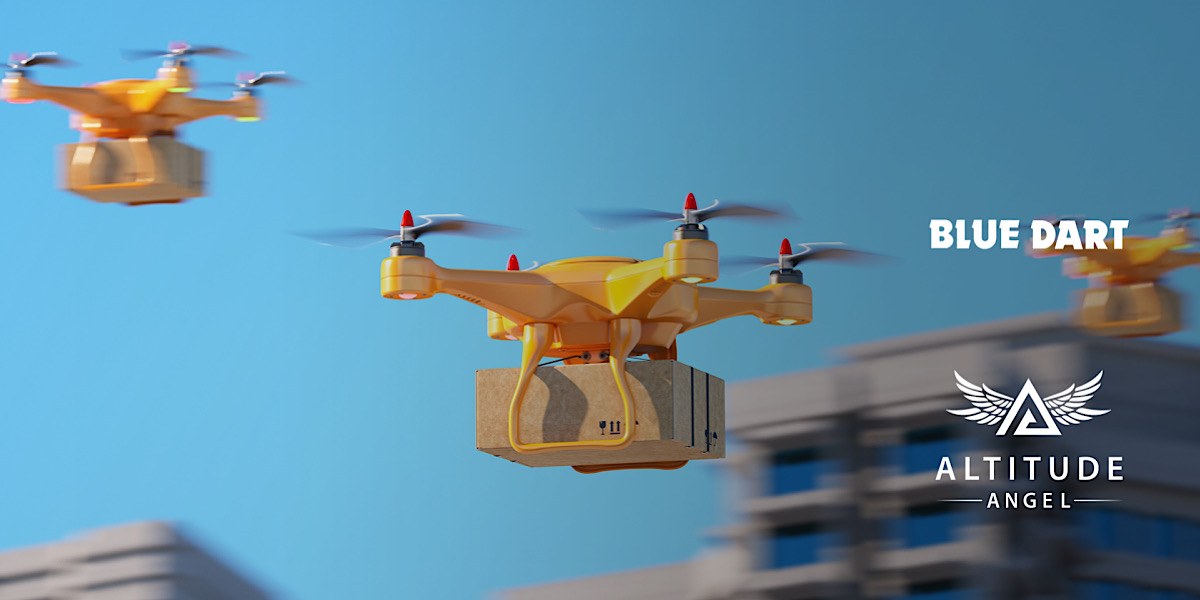
India kicks off ‘Medicine from the Sky’ BVLOS drone delivery trials

By Ishveena Singh

Comments

The state of Telangana in India is beginning trial runs for the delivery of COVID-19 vaccines, medicines, and other healthcare items using drones from today. For this “Medicine from the Sky” project, logistics company Blue Dart has teamed up with drone delivery startup Skye Air Mobility and UK-based Unified Traffic Management (UTM) technology platform Altitude Angel.

India’s Ministry of Civil Aviation (MoCA) has granted the Government of Telangana a conditional exemption from drone regulations for its “Medicine from the Sky” project, which is being supported by World Economic Forum, Healthnet Global, and Indian think tank Niti Aayog. Eight consortiums have been approved to carry out BVLOS drone delivery trials.

Continue reading… “India kicks off ‘Medicine from the Sky’ BVLOS drone delivery trials”

AI IN REPRODUCTIVE MEDICINE: REVOLUTIONIZING ASSISTED REPRODUCTIVE TECHNOLOGY

by Aratrika Dutta

There is a rapid growth in technology, especially artificial intelligence over the past few years. AI has gone through various stages from the stage of experimental to the stage of implementation in various fields and medicine is not an exception. Can the integration of AI in reproductive medicine revolutionize assisted reproductive technology?

AI and ML are rapidly changing the practice of medicine across various disciplines. AI is proving to be increasingly applicable to healthcare. Major instances have already been made in disciplines where pattern recognition and classification are integral to the practice such as dermatology, radiology, and pathology.  The field of reproduction science has been slow to track the opportunities in AI. Despite this, multiple artificial intelligence solutions have been used to enhance the performance of assisted reproductive technology (ART).

Continue reading… “AI IN REPRODUCTIVE MEDICINE: REVOLUTIONIZING ASSISTED REPRODUCTIVE TECHNOLOGY”

Picking the way to a better asparagus future with robotic harvesting

A robotic asparagus harvester project led by growers and supported by the Government is set to reinvigorate the New Zealand asparagus industry by alleviating ongoing labour challenges.

 BY DAVID EDWARDS 

The New Zealand Asparagus Council and Tauranga-based Robotics Plus will work alongside New Zealand asparagus growers to develop a world-first commercial-scale autonomous robotic asparagus harvester to help address ongoing labour shortages in the industry and support growers to tap into high-value export markets.

The Government’s Sustainable Food and Fibre Futures fund is contributing $2.6 million to the $5.83 million project. 

“We’re really excited to get this project under way as we simply don’t have enough people to do the work,” says Mangaweka Asparagus grower and NZAC Chair, Sam Rainey.

“Robotic harvesting will be a game-changer for the asparagus industry that currently relies heavily on picking asparagus by hand, which is hard toil. An average picker will walk 10 kilometres per day, so it’s extremely difficult to attract people to do the work.

Continue reading… “Picking the way to a better asparagus future with robotic harvesting”

Review: Facebook’s Ray-Ban Stories make the case for smart glasses

The Stories realize the vision that Snap’s Spectacles dreamed

By Lucas Matney

Facebook’s first pair of smart glasses doesn’t feel like much of a Facebook product.

You won’t find the Facebook logo emblazoned on them or even its name in small print by the serial code. They aren’t “Facebook Stories” or “Ray-Ban’s Facebook Stories” or even “Ray-Ban Stories in collaboration with Facebook.” Unlike other Facebook-designed hardware like the Quest 2 or Portal, the Ray-Ban Stories feel more self-aware and restrained as though the company knew exactly what use cases they needed to hit, and stopped themselves from trying to do much more than that.

The glasses made in partnership with eyewear giant EssilorLuxottica are certainly the most basic device Facebook has shipped. They only do a few things: You can take photos and videos; you can take phone calls; and you can listen to music. That’s it. But bringing audio into the mix via near-ear speakers embedded in the arms of the frames makes these a much more realized device than Snap’s Spectacles that shipped five years ago.

Continue reading… “Review: Facebook’s Ray-Ban Stories make the case for smart glasses”

Russian tech firm Yandex to test self-driving taxis in Moscow this year – ET Auto

Robotaxis will available through the company’s Yandex.Go application in one Moscow district for certain customers.

MOSCOW: Adventurous Muscovites may soon be able to travel around parts of Moscow in driverless taxis as Russian tech giant Yandex plans to start testing the autonomous vehicles in the city this year, the company said on Wednesday.

Yandex, which operates a raft of services from online search to food delivery, has been testing self-driving technology for more than three years in Russia, Israel and the United States.

Robotaxis will available through the company’s Yandex.Go application in one Moscow district for certain customers, Yandex said in a statement.

Continue reading… “Russian tech firm Yandex to test self-driving taxis in Moscow this year – ET Auto”

Seattle’s first robotic parking garage opens

A car on a piston at the robotic parking garage in the Spire

BY  Joshua McNichols

Residents of this luxury Seattle tower drive their car onto a platform, exit the car, and punch in a code. Then their car disappears down a hole. 

That’s called “parking” at the Spire. 

Upon seeing the technology demonstrated for the first time, most people say: “Whoa.” And then they want to see what’s down the hole.

“We’re the only ones that have a key to this door, because the parking system is a building-sized machine and no one should be in the lower basement levels while the machine is in operation, except skilled technicians and engineers,” said Michael Dennison with the US company that distributes the Swiss-made robotic parking equipment.

Seattle’s first automated parking system is part of the Spire, a 41-story luxury condominium tower constructed on the edge of Belltown, not far from the Space Needle.

Continue reading… “Seattle’s first robotic parking garage opens”

Chinese driverless car firm WeRide launches ‘Robovan’ for autonomous deliveries

WeRide’s Robovan, an autonomous vehicle designed for urban logistics. WeRide has partnered with automaker Jiangling Motors and delivery firm ZTO Express, for the Robovan project.


By Arjun Kharpa
l

KEY POINTS

  • Chinese autonomous driving start-up WeRide has partnered with Jiangling Motors and delivery firm ZTO Express to launch a self-driving cargo van for logistics.
  • WeRide CEO Tony Han said he expects “tens of thousands” of the Robovan to be deployed in the future.
  • WeRide is one of China’s autonomous driving start-ups, valued at around $3.3 billion, and has been testing robotaxis since 2019. 

GUANGZHOU, China — Chinese autonomous driving start-up WeRide has partnered with a top carmaker and delivery company to launch a self-driving cargo van.

The strategic partnership between WeRide, automaker Jiangling Motors (JMC) and delivery firm ZTO Express, aims to commercialize and mass produce the “Robovan” for urban logistics.

Nissan-backed WeRide makes autonomous driving systems for various vehicles. Since 2019, it has been testing robotaxis, or autonomous cabs, on the streets of Guangzhou, China where it is headquartered. The company opened the service to members of the public last year in limited areas of the city.

Continue reading… “Chinese driverless car firm WeRide launches ‘Robovan’ for autonomous deliveries”

Synthetic biology enables microbes to build muscle

Researchers at the McKelvey School of Engineering at Washington University in St. Louis have developed a synthetic chemistry approach to polymerize proteins inside of engineered microbes. This enabled the microbes to produce the high molecular weight muscle protein, titin, which was then spun into fibers. In the future, such material could be used for clothing, or even for protective gear. Credit: Washington University in St. Louis

Would you wear clothing made of muscle fibers? Use them to tie your shoes or even wear them as a belt? It may sound a bit odd, but if those fibers could endure more energy before breaking than cotton, silk, nylon, or even Kevlar, then why not?

Don’t worry, this muscle could be produced without harming a single animal.

Researchers at the McKelvey School of Engineering at Washington University in St. Louis have developed a synthetic chemistry approach to polymerize proteins inside of engineered microbes. This enabled the microbes to produce the high molecular weight muscle protein, titin, which was then spun into fibers. 

Their research was published Monday, August 30 in the journal Nature Communications.

Continue reading… “Synthetic biology enables microbes to build muscle”

Yext Launches AI-Powered Doctor Finder Solution To Make Searching For Healthcare Providers A Seamless Experience

The solution enables healthcare organizations to match patients to the right provider by understanding the meaning behind what they’re searching for online.

Yext, Inc.  the AI Search Company, announced the availability of “Find-a-Doc,” an AI-powered search solution for healthcare organizations to improve the pre-appointment patient experience. Built on Answers, Yext’s revolutionary search platform, Find-a-Doc enables patients to quickly and easily identify the right provider for their needs on a healthcare organization’s website.

When a patient searches for a specific doctor specialty, insurance type, and other criteria, Find-a-Doc will rely on advanced natural language processing (NLP) to actually understand the patient’s query and return the doctors that match their criteria — complete with headshots, contact information, and helpful prompts like “make an appointment” and “get directions.” Unlike traditional doctor finder tools, Yext’s solution does not limit a patient to the criteria they can input — rather, it allows for freedom and flexibility so patients can search for exactly what they need in natural language.

Continue reading… “Yext Launches AI-Powered Doctor Finder Solution To Make Searching For Healthcare Providers A Seamless Experience”

Honda to start testing self-driving car service in Japan

Honda has just announced that it will be starting a trial programme for autonomous vehicles in Japan, which will take place in Utsunomiya City and Haga Town in the Tochigi Prefecture. The move is a step towards realising an autonomous vehicle mobility service (Maas) business in the country, which Honda is planning to launch together with Cruise (a developer for self-driving cars) and General Motors.

During the first phase, Honda will deploy a high-definition mapping vehicle (pictured above) to create a highly detailed digital version of the trial city. This will allow the Cruise AV autonomous vehicle to be driven on public roads and self-adapt to traffic environments, as well as relevant Japanese laws and regulations.

Continue reading… “Honda to start testing self-driving car service in Japan”

Mobileye self-driving taxis heading to public roads next year

The Intel subsidiary’s Mobileye Drive autonomous system will undergo public testing in Germany and Israel in 2022.

By Craig Cole

Self-driving vehicles are the holy grail for automakers. And while there are no autonomous cars or trucks available today, practically every OEM and supplier, plus a constellation of other companies are hard at work making them a reality. Moving one step closer to a hands-free future, Mobileye, a subsidiary of computer chip titan Intel, unveiled a new robotaxi at the IAA show in Munich on Tuesday.

Based on the Chinese Nio ES8 all-electric, six-passenger SUV, the Mobileye AV is the first production autonomous car fitted with the firm’s self-driving system. The company calls this Mobileye Drive, and it’s a Level 4 autonomous system, meaning it does not require human interaction in the vast majority of situations. To enable this, the Mobileye AV has 13 cameras, plus three long-range lidar sensors, six short-range lidar arrays and half a dozen radar units — probably more high-tech hardware than a jet fighter. 

Tying all this advanced hardware together are eight of the company’s EyeQ 5 system-on-a-chip integrated circuits, which are part of Mobileye’s AVKit58 system. This is the first time Mobileye Drive has been fitted to vehicles used for driverless, ride-hailing services, an important milestone for the company.

The Mobileye AV will undergo real-world testing in Munich and Tel Aviv next year. During use, trained safety drivers will monitor the vehicles as they operate autonomously. German law currently allows these vehicles to drive themselves, but regulations still require that a human be present to keep watch over everything. Curiously, these fleets of robotaxis will not be geofenced, meaning they can drive just about anywhere. Mobileye’s crowdsourced mapping helps enable this impressive flexibility. 

Continue reading… “Mobileye self-driving taxis heading to public roads next year”

These are the next-gen hydrogen-powered drones Hyundai is working on

By Ishveena Singh

Hyundai Motor Group says it wants to become completely carbon neutral by 2045. To achieve this goal, the company is making investments in cleaner transportation and greener energy solutions. Among other things, these investments would include a couple of next-generation drone platforms.

Hyundai’s drone plans combine both ground-based uncrewed autonomous vehicles and urban air mobility solutions. The drones will utilize what Hyundai is calling a “Fuel Cell e-Bogie.” Inspired from the rail industry, these Fuel Cell e-Bogies will house a fully enclosed system with hydrogen fuel cell propulsion and independent four-wheel steering.

Continue reading… “These are the next-gen hydrogen-powered drones Hyundai is working on”