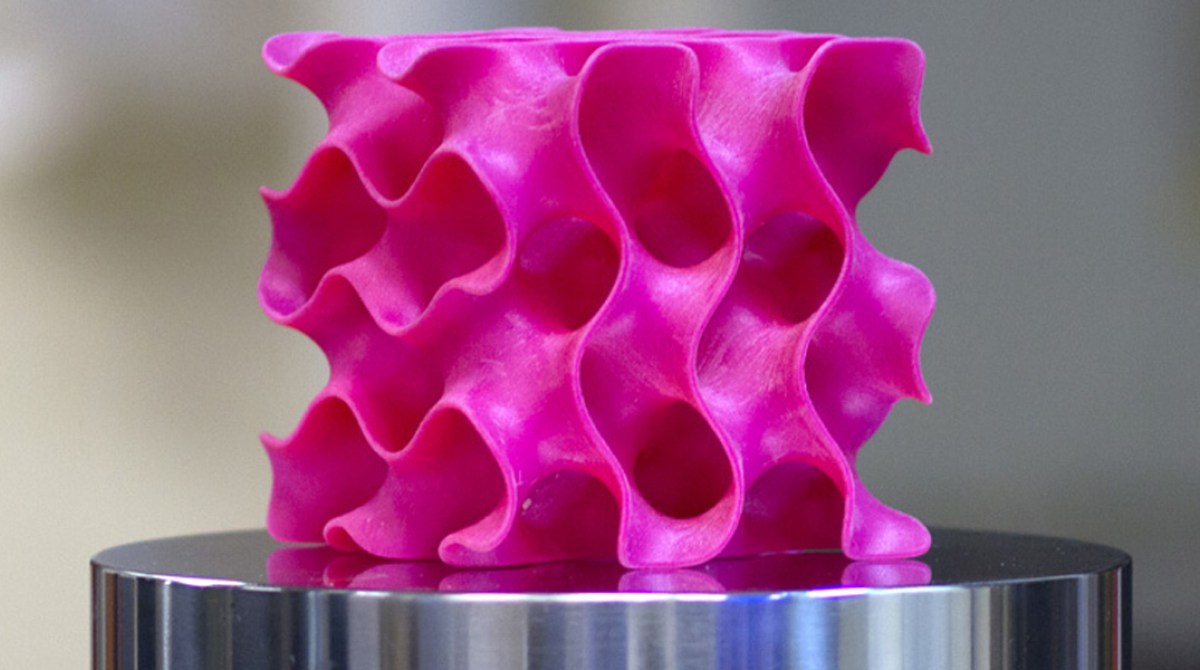
Last September, we wrote about the Hasso-Plattner-Institute in Germany and their R&D on metamaterials, hacking the internal structures of materials to create simple, non-powered machines. By experimenting with various microstructural designs, researchers were able to 3D print simple machines that can deform to create some form of actuation, allowing the 3D printing of switches, latches, door handles, and the like.
5 Amazing illegal uses for Alexa
If you let your imagination run wild in the world of automatic speech recognition (ASR) and natural language understanding (NLU), and you throw in a little fear, uncertainty and doubt (FUD), you can come up with several illegal uses for systems such as Alexa Voice Service, Google Home, Siri, and Cortana that will give you pause. As I have previously written, Alexa is the “killer app” for the Internet of Things (IoT). It is not dangerous, at least not in its present form. But just for fun, let’s play pretend in our world of infinite possibilities.
AI is crushing humanity at poker
The first day of the Brains vs. AI poker tournament is in the books, and the Libratus bot from Carnegie Mellon University emerged as the clear winner, collecting $81,716 to the humans $7,228. Both the players and Libratus’ creators cautioned that it was still too early to make a judgement call about who might win the 20-day tournament. But it’s clear that this year’s AI has made some major improvements on the 2015 system, Claudico, which ended up losing to humanity.
Robots are transforming how we see wildlife
Wildlife photographer Will Burrard-Lucas had long wanted to add up-close-and-personal images of iconic African animals to his portfolio. But to get those intimate shot of lions and leopards, he would need to crawl up right next to their sharp-toothed faces. So Burrard-Lucas devised a far less deadly alternative.
Continue reading… “Robots are transforming how we see wildlife”
Prepping people to stay ahead of technological change
When education fails to keep pace with technology, the result is inequality. Without the skills to stay useful as innovations arrive, workers suffer—and if enough of them fall behind, society starts to fall apart. That fundamental insight seized reformers in the Industrial Revolution, heralding state-funded universal schooling. Later, automation in factories and offices called forth a surge in college graduates. The combination of education and innovation, spread over decades, led to a remarkable flowering of prosperity.
NOTE: A good way to stay ahead of the curve of technology changes is with DaVinci Tech Academy.
Continue reading… “Prepping people to stay ahead of technological change”
Here’s why an AI firm is smashing windows
In a sound-proofed hangar on an RAF airbase just north of Cambridge, UK, Chris Mitchell and his colleagues are busy using sledgehammers to teach their computers a lesson. The team has gathered thousands of window panes and doors, all of different shapes and sizes, which they then smash, one by one, recording the distinctive shattering sound of each type of glass. Sometimes they swing sledgehammers or garden spades, sometimes they throw bricks. “We completely underestimated the mess it would make,” says Mitchell. “And how tiring it would be.”
Continue reading… “Here’s why an AI firm is smashing windows”
Robots will destroy our jobs and we’re not even ready for it
The McDonald’s on the corner of Third Avenue and 58th Street in New York City doesn’t look all that different from any of the fast-food chain’s other locations across the country. Inside, however, hungry patrons are welcomed not by a cashier waiting to take their order, but by a “Create Your Taste” kiosk – an automated touch-screen system that allows customers to create their own burgers without interacting with another human being.
Continue reading… “Robots will destroy our jobs and we’re not even ready for it”
Self-driving trucks to haul cargo between shipping terminals in Singapore
Singapore’s shipping ports are already among the busiest and most efficient in the world. Now the city-state is exploring a new way to make them run even better: convoys of driverless trucks operating between terminals. The idea is that a lead truck will be driven by a human, with the follower vehicles being automated.
Continue reading… “Self-driving trucks to haul cargo between shipping terminals in Singapore”
Are you going to lose your job to AI? Here’s what experts really think
There’s a big temptation for businesses to use artificial intelligence to shave off time and money wherever they can. According to experts, that’s not the smartest use of the technology.
Continue reading… “Are you going to lose your job to AI? Here’s what experts really think”
Understanding the Disruptive Impact of Tomorrow’s Transportation
Arconic – The Road Ahead from WIRED Brand Lab on Vimeo.
“Until we get to that driverless era, we’ve got a slow-moving parking lot that’s working at a glacial speed in major cities literally all over the world,” says Futurist Thomas Frey, founder of thinktank DaVinci Institute.
Continue reading… “Understanding the Disruptive Impact of Tomorrow’s Transportation”
DaVinci Coders form Team to Compete for IBM Watson AI X-Prize
DaVinci Coders is excited to announce that the students in our upcoming JavaScript course will serve as the foundational team for competing in the recently announced IBM Watson AI X-Prize, a $5 million competition designed around using artificial intelligence to solve some of the world’s greatest problems.
“The IBM Watson AI X-Prize fits in perfectly with much of the research we’ve been doing, and we feel well positioned to compete on the world stage for this prestigious prize,” says Thomas Frey, Senior Futurist at the DaVinci Institute. “We’re already attracting some remarkably high caliber students and this seems like the perfect vehicle for leveraging their talents on a project that can benefit the entire world.”
Continue reading… “DaVinci Coders form Team to Compete for IBM Watson AI X-Prize”
Scientists are planning to replace antibiotics
When you use something so much, your body becomes accustomed to it, and it no longer has the same effect that it once did. This is exactly what’s happening with antibiotics. Our bodies are becoming immune to their effects and building an antibiotic resistance. Statistics show that at least 2 million people are infected every year by antibiotic-resistant bacteria just in the US alone; out of the 2 million around 23,000 people die because of it. Some researchers have even estimated that if no action is taken by 2050 as many as 10 million people will die each year from superbugs, costing the nation around $100 trillion trying to treat.
Continue reading… “Scientists are planning to replace antibiotics”