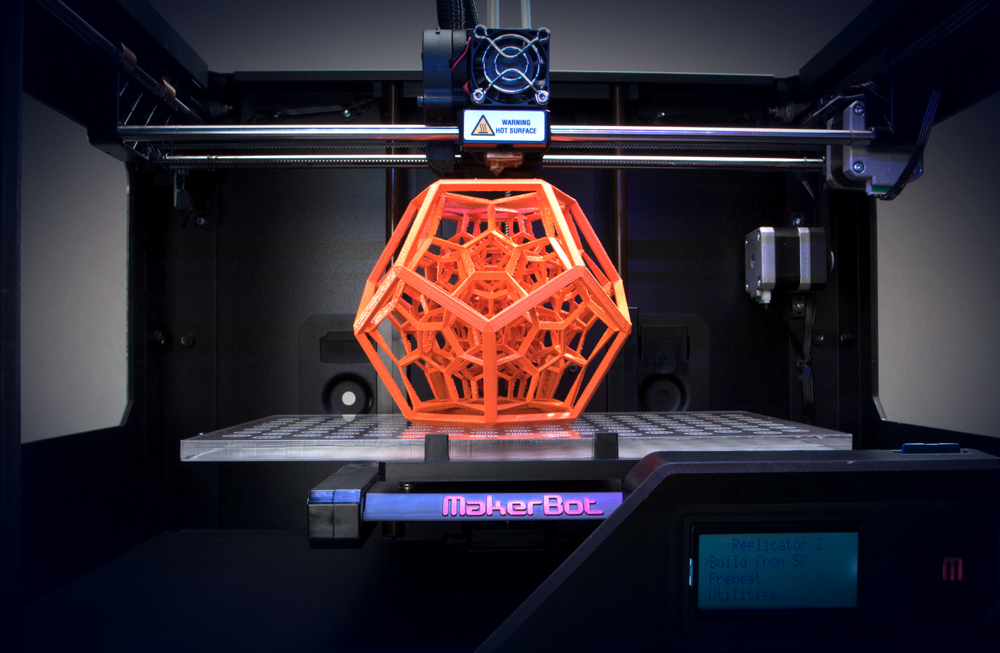
Every end of the year, Yahoo India releases “The Year in Review lists”. This review list reveals the people, events, and stories that captured the attention of Indians in the last 12 months. Here are the list of most significant technology products in the year 2016.
In the hospitals of the future, your doctor may walk out with your charts and back in with a new body part for you to try on. At least, that appears to be the future the Queensland University of Technology (QUT) in Brisbane, Australia has in mind. The institution is in the process of constructing a “biofabrication” room meant for 3D-printing bone, cartilage and other human tissue as it is needed. Known as the Herston Biofabrication Institute, the goal of the ambitious new project, currently slated for a 2017 launch, will be to “advance knowledge and technology in 3D scanning, modeling, and printing of bone.”
London doctors have made the headlines this week as they become the first medical staff ever to use a 3D printed heart model to improve surgical procedures and predict any dangers such as serious changes to a person’s heartbeat. It works by taking images from a CMR (cardiovascular magnetic resonance) scan and creating an exact replica of the subject’s heart, muscles, valves, and chambers.
The Russian Fund for Perspective Research has performed tests on 3D printed bullets. According to the organization, the additive manufactured ammunition performed in a similar manner to traditionally made bullets.
Futurist Thomas Frey is in town to talk to a Greater Des Moines Partnership breakfast Friday. I caught up with him by phone to discuss how our metro is likely to change as disruptive technologies pile up. By the time we were done, I had half-jokingly asked him if Iowa could 3-D print a mountain range, a much-wanted perk here in the flatlands.
A London-based startup has combined some of today’s most disruptive technologies in a bid to change the way we’ll build the future. By retrofitting industrial robots with 3D printing guns and artificial intelligence algorithms, Ai Build has constructed machines that can see, create, and even learn from their mistakes.
Scientists think they might have finally cracked the cure for baldness, and in a fairly unusual way.
While traditional baldness ‘cures’ have tended to focus on lotions (think Homer Simpson), transplants (Wayne Rooney) or wigs (Trump?), new technology being developed by L’Oreal is using 3D printing. Continue reading… “A cure for baldness thanks to 3D printing?”
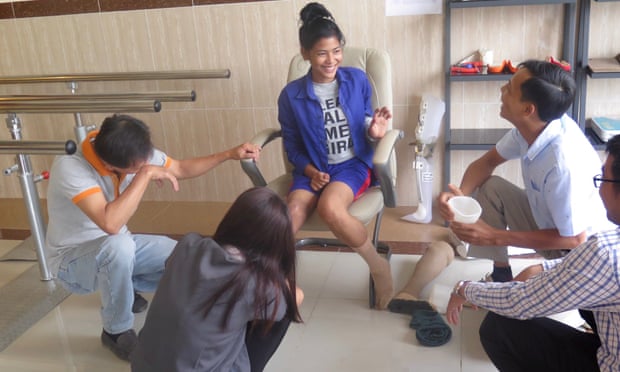
Groundbreaking 3D printing and scanning techniques are improving access to fully customisable artificial limbs
Before the vehicle that she was travelling in flipped over and trapped her right leg, Leakhena Laing was a happy teenager who enjoyed climbing trees and playing football with friends. After her limb was amputated, she could only sit and watch.
Whether it’s rhinoplasty or breast augmentation, the general timeline of a cosmetic surgery consultation is relatively consistent: a patient walks in with an idea—often equipped with pictures—and a plastic surgeon outlines what they can do.
Historically, doctors have evolved from sketching proposed changes to embracing two-dimensional imaging on computers to incorporating 3D imaging. Now, some practices are adopting 3D printed models to offer patients a sort of blueprint that they can physically hold and touch with their own hands, and make the $13.5 billion cosmetic procedure industry even more accessible.
Talk about an immersive dining experience.At Food Ink, the main draw isn’t even the food, but the way in which it’s made. You see, everything at this London concept restaurant is 3D-printed. From the dishes to the dishes upon which they sit, you’re eating at the throne of technology. Because who wants hand-prepared meals when they can be printed?Self-described as a “conceptual pop-up dinner series where fine cuisine meets art, philosophy, and tomorrow’s technologies,” this exceptionally unique experience uses 3D-printing to make the food, the utensils, the furniture — literally everything.
One of the trademarks that distinguishes robots from humans is the ability to reproduce. This dividing between man and machine just got blurrier. Researchers in Amsterdam have created robots that can mate and spawn offspring through a process similar to human reproduction.
Robots have created quite a stir in the media recently, as more and more machines take on human tasks. Some estimates suggest automation could take over half of the work force.
3D Printing is changing the world of guns, souvenirs, medicine, and now food. 3D printed food may sound like sci-fi, but it’s already a reality in some capacity.
A company called byFlow has created a 3D printer that utilizes pastes of any variety to build food items in a few smooth movements of a wand. The limitations of flavor and design are only limited to the chef’s imagination.