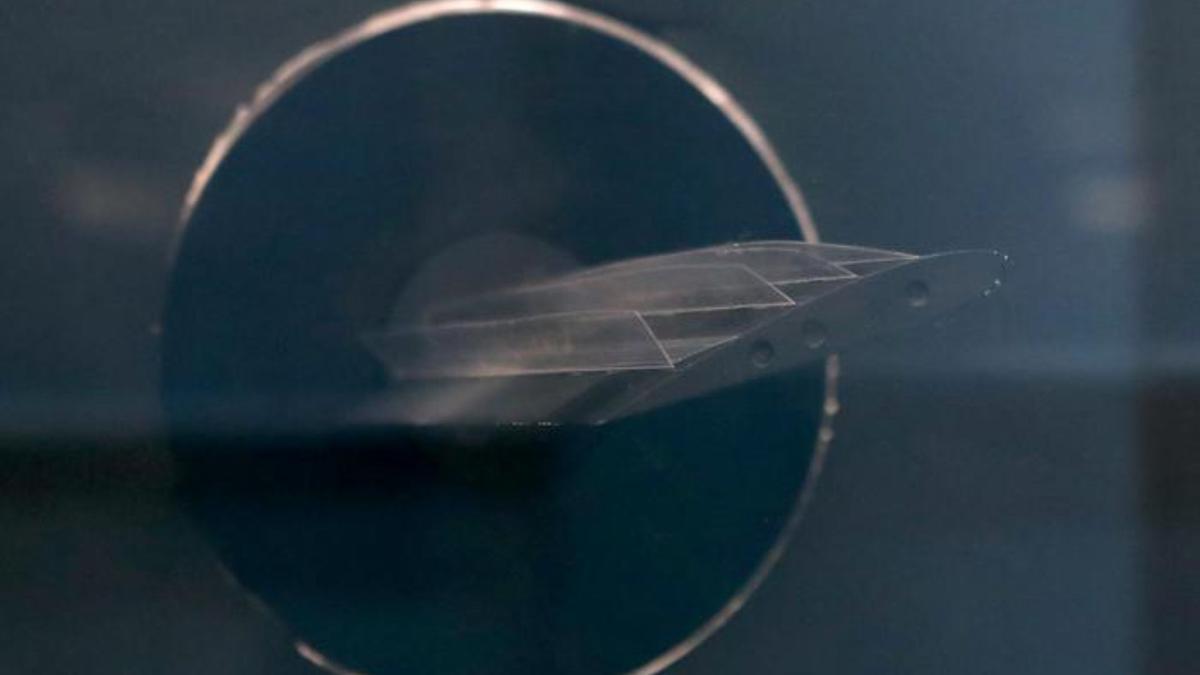
Inspired by Birds, Princeton Engineers Develop Advanced Multi-Row Wing Flaps to Improve Aircraft Performance and Safety

Researchers at Princeton University’s School of Engineering have looked to nature—specifically, birds—to enhance flight safety and efficiency in aircraft. Inspired by the covert feathers birds use for precise maneuvers, the team has designed multi-row flaps that deploy automatically to prevent aircraft from stalling.

Birds rely on covert feathers during complex aerial movements, like landing in high winds, to improve control and stability. While engineers have long used single-row flaps in aircraft to improve lift, they haven’t explored multi-row configurations that mimic how birds manage airflow in response to environmental changes. Assistant Professor Aimy Wissa and her team focused on the aerodynamics of deploying multiple rows of flaps and how this design could improve flight performance.

Continue reading… “Inspired by Birds, Princeton Engineers Develop Advanced Multi-Row Wing Flaps to Improve Aircraft Performance and Safety”


China Unveils World’s Most Powerful Hydraulic Cylinder, Marking Breakthrough in Marine Engineering

China has introduced the world’s most powerful hydraulic cylinder for marine pile driving, a remarkable technological feat unveiled in Changzhou, Jiangsu province. With a record-breaking maximum thrust of 5,000 tons—enough to lift 1,000 adult African elephants—the cylinder represents a significant advance in China’s engineering capabilities, according to reports from local media.

Designed by the state-owned China Communications Construction Company (CCCC), this hydraulic powerhouse stands 92 feet tall and measures 6.5 feet in diameter, roughly the height of a ten-story building. The SCMP reported that this massive cylinder will serve as the central “heart” of a 150-meter pile-driving vessel currently under construction, positioning China as a leader in marine engineering technology and reducing dependence on imported components.

Continue reading… “China Unveils World’s Most Powerful Hydraulic Cylinder, Marking Breakthrough in Marine Engineering”

Unlocking the Secrets of Ancient Roman Concrete: A Self-Healing Formula for Modern Strength

Ancient Roman structures built with concrete have withstood centuries, inspiring researchers to uncover the secret behind their resilience. Unlike today’s Portland cement-based concrete, Roman concrete is known for its incredible durability and even a self-healing ability. This strength has led scientists to seek ways to replicate it, hoping to craft stronger, more sustainable materials for modern use.

Portland cement, developed in the 19th century, is the basis of today’s concrete, but it lacks the robustness of Roman concrete and has a high environmental cost due to its complex production process. Engineers are now exploring concrete alternatives that reduce or eliminate the use of traditional cement.

Continue reading… “Unlocking the Secrets of Ancient Roman Concrete: A Self-Healing Formula for Modern Strength”

KAIST Unveils WalkON Suit F1: A Wearable Robot for Paralyzed Individuals with Self-Walking Assistance

Researchers at the Korea Advanced Institute of Science and Technology (KAIST) have developed an advanced wearable robot, the WalkON Suit F1, designed to provide greater independence for individuals with paraplegia. Announced on October 24, this new version allows users to put on the suit directly from their wheelchairs without needing help from others.

The WalkON Suit series, under development since 2015, targets individuals with the most severe form of paralysis, classified as ASIA Impairment Scale – A (complete paralysis). Unlike other rehabilitation and strength-assisting robots in use, the WalkON Suit F1 is designed specifically to aid independent mobility for people with paraplegia.

Continue reading… “KAIST Unveils WalkON Suit F1: A Wearable Robot for Paralyzed Individuals with Self-Walking Assistance”

SpinLaunch: Revolutionizing Satellite Launches with Kinetic Energy

A California-based company, SpinLaunch, is turning heads with its groundbreaking satellite launch system, capturing the imagination of space enthusiasts and even Punkin Chunkin fans. SpinLaunch’s innovative approach uses a massive rotating arm to hurl satellites into low Earth orbit, eliminating the need for traditional rocket fuel and relying solely on electricity.

The company has already achieved multiple successful test launches. “This is not a rocket, and clearly our ability to perform this many tests within 11 months, all functioning as planned, really showcases the power of our technology,” said Jonathan Yaney, founder and CEO of SpinLaunch, in a 2022 interview with Space.com after the company’s 10th successful test launch. SpinLaunch aims to deploy satellite constellations into orbits below 600 miles by 2026.

Continue reading… “SpinLaunch: Revolutionizing Satellite Launches with Kinetic Energy”

UCL Sets New Wireless Transmission Speed Record, Paving the Way for Faster Networks

Researchers from University College London (UCL) have shattered the world record for wireless transmission speed, marking a significant step toward faster, more reliable wireless communication. The UCL team successfully transmitted data over the air at an astonishing speed of 938 Gigabits per second (Gb/s) across a frequency range of 5-150 Gigahertz (GHz). This speed is nearly 9,380 times faster than the current average 5G download speed in the UK, which stands at around 100 Megabits per second (Mb/s). The breakthrough comes with a total bandwidth of 145GHz, more than five times the previous world record.

Currently, wireless networks transmit data using a narrow range of radio frequencies, typically below 6GHz. This has led to congestion and limited the speed of wireless communication technologies such as Wi-Fi and 5G. The UCL team, however, overcame this bottleneck by utilizing a much wider range of frequencies, combining both radio and optical technologies for the first time.

Continue reading… “UCL Sets New Wireless Transmission Speed Record, Paving the Way for Faster Networks”

Nuclear Power’s Role in Revolutionizing Data Centers with Microreactors

As artificial intelligence drives exponential growth in data demand, nuclear power is emerging as a key player in revolutionizing energy supply for data centers. Tech giants like Oracle and Microsoft, alongside influential figures such as Bill Gates, have begun exploring nuclear energy solutions. In a notable move, Microsoft has secured an agreement to purchase power from the Three Mile Island reactor, signaling a shift toward clean, reliable energy sources for its data operations.

One of the most promising developments in this field is the advent of micro nuclear reactors. These compact reactors offer a safe, sustainable, and efficient way to meet the growing energy needs of data centers and other industries. Companies like Nano Nuclear Energy are making strides in this area, aiming to deliver commercial microreactors by the early 2030s, with prototypes expected as soon as 2027.

Continue reading… “Nuclear Power’s Role in Revolutionizing Data Centers with Microreactors”

Quantum Computing Threatens Encryption: Chinese Researchers Crack RSA with D-Wave Technology

In a groundbreaking yet concerning development for global cybersecurity, Chinese researchers have demonstrated how quantum computing could accelerate the downfall of current encryption methods. Using D-Wave’s quantum annealing systems, the researchers have successfully cracked classic encryption techniques, potentially fast-tracking the timeline for when quantum computers could undermine the cryptographic systems that protect sensitive information worldwide.

The research, published in the Chinese Journal of Computers under the title “Quantum Annealing Public Key Cryptographic Attack Algorithm Based on D-Wave Advantage,” highlights how D-Wave’s quantum machines were able to break RSA encryption and launch attacks on symmetric encryption algorithms. These findings pose serious questions about the future of cybersecurity.

Continue reading… “Quantum Computing Threatens Encryption: Chinese Researchers Crack RSA with D-Wave Technology”

The Future of Water-Based Fuel: Is Hydrogen Being Left Behind?

Water has always been a source of life, but now, it’s set to power cars, reshaping the future of clean energy. While hydrogen has long been hailed as the primary clean fuel for the automotive sector, recent developments suggest that water-based fuel might take the lead. The introduction of the first water-powered car has sparked discussions among experts, with some even suggesting that this breakthrough could mark “the end of hydrogen” as the go-to clean fuel.

Electriq Global, an Australian-Israeli company, has developed a revolutionary fuel that is 60% water-based. Using innovative technology, Electriq extracts hydrogen from water and uses it to power vehicles, offering a cheap, clean, and safe fuel alternative. The potential impact on global energy consumption and the automotive industry is immense.

Continue reading… “The Future of Water-Based Fuel: Is Hydrogen Being Left Behind?”

A Breakthrough in Hydrogen Fuel: Splitting Seawater Without Corrosive Byproducts

Scientists have developed a groundbreaking method to split seawater into hydrogen fuel using electrodes, eliminating the production of harmful and corrosive chlorine gas that typically results from such processes. This innovative approach, spearheaded by California-based startup Equatic, in collaboration with ARPA-E, promises to generate clean hydrogen fuel without requiring pure water—making it a major step forward in sustainable energy.

Traditionally, hydrogen fuel is produced via electrolysis, a process in which water is split into hydrogen and oxygen using an electrolyzer. However, using seawater has been problematic due to the corrosive minerals and salts it contains. When seawater is subjected to electrolysis, these salts are separated, leading to the production of toxic chlorine gas, which corrodes the machine’s internal components and gums up its operations.

Continue reading… “A Breakthrough in Hydrogen Fuel: Splitting Seawater Without Corrosive Byproducts”

The Mind of Fungi: How Brainless Organisms Show Signs of Intelligence

Fungi are remarkable lifeforms that challenge conventional ideas of intelligence. Despite lacking brains, these organisms exhibit signs of decision-making and communication. But just how complex are they, and what insights can they provide into other forms of awareness? A team of researchers from Japan’s Tohoku University and Nagaoka College sought to explore these questions through an intriguing experiment on the cord-forming fungus Phanerochaete velutina. Their study, published in Fungal Ecology, reveals that fungi can “recognize” different spatial environments and adjust their growth strategies accordingly.

While fungi are often recognized by their aboveground mushrooms, these are merely the surface manifestation of a vast underground network known as mycelium. These intricate webs stretch for miles beneath the soil, capable of transmitting environmental information throughout the network. Yet, the growth of mycelium doesn’t appear random—it seems to follow a deliberate, calculated pattern.

Continue reading… “The Mind of Fungi: How Brainless Organisms Show Signs of Intelligence”

Photons Defy Time: New Quantum Study Shows Light Can Exit Before Entering

Quantum physics often challenges our understanding of reality, and a new study led by Daniela Angulo from the University of Toronto adds another mind-bending discovery to the mix: photons, the wave-particles of light, can seem to pass through a cloud of atoms in “negative” time, effectively appearing to exit a material before they even enter it.

Aephraim Steinberg, a physicist from the same university, shared this surprising result on X (formerly Twitter), after the team’s findings were uploaded to arXiv.org in early September. While not yet peer-reviewed, the study reveals that photons interacting with a cloud of ultracold rubidium atoms can appear to spend a negative amount of time in the excited state—a phenomenon that defies conventional expectations.

Continue reading… “Photons Defy Time: New Quantum Study Shows Light Can Exit Before Entering”