Would you trust a robot chef? This innovative one can ‘taste’ food to prepare it exactly as you like it!

CAMBRIDGE, England — A robotic chef is learning how to “taste” food as it cooks it — just like humans do to see if their meal has enough seasoning. The new machine can even change the taste of food depending on individual tastes!

Researchers at Cambridge University say this could one day lead to automated robots in food preparation that know exactly what tastes good to most customers. Aiming to nail down the science of the art of cookery has already led to the robot chef being able to make an omelet based on a human taster’s feedback.

The team found by creating a “taste as you go” approach improved the robot’s ability to quickly and accurately assess the saltiness of a dish. To imitate the human process of chewing and tasting in their robot chef, the researchers attached a conductance probe, which acts as a salinity sensor, to a robot arm.

They prepared scrambled eggs and tomatoes, varying the number of tomatoes and the amount of salt in each dish. Using the probe, the robot “tasted” the dishes in a grid-like fashion, returning a reading in just a few seconds.

To imitate the change in texture caused by chewing, the team then put the egg mixture in a blender and had the robot test the dish again. The different readings at different points of “chewing” produced taste maps of each dish.

Continue reading… “Would you trust a robot chef? This innovative one can ‘taste’ food to prepare it exactly as you like it!”

NVIDIA Researchers Demonstrate Ultra-thin Holographic VR Glasses That Could Reach 120° Field-of-view

By Ben Lang

A team of researchers from NVIDIA Research and Stanford published a new paper demonstrating a pair of thin holographic VR glasses. The displays can show true holographic content, solving for the vergence-accommodation issue. Though the research prototypes demonstrating the principles were much smaller in field-of-view, the researchers claim it would be straightforward to achieve a 120° diagonal field-of-view.

Published ahead of this year’s upcoming SIGGRAPH 2022 conference, a team of researchers from NVIDIA Research and Stanford demonstrated a near-eye VR display that can be used to display flat images or holograms in a compact form-factor. The paper also explores the interconnected variables in the system that impact key display factors like field-of-view, eye-box, and eye-relief. Further, the researchers explore different algorithms for optimally rendering the image for the best visual quality.

Continue reading… “NVIDIA Researchers Demonstrate Ultra-thin Holographic VR Glasses That Could Reach 120° Field-of-view”

Ep. 86: Space exploration (and why it matters) with sarah cruddas

Watch our interview with Sarah Cruddas on Youtube or catch it on the Futurati Podcast.

Sarah Cruddas is a space journalist, international TV host, and award winning author. She has an academic background in astrophysics and is a global thought leader in the growing commercial space sector.

Pairs Well With

Continue reading… “Ep. 86: Space exploration (and why it matters) with sarah cruddas”

How patient-on-a-chip tech could be the future of drug discovery

By Ben Hargreaves

Testing drug compounds on a chip designed to mimic human organs sounds closer to science fiction than reality, yet the technology already exists and is already being put to use. Ben Hargreaves discovers how the technology could provide more accurate safety predictions and even discover new treatments.

The limits of animal models in drug discovery are well known. If you are reading this then you are likely not a mouse, and as a result, will react to drug compounds differently. In testing new treatments, what is promising in animal models may not transfer particularly well to humans, which helps to explain why there is a 90% failure rate during clinical development. The low rate of success is one of the contributors to the high cost and the slow R&D process that takes promising compounds through early testing and into the clinic. Moreover, there is the question of the ethics of using animals, numbering in the millions each year, in clinical trials, which sees most euthanized at the end of the process.

The challenge that the pharma industry faces is the lack of better alternatives to animal models. There are existing alternatives, with one being human cell culture systems, which provide an environment that is closer to that which will eventually receive treatment but do not contain the complexity of a complete organism. An organoid system approach takes self-organising clusters of cells that grow in three dimensions, closely resembling real tissue and organs. Despite the potential, there are limiting factors such as the need to provide optimal culturing conditions for different types of organoid, with each potentially containing a range of cells types. An alternative to these systems is one that is growing in popularity and commercial application, a technology referred to as ‘organ-on-a-chip’.

Continue reading… “How patient-on-a-chip tech could be the future of drug discovery”

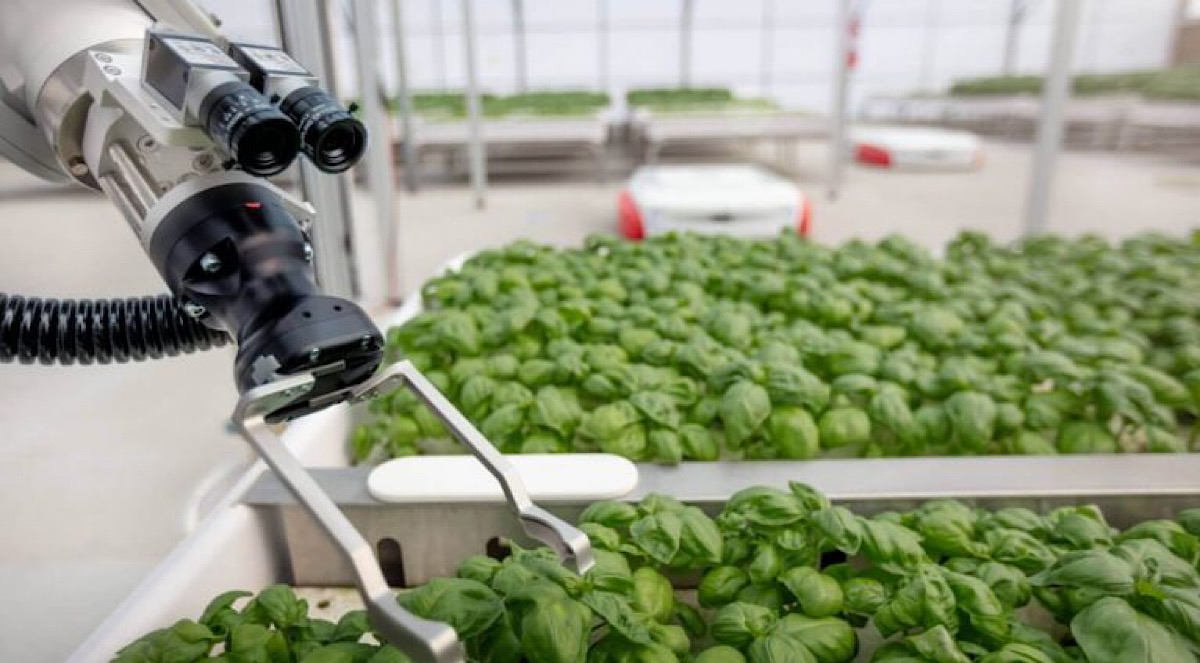
This California Greenhouse is Run by Robots

(Photo: Iron Ox)A farm technology startup is using robots and artificial intelligence to tackle sustainability concerns in agriculture.  

By Adrianna Nine

Northern California-based Iron Ox was born from the realization that conventional American agriculture negatively impacts the environment in a multitude of ways. The type of farming most of us are familiar with uses as much as 70 percent of the world’s fresh water supply and produces up to 1.19 gigatons of greenhouse gasses every year. There’s also the issue of wasted produce, with up to 40 percent of fruits and veggies ending up in a landfill before ever reaching a consumer. While companies like Imperfect Foods, Uglies, and Misfits Market aim to offset this by proudly selling produce your typical grocery store won’t, these businesses don’t address the root of the problem: how the produce is grown.   

Iron Ox uses two house-designed, AI-supported robots to perform most repetitive farming tasks and ensure resources are used efficiently. The first of these, called Grover, makes up the brawn of Iron Ox’s robotic crew. Able to lift more than 1,000 pounds, Grover helps move plant “modules” (i.e. planter boxes) around the greenhouse. Grover also helps water and harvest crops in tandem with Phil, the company’s brainier robot farmer. Phil monitors and delivers each module’s water, nutrient mix, and pH levels to maximize crop yield and quality while making sure resources aren’t overused. 

Continue reading… “This California Greenhouse is Run by Robots”

SOUTH KOREA’S RECON LABS RAISES $4.4M TO HELP SHOPPERS VISUALIZE PRODUCTS BY CREATING 3D MODELS IN AR 

By Kate Park

Augmented reality (AR) can help customers shopping online preview products before making a purchase, and is a growing area of investment for e-commerce businesses. According to a recent survey of 16,000 Snapchat users in 16 markets, 92% of Gen Zers want to use AR and VR for online shopping.

Now, a South Korean augmented reality (AR) startup called RECON Labs, which enables e-commerce customers to create 3D models within a few hours by taking a short video of products via its platform PlicAR, has raised $4.4 million. The company will use its Series A funding to increase its headcount and enhance its platform PlicAR, which helps automatically turn a 2D image into a 3D view of its products without requiring any special skills in 3D modeling.

RECON Labs CEO Seong-hoon Ban told TechCrunch that the firm works with a number of e-commerce marketplaces and retailers, including furniture companies that want to help their clients visualize products in 3D models in actual life-size in augmented reality.

The company currently offers its service to more than 22 small and medium companies in South Korea, and is in discussion with potential customers in the fashion, toy and food sectors, Ban said. Retailers can save time and costs by using PlicAR without building their own 3D modeling platform, he added.

RECON Labs claims it has more than 10,000 products that are 2D converted into 3D content. The platform will let users download, upload, view, sell and buy 3D assets through its web-based service in the future, like Sketchfab, which was acquired by Epic Games in 2021, Ban said.

Continue reading… “SOUTH KOREA’S RECON LABS RAISES $4.4M TO HELP SHOPPERS VISUALIZE PRODUCTS BY CREATING 3D MODELS IN AR “

Washington is the first state to require all-electric heating in new buildings

Most new large apartment and commercial buildings must install heat pumps under the state’s new energy code.

By Emily Pontecorvo

New construction goes up in Bellevue in February 2022. A recently enacted state building code will require most new commercial buildings and large multifamily buildings to install electric heat pumps.

Washington recently became the first state in the country to mandate that newly constructed buildings be outfitted with all-electric space heating and hot water systems. 

The State Building Code Council voted 11-3 on April 22 to adopt a revised energy code that requires most new commercial buildings and large multifamily buildings to install electric heat pumps. The council is expected to consider a similar proposal for smaller residential buildings later this year. 

Heat pumps are an extremely energy-efficient technology that can extract heat from the outside air, even on very cold days, and pump it inside to provide space heating. They can also run in reverse and provide cooling in the summer. The revised code also mandates the use of heat-pump hot water heaters.

Continue reading… “Washington is the first state to require all-electric heating in new buildings”

Ep. 84 Russia, cybercrime, and the future of war, with Rik Ferguson.

Watch our interview with Rik Ferguson on Youtube or on the Futurati Podcast website

Rik Ferguson is vice president of security research at Trend Micro and is actively engaged in studying online threats and the underground economy. He also researches the wider implications of new developments in the Information Technology arena and their impact on security.

Continue reading… “Ep. 84 Russia, cybercrime, and the future of war, with Rik Ferguson.”

The Design for the World’s First Floating Sustainable City Unveiled

by Otilia Drăgan

“Floating infrastructure” and “waterborne urbanism” sound like things from a Sci-Fi movie, but they are being brought to life in a truly groundbreaking project. The world’s first floating city that’s also 100% sustainable was announced a couple of years ago, and its future design was recently unveiled.

As it is in most cases, while some are lobbying for a return to minimalistic, simple dwellings that are as close to nature as possible, others are taking a radically opposite approach, envisioning futuristic urban communities that are unlike anything that’s been done before. Neom is one of the most recent projects of this kind, which is currently being built in the Tabuk province of Saudi Arabia. 

But there’s no other floating city concept except for Oceanix Busan. UN-Habitat, the Busan Metropolitan City of the Republic of Korea, and Oceanix (a New York-based blue technology company) teamed up to create this futuristic city that is by no means a simple experiment, but a potential solution to a very serious problem. 

Continue reading… “The Design for the World’s First Floating Sustainable City Unveiled”

China Will Test Planetary Defense by Crashing a Spacecraft into An Asteroid

China’s plans are similar to a NASA mission that will slam into an asteroid later this year.

By Becky Ferreira

China plans to crash a spaceship into an asteroid that is potentially hazardous to Earth to alter its trajectory, a maneuver that caps off a multi-step planetary defense strategy that was outlined by a representative of the nation’s space agency on Sunday, reports SpaceNews. 

The asteroid deflection mission is scheduled for launch sometime in the mid-2020s, according to Wu Yanhua, deputy director of the China National Space Administration (CNSA), who described the project during a celebration of China’s Space Day, which commemorates the launch of the nation’s first satellite, Dongfanghong-1, on April 24, 1970.

Continue reading… “China Will Test Planetary Defense by Crashing a Spacecraft into An Asteroid”