Berkeley researchers design self-folding in-flight drone arms

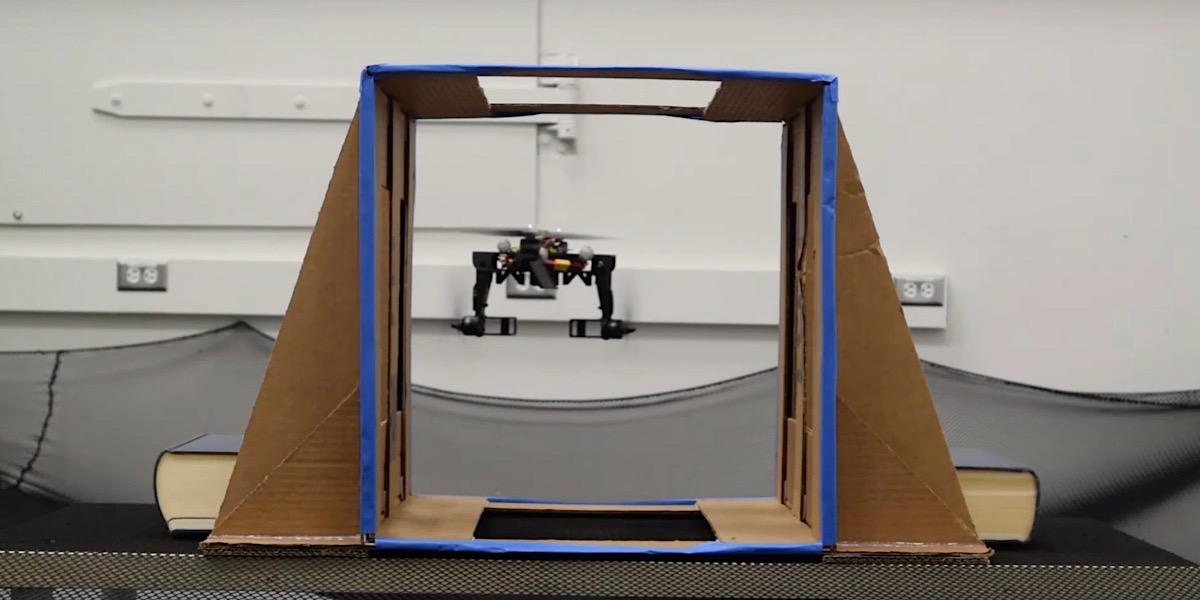
Researchers at UC Berkeley have developed a drone whose hinged arms can fold themselves from horizontal to vertical position in order to pass through tight spaces or carry light objects.

By Bruce Crumley

The objective of researchers at Berkeley’s High Performance Robotics Laboratory (HiPeRLab) was to design a quadcopter capable of raising and lowering its arms while in flight to adjust to limited spaces, or increase the tasks it could perform. To do that, they inserted hinges between the body of the square craft and its rotor-equipped appendages to enable their lowering and raising. In contrast to other experimental UAVs tricked up for similar folding movement, however, HiPeRLab scientists figured out a way for the drone itself to power all that flapping.

Previous limb-adjusting vehicles created by labs like Purdue University’s Engineering Technology school were outfitted with actuators that shifted the arms and rotors into different positions, making them more efficient in certain conditions like heavy winds. The HiPeRLab staff wanted to avoid inclusion of actuators, which draw off the drone’s batteries and thereby reduce its flight time. Their solution: use passive hinges whose up and down folding is powered by the rotors themselves.

Continue reading… “Berkeley researchers design self-folding in-flight drone arms”

THIS DEVICE TURNS AIR INTO PURE DRINKING WATER, PROVIDING 10 LITERS OF FRESH MINERAL WATER EACH DAY

BY NEHA MISTRY  

What’s funny about the idea of progress is that it’s much more layered than we think. Sure, 30 years from now, we will have sent humans to Mars… but 30 years from now most cities will even be dealing with extreme climate change, polluted air, and scarcity of resources like running water. Sounds odd when you look at the whole picture, right? Well, we’re living in a world that’s on a path to change, and it may be prudent to stop taking things like drinking water for granted.

Meet Kara Pure, a water dispenser that basically turns air into drinking water. Designed by Cody Soodeen, Kara Pure wasn’t created in a void — Soodeen grew up in a town where the drinking water was contaminated by a strain of bacteria that had health implications for the people who consumed it. Unfit drinking water isn’t particularly rare nowadays, with groundwater tables either being infected/polluted, or being entirely depleted due to overconsumption and a lack of accounting for climate change. While Kara Pure is clearly built keeping a pretty inevitable future in mind, it’s important that Soodeen and other people like him perfect the technology now, rather than later.

Continue reading… “THIS DEVICE TURNS AIR INTO PURE DRINKING WATER, PROVIDING 10 LITERS OF FRESH MINERAL WATER EACH DAY”

Why humans might need artificial gravity for future space travel

Astronauts are set to travel to Mars in the not-so-distant future. Some missions will result in people living in an extended period of microgravity.

The human body isn’t designed to handle this, so scientists are developing the best ways to mimic gravity on Earth on a spaceship.

So how will they do it?

Continue reading… “Why humans might need artificial gravity for future space travel”

World’s First Commuter Electric Plane Is Preparing for Maiden Flight

The prototype e-plane, named Alice, can accommodate nine passengers and two crew members.

By Sissi Cao 

The world’s first all-electric “commuter” plane, Alice, made by Israeli company Eviation, is preparing for its first test flight at an airport near Seattle.

A prototype of Alice was spotted on Monday at Arlington Municipal Airport north of Seattle, Washington, where it performed engine tests in preparation for a high-speed taxi test.

Alice made its first public appearance at the Paris Air Show in 2019. Eviation claimed the electric aircraft could reduce maintenance and operating costs by up to 70 percent compared with commercial jets. The latest iteration of Alice features a fly-by-wire system made by Honeywell and boasts a range of 440 nautical miles and a maximum cruise speed of 250 knots.

Alice’s “commuter” configuration can accommodate nine passengers and a crew of two. The plane can also be transformed into an “executive” configuration, designed for fewer people in business class-like seating, and a “cargo” configuration that offers a 450-cubic-foot, temperature-controlled cargo bay.

Eviation CEO Omer Bar-Yohay told FLYING magazine on Monday that Alice was only “five to six [nice weather] testing days away from starting the flight campaign.”

Eviation took Alice for a low-speed taxi test on December 17, the same date 118 years ago when the Wright Brothers test flew their first airplane. Bar-Yohay posted a video of the test on Twitter the next day and wrote, “December 17th, 1903 was a historic day as the Wright Brothers changed the world forever with the first powered flight. We just taxied Alice yesterday…no big deal.”

Continue reading… “World’s First Commuter Electric Plane Is Preparing for Maiden Flight”

Nuro’s newest autonomous delivery bot is designed for the masses

There’s even an airbag on the exterior

By Kirsten Korosec

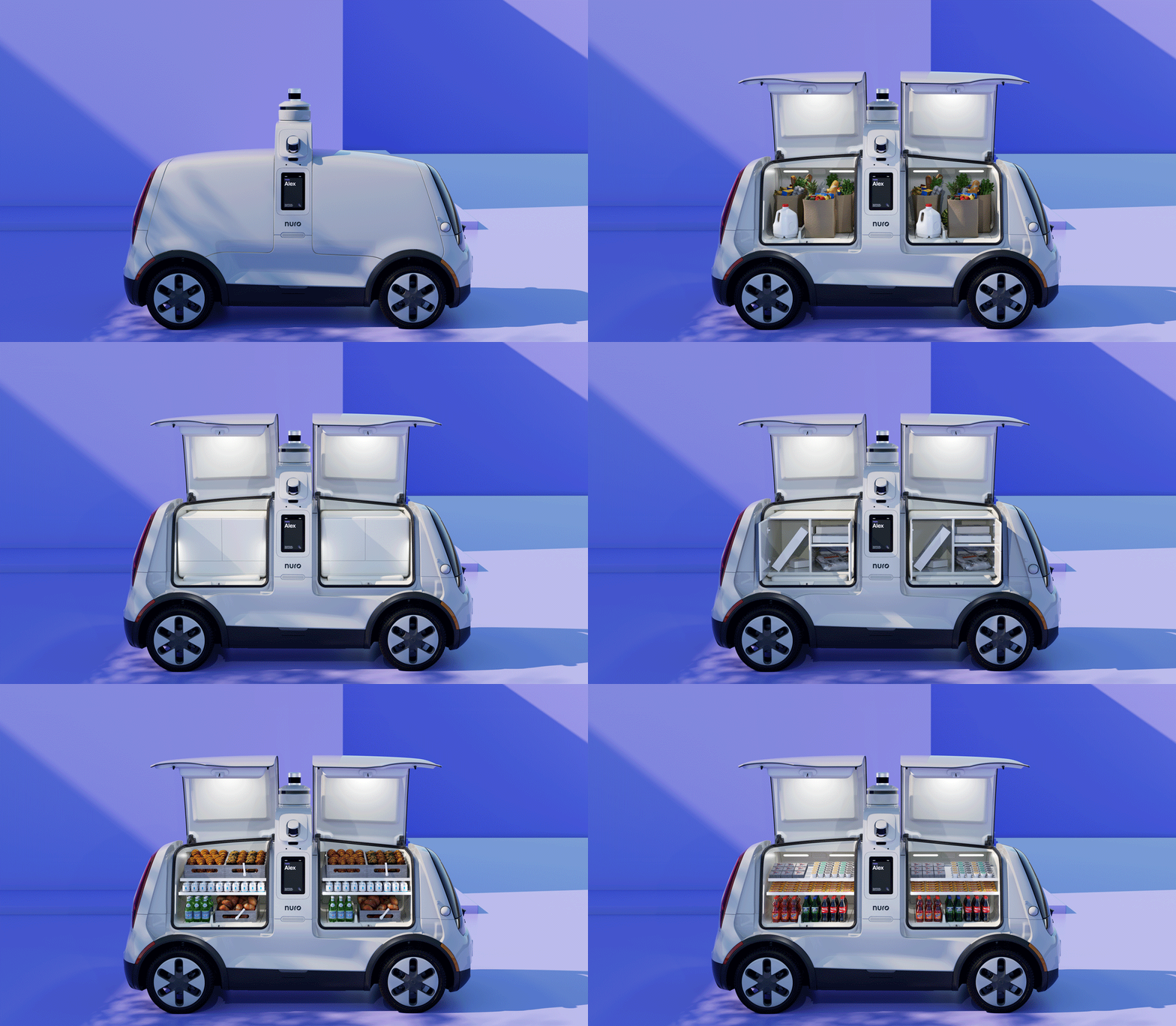
Nuro showed off Wednesday one of the final pieces of its commercial autonomous delivery strategy.

The startup, which has raised more than $2.13 billion since former Google engineers Dave Ferguson and Jiajun Zhu founded the company in June 2016, unveiled a third-generation electric autonomous delivery vehicle designed for commercial operations and manufactured in partnership with BYD North America.

Nuro has dropped the alpha-numeric nomenclature (R1 and then R2) for this delivery bot that is designed to haul packages, not people. Instead, the vehicle is called “Nuro” — a self-titled album of sorts meant to introduce the robot to the masses and a name that illustrates where this flagship model sits within the company. If it’s not clear, the “Nuro” is at the top.

The Nuro bot is not a sidewalk delivery bot. This new generation, and all of Nuro’s previous iterations, are meant for the road.

Continue reading… “Nuro’s newest autonomous delivery bot is designed for the masses”

Meta Reality Realms Launches First NFT Collection Backed by Real-World Land Properties

Image 1: Eden Prime  

First-Ever NFTs Backed By Real Land Assets

DENVER, Jan. 07, 2022 (GLOBE NEWSWIRE) —  Meta Reality Realms announced today its official launch introducing its first-ever NFT collection of real-world properties.  

As part of its launch, anyone will now have the opportunity to turn their real-world properties and assets into NFTs to be sold on the blockchain. This original take on NFTs, spearheaded by Meta Reality Realms, is the first of its kind to allow investors that own physical land to obtain both a physical and virtual warranty deed for their property.  

Each deed allows investors to not just own the digital art but also the blockchain-based NFT ID, which is expected to unlock endless possibilities in future Augmented Reality Zone sites that will exist both physically and virtually.  

“Alongside cryptocurrency, land will be the most important asset to own in the future,” explained Meta Reality Realms founder and CEO, Aaron Beltran. “Our NFTs are backed by real-world assets that anyone should be thinking about investing in, as the future of augmented reality gets closer.”

The future of Augmented Reality Zone sites is still progressing. By bringing awareness to NFTs backed by physical property, Meta Reality Realms is committed to preparing investors for the virtual future. 

Meta Reality Realms is the first company to allow real land ownership to be purchased and sold on the blockchain.

Continue reading… “Meta Reality Realms Launches First NFT Collection Backed by Real-World Land Properties”

Hyundai’s robot vision of the future is unexpectedly realistic

By Shane McGlaun

Typically we think of automotive manufacturer Hyundai, its cars and SUVs that come to mind. Hyundai is on hand at CES 2022, and it has revealed something that isn’t automotive-related but is aimed at ushering in a new type of mobility. The product is called the Plug & Drive (PnD) Robotic Module, and Hyundai says it’s designed to enable the Mobility of Things (MoT) concept. Via Hyundai

Hyundai says PnD is a modular platform that adds mobility to traditionally inanimate objects. The platform can be used to mobilize large and small objects and build robots. Hyundai has a stated goal of creating robots using the new platform that would allow personal mobility, connected communication, and the ability for the devices to operate atomically.

Continue reading… “Hyundai’s robot vision of the future is unexpectedly realistic”

Futurati Podcast with Danica Remy

Listen on Youtube

Listen on the Futurati Podcast website. 

Danica Remy is the President of the B612 Foundation, an organization dedicated to protecting Earth from asteroid impacts. She co-founded the international program “Asteroid Day”, supported by the Government of Luxembourg and sanctioned by the United Nations, as an official day to increase global awareness and education of asteroids.

Related

Continue reading… “Futurati Podcast with Danica Remy”

Engineering Artificial Lungs With Help From Lizards

The lizard lung forms quickly by a leveraging simple mechanical process the researchers likened to a mesh stress ball, the common toy. As fluid fills the developing lung, the inner membrane pushes out against smooth muscle tissue. The muscle separates into a honeycomb-shaped mesh and the membrane bulges out through the gaps, creating the surface area needed for gas exchange. Credit: Image courtesy Celeste Nelson and Michael PalmerRead time:  5 minutesGet PDF Version

When it comes to studying lungs, humans take up all the air, but it turns out scientists have a lot to learn from lizards.

A new study from Princeton University shows how the brown anole lizard solves one of nature’s most complex problems — breathing — with ultimate simplicity. Whereas human lungs develop over months and years into baroque tree-like structures, the anole lung develops in just a few days into crude lobes covered with bulbous protuberances. These gourd-like structures, while far less refined, allow the lizard to exchange oxygen for waste gases just as human lungs do. And because they grow quickly by leveraging simple mechanical processes, anole lungs provide new inspiration for engineers designing advanced biotechnologies.

Continue reading… “Engineering Artificial Lungs With Help From Lizards”