A New CRISPR Tool Flips Genes On and Off Like a Light Switch

By Shelly Fan 

CRISPR is revolutionary. It’s also a total brute.

The classic version of the gene editing wunderkind literally slices a gene to bits just to turn it off. It’s effective, yes. But it’s like putting an electrical wire through a paper shredder to turn off a misbehaving light bulb. Once the wires are cut, there’s no going back.

Why not add a light switch instead?

This month, a team from the University of California, San Francisco (UCSF) reimagined CRISPR to do just that. Rather than directly acting on genes—irrevocably dicing away or swapping genetic letters—the new CRISPR variant targets the biological machinery that naturally turns genes on or off.

Translation? CRISPR can now “flip a light switch” to control genes—without ever touching them directly. It gets better. The new tool, CRISPRoff, can cause a gene to stay silent for hundreds of generations, even when its host cells morph from stem cells into more mature cells, such as neurons. Once the “sleeping beauty” genes are ready to wake up, a complementary tool, CRISPRon, flips the light switch back on.

This new technology “changes the game so now you’re basically writing a change [into genes] that is passed down,” said author Dr. Luke Gilbert. “In some ways we can learn to create a version 2.0 of CRISPR-Cas9 that is safer and just as effective.”

Continue reading… “A New CRISPR Tool Flips Genes On and Off Like a Light Switch”
Experimental CRISPR Treatment Cuts Cholesterol in Mice by Up to 57% in a Single Shot

By PETER DOCKRILL

Scientists have improved upon a form of gene-editing therapy, creating an experimental treatment that looks to hold great promise for treating high cholesterol – a diagnosis affecting tens of millions of Americans, and linked to a number serious health complications.

In new research conducted with mice, researchers used an injection of a newly-formulated lipid nanoparticle to deliver CRISPR-Cas9 genome editing components to living animals, with a single shot of the treatment reducing levels of low-density lipoprotein (LDL) cholesterol by up to 56.8 percent.

In contrast, an existing FDA-approved lipid nanoparticle (or LNP; a tiny, biodegradable fat capsule) delivery system could only manage to reduce LDLs by 15.7 percent in testing.

Of course, these results have so far only been demonstrated in mice, so the new therapy will take a lot of further testing before we know it’s both safe and equally effective in humans. But based on these results so far, signs are promising.

Continue reading… “Experimental CRISPR Treatment Cuts Cholesterol in Mice by Up to 57% in a Single Shot”

CRISPR Offers the Potential to Live Forever, But to What End?

By Matthew Bacher

Due to the unique consequences of the pandemic, we are able to catch a glimpse of a potential future. One where we sit, plugged into our computers, devoid of physical human connection. What will society look like after the pandemic? Will we continue to stay isolated? Surely advancements in technology have played key roles in prolonging our lives, allowing us to continue to “work” and “socialise,” but to what end? With these newly emerging technologies are we destined to live forever, in a suspended state, in front of the glow of our 4k computer screens? Will gene editing technologies be used to keep us alive forever so that we can binge watch infinite Netflix shows, send meaningless emails and scroll through social media feeds?

Continue reading… “CRISPR Offers the Potential to Live Forever, But to What End?”

New Research Could Enable Direct Data Transfer From Computers to Living Cells

New-research-could-enable-direct-data-transfers-computers-living-cells

As the modern world produces ever more data, researchers are scrambling to find new ways to store it all. DNAholds promise as an extremely compact and stable storage medium, and now a new approach could let us write digital data directly into the genomes of living cells.

Efforts to repurpose nature’s built-in memory technology aren’t new, but in the last decade the approach has gained renewed interest and seen some major progress. That’s been driven by an explosion of data that shows no signs of slowing down. By 2025, it’s estimated that 463 exabytes will be created each day globally.

Storing all this data could quickly become impractical using conventional silicon technology, but DNA could hold the answer. For a start, its information density is millions of times better than conventional hard drives, with a single gram of DNA able to store up to 215 million gigabytes.

Continue reading… “New Research Could Enable Direct Data Transfer From Computers to Living Cells”

Researchers discover new way to deliver DNA-based therapies for diseases

researchers-discover-way-to-deliver-DNA-based-therapies

University of Minnesota Twin Cities researchers in the Department of Chemistry have created a new polymer to deliver DNA and RNA-based therapies for diseases. For the first time in the industry, the researchers were able to see exactly how polymers interact with human cells when delivering medicines into the body. This discovery opens the door for more widespread use of polymers in applications like gene therapy and vaccine development.

The research is published in the Proceedings of the National Academy of Sciences (PNAS), a peer-reviewed multidisciplinary scientific journal.

Gene therapy involves altering the genes inside the body’s cells to treat or cure diseases. It requires a carrier that “packages” the DNA to deliver it into the cell—oftentimes, a virus is used as a carrier. Packaging of nucleic acids is also used in vaccines, such as the recently developed messenger RNA (mRNA) COVID-19 vaccine, which is enclosed in a lipid.

The research team is led by chemistry professor Theresa Reineke and associate professor Renee Frontiera. Reineke’s lab synthesizes polymers, which are long-chain molecules that make up plastics, to use for packaging the nucleic acids instead.

“It’s kind of like ordering something from Amazon, and it’s shipped in a box,” Reineke explained. “Things get broken if they’re not delivered in a package. That’s basically what we’re doing here but on a nano-level. We’re taking these really sensitive RNA and DNA cargo that are susceptible to enzymatic degradation, that won’t get to their target unless you have something to protect them.”

Continue reading… “Researchers discover new way to deliver DNA-based therapies for diseases”

The world’s first DNA ‘tricorder’ in your pocket

by Cold Spring Harbor Laboratory

world's-first-DNA-tricorder-1
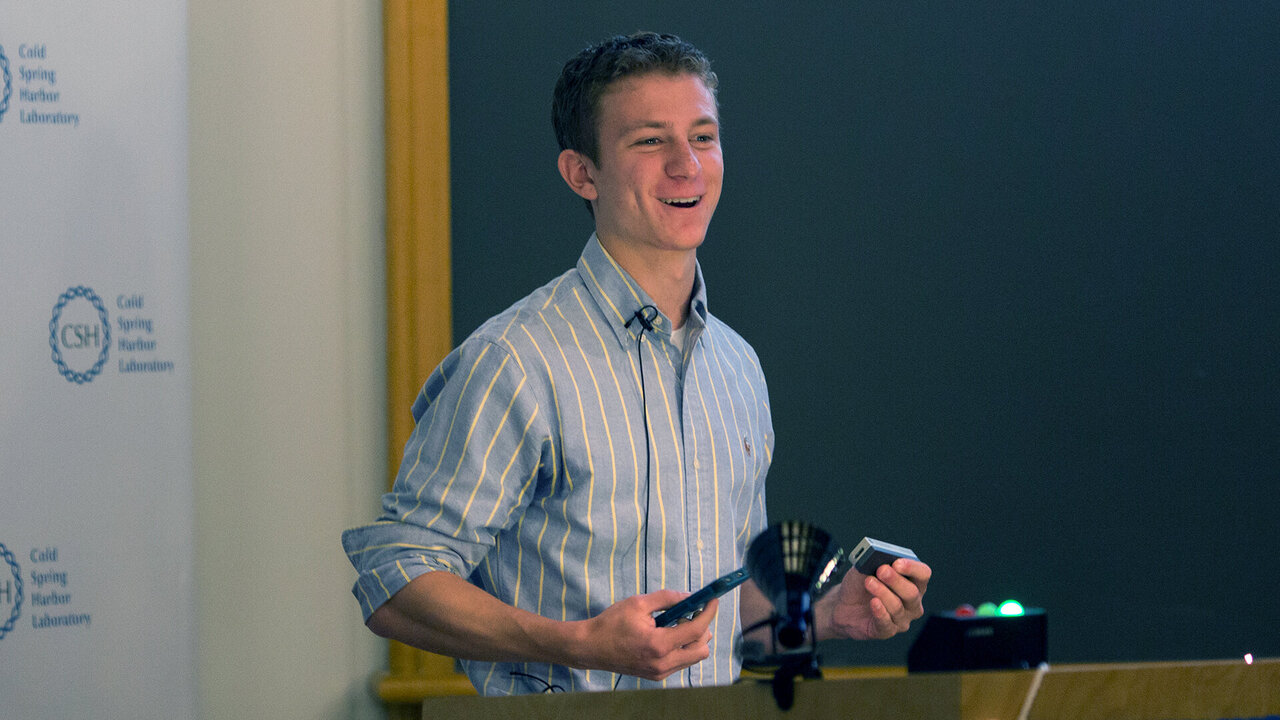
Aspyn Palatnick holding the world’s first mobile genetics laboratory at Cold Spring Harbor Laboratory’s 125th anniversary Open House. The combination of the new iPhone app, iGenomics, a DNA analyzer, and Oxford Nanopore’s USB-sized MinION, a DNA sequencer, make genome analysis portable and accessible. Credit: CSHL

Cold Spring Harbor Laboratory (CSHL) scientists developed the world’s first mobile genome sequence analyzer, a new iPhone app called iGenomics. By pairing an iPhone with a handheld DNA sequencer, users can create a mobile genetics laboratory, reminiscent of the “tricorder” featured in Star Trek. The iGenomics app runs entirely on the iOS device, reducing the need for laptops or large equipment in the field, which is useful for pandemic and ecology workers. Aspyn Palatnick programmed iGenomics in CSHL Adjunct Associate Professor Michael Schatz’s laboratory, over a period of eight years, starting when he was a 14-year-old high school intern.

The iPhone app was developed to complement the tiny DNA sequencing devices being made by Oxford Nanopore. Palatnick, now a software engineer at Facebook, was already experienced at building iPhone apps when joining the Schatz laboratory. He and Schatz realized that:

“As the sequencers continued to get even smaller, there were no technologies available to let you study that DNA on a mobile device. Most of the studying of DNA: aligning, analyzing, is done on large server clusters or high-end laptops.”

Schatz recognized that scientists studying pandemics were “flying in suitcases full of Nanopores and laptops and other servers to do that analysis in the remote fields.” iGenomics helps by making genome studies more portable, accessible, and affordable.

Continue reading… “The world’s first DNA ‘tricorder’ in your pocket”

Human aging process biologically reversed in world first

C8E14048-47A7-4A4D-9905-3D849245A493

The ageing process has been biologically reversed for the first time by giving humans oxygen therapy in a pressurised chamber.

 Scientists in Israel showed they could turn back the clock in two key areas of the body believed to be responsible for the frailty and ill-health that comes with growing older.

As people age, the protective caps at the ends of chromosomes – called telomeres – shorten, causing DNA to become damaged and cells to stop replicating. At the same time, “zombie” senescent cells build up in the body, preventing regeneration.

Increasing telemere length and getting rid of senescent cells is the focus of many anti-ageing studies, and drugs are being developed to target those areas.

Now scientists at Tel Aviv University have shown that giving pure oxygen to older people while in a hyperbaric chamber increased the length of their telomeres by 20 per cent, a feat that has never been achieved before.

Continue reading… “Human aging process biologically reversed in world first”

Revolutionary synthetic DNA disk could hold key to future of storage

940E9331-3C41-4990-A3F1-AD47087971D5

Synthetic DNA could solve the world’s storage problems

 A new proof of concept that would see data stored on synthetic DNA could hold the key to the world’s storage problems. In theory, if the concept is successful, all the world’s accumulated data would fit inside a shoebox.

By 2025, it is estimated that 463 exabytes of data will be produced every day – equivalent to 212,765,957 DVDs – and data center providers are constantly expanding to provide storage for this deluge of information. A single gram of DNA, however, can hold 455 exabytes of information – a fact that has drawn the attention of computer scientists.

Continue reading… “Revolutionary synthetic DNA disk could hold key to future of storage”

CRISPR therapy restores retinal and visual function in mice

68E88ED7-E447-4F66-8CFB-63EF6F8F337D

A breakthrough study, led by researchers from the University of California, Irvine, results in the restoration of retinal and visual functions of mice models suffering from inherited retinal disease.

Published today in Nature Biomedical Engineering, the paper, titled, “Restoration of visual function in adult mice with an inherited retinal disease via adenine base editing,” illustrates the use of a new generation CRISPR technology and lays the foundation for the development of a new therapeutic modality for a wide range of inherited ocular diseases caused by different gene mutations.

Continue reading… “CRISPR therapy restores retinal and visual function in mice”

Researchers reveal a much richer picture of the past with new DNA recovery technique

7071E047-2FE5-4A52-B5F0-4954694658DC

A shot of the Klondike region in the Yukon, where the permafrost samples containing sediment DNA, were collected.

Researchers at McMaster University have developed a new technique to tease ancient DNA from soil, pulling the genomes of hundreds of animals and thousands of plants—many of them long extinct—from less than a gram of sediment.

The DNA extraction method, outlined in the journal Quarternary Research, allows scientists to reconstruct the most advanced picture ever of environments that existed thousands of years ago.

The researchers analyzed permafrost samples from four sites in the Yukon, each representing different points in the Pleistocene-Halocene transition, which occurred approximately 11,000 years ago.

This transition featured the extinction of a large number of animal species such as mammoths, mastodons and ground sloths, and the new process has yielded some surprising new information about the way events unfolded, say the researchers. They suggest, for example, that the woolly mammoth survived far longer than originally believed.

Continue reading… “Researchers reveal a much richer picture of the past with new DNA recovery technique”

CRISPR-based COVID test is rapid, accurate and costs less than $1

1701717C-A9FD-421B-8DB7-CA3017B9BA99

CRISPR’s claim to fame may be gene editing—and turning the scientific community on its head when it first debuted—but it may have another trick up its sleeve.

Recent studies have indicated CRISPR tools have the potential for in vitro diagnostics, something Chinese scientists have leveraged to develop a 100% accurate COVID-19 test that can be mass manufactured for 70 cents.

Continue reading… “CRISPR-based COVID test is rapid, accurate and costs less than $1”

Body fat transformed by CRISPR gene editing helps mice keep weight off

 1EADAD0E-F41D-42CD-AD4B-AE3A61699229

A 3D illustration of brown fat cells, which both burn and store energy

 White fat cells can be turned into energy-burning brown fat using CRISPR gene-editing technology. These engineered cells have helped mice avoid weight gain and diabetes when on a high-fat diet, and could eventually be used to treat obesity-related disorders, say the researchers behind the work.

Human adults have plenty of white fat, the cells filled with lipid that make up fatty deposits. But we have much smaller reserves of brown fat cells, which burn energy as well as storing it. People typically lose brown fat as they age or put on weight. While brown fat seems to be stimulated when we are exposed to cold temperatures, there are no established methods of building up brown fat in the body.

Yu-Hua Tseng at Harvard University and her colleagues have developed a workaround. The researchers have used the CRISPR gene-editing tool to give human white fat cells the properties of brown fat.

Continue reading… “Body fat transformed by CRISPR gene editing helps mice keep weight off”

Discover the Hidden Patterns of Tomorrow with Futurist Thomas Frey
Unlock Your Potential, Ignite Your Success.

By delving into the futuring techniques of Futurist Thomas Frey, you’ll embark on an enlightening journey.

Learn More about this exciting program.