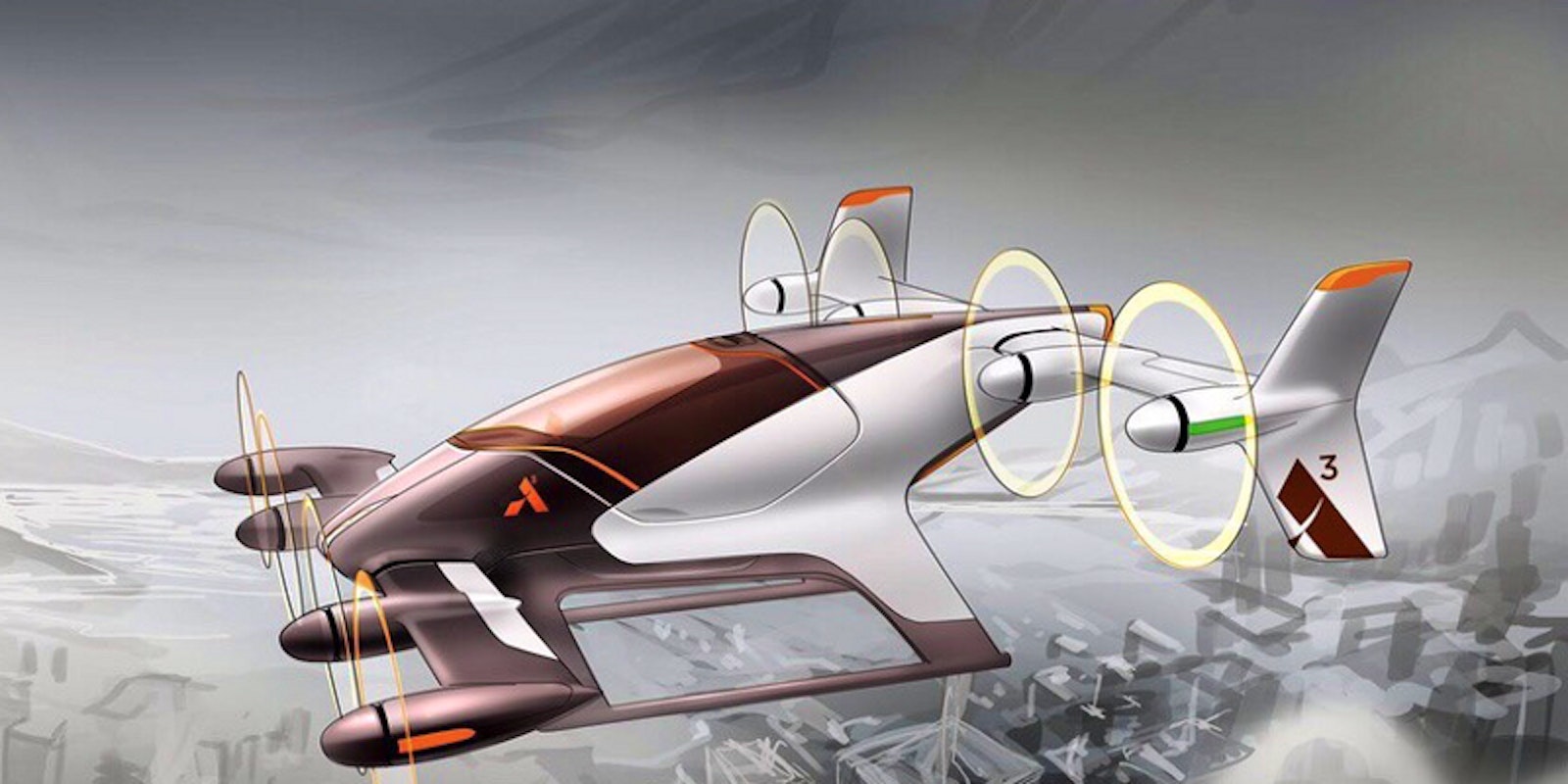
Even as self-driving cars become more and more ubiquitous, there’s one problem that Silicon Valley hasn’t solved: the traffic jam. But Airbus Group, a U.S. aeronautics and space company, thinks that it has a solution. The company’s Silicon Valley branch recently announced it’s been working on a secret project titled “Vahana,” an autonomous flying vehicle that can be used for both passenger and cargo transport.
The artificial intelligence that beat human players in Go can now learn from its own memory. Google’s DeepMind AI, according to its programmers, is now capable of intelligently building on what’s already inside its memory.
Pittsburgh is installing traffic lights controlled by artificial intelligence, and they could be coming to your city soon.
Your commute could get a lot shorter without you even knowing thanks to traffic lights with artificial intelligence brains inside.
Over the past couple years, a startup named Surtrac has been mentally upgrading traffic lights in Pittsburgh with artificial intelligence. These lights collect data on the amount of traffic from cameras and radar signals, and the network of lights coordinates to ensure that all the traffic passes through intersections as fast as possible.
Robots are now just as good at transcribing speech as humans.
According to a paper published yesterday, a team of Microsoft engineers in the Artificial Intelligence and Research division reported their system reached a word error rate (WER) of 5.9 percent, a figure that is roughly equal to that of human abilities.
Stretched, trijet 50-seat configuration to be tested by subscale supersonic demonstrator
Guy Norris Los Angeles
Boom Time
More than half a century after development of the Concorde was launched, progress toward economically viable supersonic airliners has proved elusive. But now a Silicon Valley-backed startup says the ingredients for a successful, small, faster-than-sound airliner are in place, thanks to a new wave of enabling technology and a market primed with the need for speed.
Since first unveiling plans earlier this year for a 40-seat, twin-engine, supersonic transport, Denver-based Boom Technology has revised and fine-tuned the design that will cruise at Mach 2.2 for the same ticket price as subsonic business class. The aircraft has since been stretched to seat up to 50 and is now reconfigured as a trijet to permit immediate use on long overwater routes.
NO, REALLY. AMPUTEES HAVE BEEN TESTING THEM FOR OVER A YEAR
For a full decade, Gudmundur Olafsson was unable to move his right ankle. That’s because it wasn’t there. Olafsson’s amputated lower leg was the delayed casualty of an accident from his childhood in Iceland, when he was hit by an oil truck. “I lived in pain for 28 years,” says Olafsson. “After 50-plus operations, I had it off.” For years after the operation he wore a Proprio Foot, a prosthetic with a motorized, battery-powered ankle, sold by the Reykjavik-based company Ossur.
A London-based startup has combined some of today’s most disruptive technologies in a bid to change the way we’ll build the future. By retrofitting industrial robots with 3D printing guns and artificial intelligence algorithms, Ai Build has constructed machines that can see, create, and even learn from their mistakes.
A 28-year-old man left paralyzed after a car accident has been able to feel as though he was touching something with his fingers after a robotic arm was connected directly to his brain in a world-first breakthrough.
Nathan Copeland, who was injured after crashing his car on a rainy night in Pennsylvania when he was just 18, spoke of experiencing a “really weird sensation” as he touches things.
Graphene just keeps getting better and better. The so-called super material – a one-atom-thick layer of carbon that has proven to be incredibly strong, flexible, light and conductive – has now been fed to larval silkworms which then created “mechanically enhanced silk”.






:format(webp)/cdn1.vox-cdn.com/uploads/chorus_image/image/51358885/KOBI_zomer.0.jpg)