Samsung is making a robot that can pour wine and bring you a drink

By Jacob Kastrenakes

Samsung-is-making-robot-that-can-pour-wine

Sounds great

Samsung is working on a robot that can pick up laundry, load the dishwasher, set the table, pour wine, and even bring you a drink. The robot is called Bot Handy, and Samsung says it’ll be able to recognize objects using a camera and AI.

The bot is meant to be “an extension of you in the kitchen, living room, and anywhere else you may need an extra hand in your home,” Sebastian Seung, president of Samsung Research, said during Samsung’s CES press conference today.

Continue reading… “Samsung is making a robot that can pour wine and bring you a drink”

Pollen Robotics’ humanoid robot can be controlled remotely with VR

Brian Heater


Pollen Robotics turned heads at last year’s CES. After all, a humanoid robot will do that on the show floor (even if it’s only half of one). The French startup is back for this year’s show (insofar as anyone is really back for the show), with some key updates to its robot, Reachy.

Continue reading… “Pollen Robotics’ humanoid robot can be controlled remotely with VR”

Uber and Lyft increase average vehicle ownership in urban areas

by Adam Dove

Uber-Lyft-increase-vehicle-ownership

The landscape of individual transportation has changed drastically since the rise of rideshare apps like Uber and Lyft. Where before, getting from A to B required you to either take public transportation, locate a taxi, or own your own private vehicle, being able to call yourself a ride with the push of a button has made going through life without owning a car much more feasible—and in some cases, even desirable.

In a recent study published in iScience, a team of Carnegie Mellon University researchers led by Jeremy Michalek have set out to quantify effects these transportation network companies (TNCs) have had on urban transportation.

“When we set out to quantify these effects, there were many feasible possibilities for the outcome,” says Michalek, professor of engineering and public policy and mechanical engineering. “For instance, it is possible that when travelers gain access to Uber or Lyft, some of them may choose to own fewer vehicles because they have an alternative way to get around. But on the other hand, it’s also true that some drivers could purchase extra vehicles for ride-hailing work, which could increase vehicle ownership. It wasn’t immediately clear what the net effect would be.”

Continue reading… “Uber and Lyft increase average vehicle ownership in urban areas”

This Flying Car Costs $599K—and It’s Now Street Legal in Holland

By Vanessa Bates Ramirez 

We’ve all had the experience of sitting in bumper-to-bumper traffic with nothing but miles of red taillights ahead, wishing we could somehow break away from the pack and zoom off to our destination traffic-free. Now drivers in the Netherlands are one step closer to making this vision a reality, as a commercial flying car has just been approved for use on roads there.

The car is called the PAL-V Liberty, and it’s made by Dutch company PAL-V. It looks a lot like what you’d probably expect or imagine a flying car to look like: a cross between a small helicopter and a very aerodynamic car (with a foldable propeller on top).

Continue reading… “This Flying Car Costs $599K—and It’s Now Street Legal in Holland”

Researchers Develop World’s Most Powerful Neuromorphic Processor for AI

ByAlex McFarland

Researchers-develop-world's-most-powerful-neuromprphic-processor

In what is a major leap forward in the field of artificial intelligence (AI), an international team of researchers led by Swinburne University of Technology has developed the world’s most powerful neuromorphic processor for AI. It operates at an astonishing rate of more than 10 trillion operations per second (TeraOps/s), meaning it can process ultra-large-scale data.

The work was published in the journal Nature. 

Led by Swinburne’s Professor David Moss, Dr. Xingyuan Xu, and Distinguished Professor Arnan Mitchell from RMIT University, the team accelerated computing speed and processing power. They were able to create an optical neuromorphic processor capable of operating over 1,000 times faster than any previous ones. The system can also process ultra-large-scale images, which is important for facial recognition as previous optical processors have failed in this regard.

Professor Moss is Director of Swinburne’s Optical Sciences Centre, and he was named a top Australian researcher in physics and mathematics in the field of optics and photonics by The Australian.

“This breakthrough was achieved with ‘optical micro-combs,’ as was our world-record internet data speed reported in May 2020,” he said.

Continue reading… “Researchers Develop World’s Most Powerful Neuromorphic Processor for AI”

Tesla’s $25,000 electric car could be coming sooner than we though

Fred Lambert 

tesla's-$25,000-electric-car-coming-sooner
TESLA’S $25,000 ELECTRIC CAR

Tesla’s recently announced $25,000 electric car could be coming sooner than we thought, according to newly unveiled documents about Gigafactory Shanghai.

When talking about what Tesla’s new battery cell and “structural battery pack” architecture could enable at Battery Day last year, CEO Elon Musk announced that Tesla will be making a $25,000 electric car.

Continue reading… “Tesla’s $25,000 electric car could be coming sooner than we though”

These Futuristic Flying Ambulances May Soon Be Zooming Around New York

By Vanessa Bates Ramirez 

Futuristic-Flying-ambulances-zooming-around-new-york

Ambulance use surged in 2020 because of the Covid-19 pandemic, even as emergency medical service providers struggled due to the revenue hit they took from delayed and canceled elective procedures. While we’re fervently hoping that far fewer people will need ambulances this year, there may soon be a whole new means of emergency transportation, at least in New York: flying ambulances.

Israeli aerospace company Urban Aeronautics announced this week that it sold its first four vertical takeoff and landing (VTOL) aircraft to Hatzolah Air, a nonprofit emergency medical air transport provider based in New York. The organization already operates fixed-wing aircraft (meaning propeller-driven or powered by a jet engine, with wings that don’t move) as part of its emergency missions.

To that end, “flying ambulances” isn’t a new concept; they’ve existed for a long time in the form of helicopters and planes. In fact, the Association of Air Medical Services estimates that around 550,000 people get medevaced in the US each year.

But Urban Aeronautics’ Cormorant CityHawk, as the aircraft is called, will bring some functional new features to the skies. Though it’s lightweight and has a compact footprint, its interior cabin is 20 to 30 percent larger than that of a helicopter, meaning it will be able to fit two EMTs, the patient plus a companion, and medical equipment (plus the pilot) without things getting too cramped.

Continue reading… “These Futuristic Flying Ambulances May Soon Be Zooming Around New York”

SCIENTISTS WANT TO SEND A ROBOT MADE OF ICE TO ANOTHER PLANET

VICTOR TANGERMANN

Scientists-want-send-robot-made-of-ice
ICEBOT

A team of researchers at the University of Pennsylvania are trying to figure out if we can send robots that are made out of ice to another planet, IEEE Spectrum reports.

The idea is to create a robot design that can leverage local resources to repair itself in case it ever breaks down.

As detailed in a new paper presented at the IEEE/RSJ International Conference on Intelligent Robots and Systems, the researchers looked a variety of ways of creating robots out of ice by using both additive and subtractive manufacturing processes.

Continue reading… “SCIENTISTS WANT TO SEND A ROBOT MADE OF ICE TO ANOTHER PLANET”

‘Virtual biopsies’ could replace tissue biopsies in future thanks to technique developed by Cambridge scientists

Viral-biopsies-could-replace-tissue-biopsies
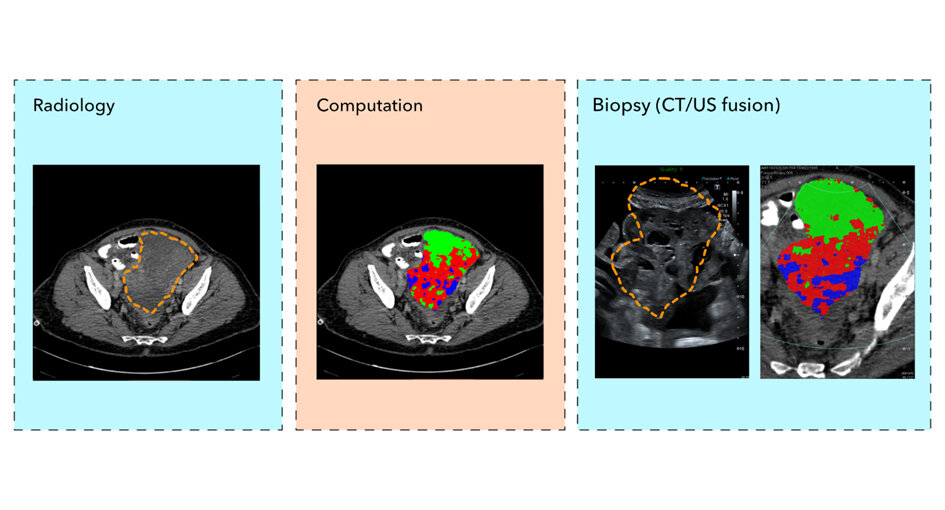
Illustration of a patient with a pelvic tumour. a Routine contrast-enhanced CT images were used to manually segment the pelvic tumour (dashed line). b Spatial radiomic feature extraction and generation of habitat maps. For this patient, three tumour habitats are feasible and highlighted in blue, red, and green, respectively. c The left figure shows the US image with the co-registered CT-based tumour segmentation (dashed line). The right figure shows the CT scan overlaying the US plane, with the habitat maps highlighted in colour. The US images correspond to a different plane orientation with respect to panels a and b Credit: University of Cambridge

A new advanced computing technique using routine medical scans to enable doctors to take fewer, more accurate tumour biopsies, has been developed by cancer researchers at the University of Cambridge. This is an important step towards precision tissue sampling for cancer patients to help select the best treatment. In future the technique could even replace clinical biopsies with ‘virtual biopsies’, sparing patients invasive procedures.

The research published in European Radiologyshows that combining computed tomography (CT) scans with ultrasound images creates a visual guide for doctors to ensure they sample the full complexity of a tumour with fewer targeted biopsies.

Continue reading… “‘Virtual biopsies’ could replace tissue biopsies in future thanks to technique developed by Cambridge scientists”

Tesla’s Autopilot Full Self-Driving Completes Round Trip From San Francisco to Los Angeles PRACTICALLY WITHOUT ANY HUMAN INTERVENTION.

By Jeff Yeung

Footage has surfaced showing a TeslaModel 3 making a round trip between San Francisco and Los Angeles using its Autopilot Full Self-Driving mode.

The video came from YouTube user Whole Mars Catalog, whose entire channel appears to be dedicated to testing Tesla’s Autopilot FSD functionality. According to the channel, the drive was made possible via the latest Beta version of Tesla’s software, and the entire round trip was completed with close to no human intervention at all, except for one scenario where debris had shot up from the road after the car in front passed over it and so the driver had to take control immediately for just one second.

Continue reading… “Tesla’s Autopilot Full Self-Driving Completes Round Trip From San Francisco to Los Angeles PRACTICALLY WITHOUT ANY HUMAN INTERVENTION.”

Study Finds More Than $100 Billion Spent on App Stores in 2020

 by Hartley Charlton

Study-finds-more-than-$100-Billion-app-stores-1

A new report by Sensor Tower reveals that 2020 has been a record-setting year for worldwide spending on the Apple App Storeand Google Play Store, which collectively passed $100 billion in a single year for the first time ever in November.

The trend of increased spending continued over Christmas, when consumers around the world spent an estimated $407.6 million across Apple’s ‌App Store‌ and Google Play. This represents a 34.5 percent year-on-year growth from approximately $303 million in 2019. At the same time in 2019, spending only increased by 17.1 percent year-on-year.

Spending on Christmas day constituted 4.5 percent of December’s total spending so far, which reached nine billion dollars globally on December 27. The majority of holiday spending was on mobile games, which climbed by 27 percent from $232.4 million at the same time last year to $295.6 million.

Continue reading… “Study Finds More Than $100 Billion Spent on App Stores in 2020”

Japanese researchers are developing satellites made of wood

Shane McGlaun 

The number of satellites being put into orbit is always increasing, and many researchers and scientists worldwide fear the amount of space junk that will accumulate in orbit around the Earth. A Japanese company called Sumitomo Forestry is working with researchers from Kyoto University to develop the first satellites made of wood by 2023. Sumitomo Forestry says that it has started research on tree growth and the use of wood materials in space.

The partnership between the company and the University will start by experimenting with different wood types in extreme environments on Earth. According to the partners, wooden satellites would burn up in the atmosphere without releasing harmful substances or raining debris onto the ground. Kyoto University Professor Takao Doi says there is concern that all satellites that reenter the Earth’s atmosphere burn and create tiny alumina particles that float in the upper atmosphere for many years.

Continue reading… “Japanese researchers are developing satellites made of wood”