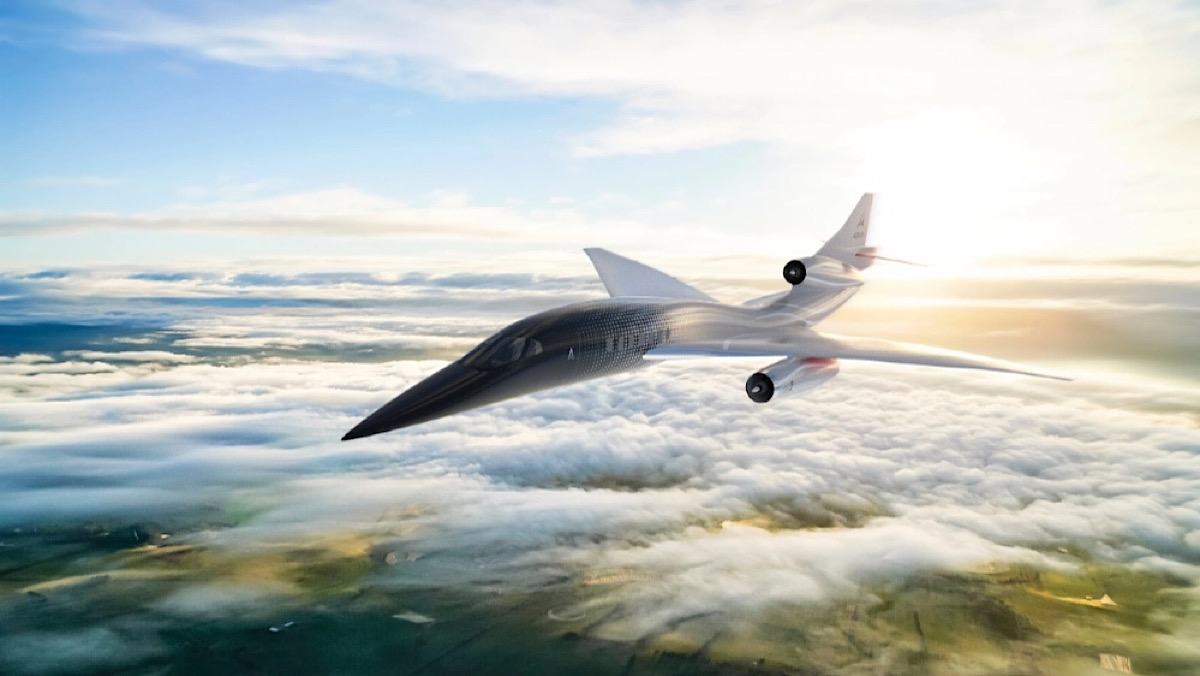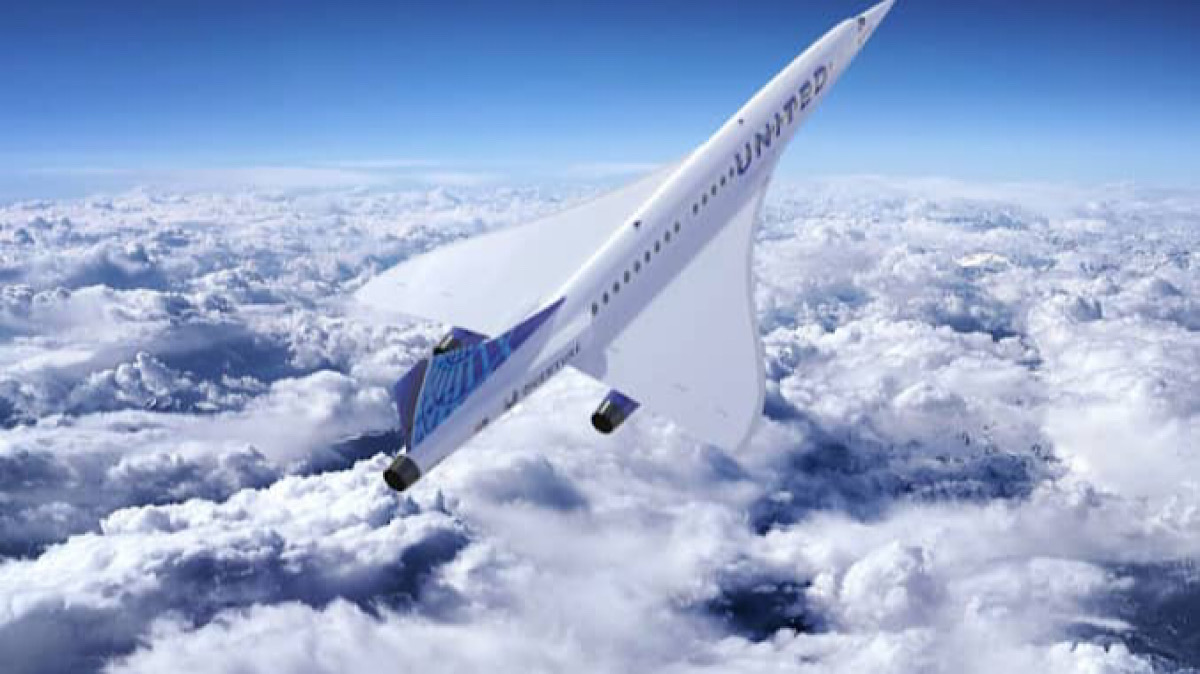
United Airlines will buy 15 ultrafast airplanes from start-up Boom Supersonic

A rendering of a United Supersonic JetSource: United Airlines


Phil LeBeau
@LEBEAUCARNEWS

KEY POINTS

  • The carrier is buying 15 planes from Boom Supersonic with the option to purchase 35 more at some point.  
  • Boom’s first commercial supersonic jet, the Overture, has not been built or certified yet.
  • Boom is targeting the start of passenger service in 2029 with a plane that could fly at Mach 1.7 and cut some flight times in half.

United Airlines is planning to turn the friendly skies into the ultrafast skies with the addition of supersonic jets.

The carrier announced Thursday it’s buying 15 planes from Boom Supersonic with the option to purchase 35 more at some point.  

Boom’s first commercial supersonic jet, the Overture, has not been built or certified yet. It is targeting the start of passenger service in 2029 with a plane that could fly at Mach 1.7 and cut some flight times in half. That means a flight from New York to London that typically lasts seven hours would only take 3½ hours.

Continue reading… “United Airlines will buy 15 ultrafast airplanes from start-up Boom Supersonic”


FAA Takes Steps to Enable a Future of Airborne Drone Deliveries

By Hugo Britt 

It is only a matter of time before the skies above U.S. cities are filled with the buzzing of airborne delivery drones.

With e-Commerce sales increasing by more than 30% between 2019 and 2020 (and an expected 11% increase in 2021), the way we approach our purchases has shifted for good. Delivery methods, too, are undergoing a period of rapid change.

In fact, you might say last mile delivery is up in the air.

Continue reading… “FAA Takes Steps to Enable a Future of Airborne Drone Deliveries”

World First As Human ‘Breast Milk’ Is Created In A Lab

By Rachel Moss

Parents could soon have another option when feeding their babies, because the world’s first human ‘breast milk’ has been formulated in a lab.

A female-led start-up, Biomilq, has successfully created milk from human mammary cells (female breast cells). The company says their milk is the closest ever match to the “macronutrient profile” of the real deal, with the same types of proteins, carbohydrates, fatty acids and bioactive lipids.

The product does lack the antibodies in breast milk straight from the mother, but the company’s co-founder and chief science officer, Dr Leila Strickland, told Forbes: “Even without antibodies, the nutritional and bioactive composition of our product will be much closer to that of breast milk than to bovine-based infant formula… our product will support immune development, microbiome population, intestinal maturation, and brain development in ways that bovine-based infant formula fundamentally cannot.”

They’ve called their product the “world’s first cell-cultured human milk outside of the breast” and say it will be available to buy within the next three years. 

Continue reading… “World First As Human ‘Breast Milk’ Is Created In A Lab”

Roboats: Amsterdam tests out electric autonomous boats on its canals

An electric boat steers close to a full-size replica of the 18th century three-mast trading ship Amsterdam at the National Maritime Museum, in Amsterdam,

By The Associated Press

AMSTERDAM (AP) — Electric cars, meet your competition. Electric boats are on the way.

Amsterdam didn’t have to look very far when searching for a way to ease traffic on its congested streets. The Dutch capital’s canals were used for transport long before cars and trucks powered by polluting internal combustion engines began clogging its narrow roads.

Already steeped in maritime history, the city’s more than 100 kilometers (60 miles) of waterways are to start hosting prototypes of futuristic boats — small, fully-autonomous electric vessels — to carry out tasks including transporting passengers and picking up garbage.

The Amsterdam Institute for Advanced Metropolitan Solutions and the Massachusetts Institute of Technology are collaborating on the Roboat project that aims to develop new ways of navigating the world’s waterways without a human hand at the wheel.

Stephan van Dijk, director of innovation at the Amsterdam institute, said the technology is “very relevant in highly complex port operations, where you have a lot of vessels and a lot of ships and a lot of quays and piers. There you can really improve the safety with autonomous systems, but also make it more efficient and into a 24/7 operations approach.”

At a recent demonstration, one 4-meter (13-foot) long electric boat sailed past a full-size replica of the 18th-century three-mast trading ship Amsterdam, providing a snapshot of the city’s nautical past and its future.

Continue reading… “Roboats: Amsterdam tests out electric autonomous boats on its canals”

At 12 Times Faster Than Sound, World’s Fastest Passenger Plane Begins Model-Testing

By Anupama Ghosh

A US-based start-up is designing a hypersonic space plane that could enable people to travel anywhere around the world in just one hour.

Venus Aerospace, a hypersonic space plane start-up, will begin testing three scale models this summer, Bloomberg reported.

Travel on a space plane may seem like a regular airplane journey till the plane reaches cruising altitude. Once at that altitude, the pilot then enables the rocket boosters and the aircraft zooms to the edge of the space at a lightning speed of more than 9,000 mph or about 12 times the speed of sound.

This is the speed that the plane maintains for the next 15 minutes. Soaring through the atmosphere again, the plane slows down, cruises back to the earth, and lands at its destination airport.

In all probability, the hypersonic space plane to be developed by Venus Aerospace will complete these functions in one hour.

Based in the US, Venus Aerospace was founded by the Duggleby couple, Sarah and Andrew Duggleby in 2020. Sarah worked as a code-writing launch engineer at the Virgin Orbit, while Andrew handled the launch, payload, and propulsion operations at the same organization.

Continue reading… “At 12 Times Faster Than Sound, World’s Fastest Passenger Plane Begins Model-Testing”

China’s New Space Station Is Powered by Ion Thrusters

The country is betting big on electric spacecraft propulsion.

 By VICTOR TANGERMANN

China’s first module of its upcoming Tiangong space station makes use of ion drives, technology that could vastly cut down the time it takes to travel to Mars — and greatly reduce the amount of fuel needed to make that trip, as the South China Morning Post reports.

The module, called Tianhe and launched in late April, is powered by four ion thrusters that use electricity to accelerate ions as a form of propulsion. In fact, the module could soon become the first spacecraft in history to transport humans using the technology, according to SCMP.

Ion drives are orders of magnitude more efficient compared to chemical propulsion. To keep the International Space Station in orbit for a year, the thrusters consume four tons of rocket fuel. With ion thrusters, it’d need just 400 kilograms to stay in orbit for the same amount of time, according to the Chinese Academy of Sciences.

A trip to Mars could be cut down from eight months to just 39 days.

China is betting big on ion thrusters, hoping to use them not just for its space station  but for upcoming satellite constellations and nuclear-powered spacecraft capable of carrying astronauts to Mars as well, according to SCMP.

Continue reading… “China’s New Space Station Is Powered by Ion Thrusters”

Rocket Delivery Of Cargo Anywhere In An Hour In New Air Force Budget Proposal

Next year, the Air Force wants to test a way to move a C-17’s worth of cargo, and potentially personnel, extremely quickly to any location on Earth.

BY JOSEPH TREVITHICK

The U.S. Air Force has released new details about its questionably ambitious plans to develop a capability to send payloads weighing up to 100 tons, including cargo and potentially personnel, roughly equivalent to the maximum load of a C-17 airlifter, anywhere in the world within one hour via a space launch rocketor derivative thereof. The service now wants to demonstrate the basic feasibility of this concept in a real end-to-end test next year. 

This and other information is contained in the service’s proposed budget for the 2022 Fiscal Year, which includes a request for nearly $48 million in additional funding for this program. This is an almost five-fold increase over the funding it received for this project for the current fiscal cycle. The Air Force 2022 Fiscal Year budget request, which was released on May 28, 2021, as part of the larger proposed budget for the U.S. military as a whole for that fiscal cycle, also identified the blandly-titled Rocket Cargo program as one of the service’s “Vanguard” efforts. The service first unveiled the concept of Vanguard Programs, a way to identify advanced research and development efforts of particularly high interest, last year. Rocket Cargo is the fourth Vanguard, with the others being the Skyborg initiative to develop an artificial intelligence-driven “computer brain” able to fly various types of future unmanned aircraft, the Golden Horde networked swarming munitions project, and the Navigation Technology Satellite 3 (NTS-3) effort.

Continue reading… “Rocket Delivery Of Cargo Anywhere In An Hour In New Air Force Budget Proposal”

US Air Force To Use Autonomous Flying Cars to Pick Up The Injured

The US Air Force’s flying car

By  Fabienne Lang

Using flying cars and eVTOLs could drastically change the way the U.S. Air Force operates in the future.

They could immensely assist medevac situations, for instance, as they could act as flying ambulances by autonomously flying to a remote airfield, landing vertically so that an injured troop member could hop aboard, strap into its wearable technologies to monitor their condition, and fly off to a site where the person can be safely looked after.

That’s one of the visions that the U.S. Air Force’s deputy chief of staff for strategy, integration, and requirements, Lt. Gen. S. Clinton Hinote, has for the future of the flying car, reported Military.com.

Not only could the flying car save lives, but it could also do so while minimizing the Air Force’s carbon footprint, and while saving the Air Force carting heavy fuel around for its aircraft and cars. They could be used to transport VIPs or during National Guard missions for firefighting, people recovery, search and rescue, and aeromedical evacuation, said Hinote.

On top of that, it would enable people to be picked up from hard-to-reach sites, something that’s integral for the Air Force, not only because air fields and runways are targets for enemy fire, but also because sometimes troops are sent far and wide to remote areas. Typically helicopters have done the job in those areas, but again, they have relied on fuel. 

Continue reading… “US Air Force To Use Autonomous Flying Cars to Pick Up The Injured”

HACKROD UNVEILS WORLD’S FIRST VIRTUAL REALITY-DESIGNED, AI-ENGINEERED, 3D-PRINTED CAR

Cali-based digital manufacturing company Hacked has partnered with Siemens PLM software to create the world’s first car designed in virtual reality, engineered with AI and 3D printed, full size, in structural alloy.

The ‘La Bandita’ speedster is intended to serve as proof of concept for an entirely new industrial design to production methodology. Hackrod’s factory of the future, powered by the Siemens Digital Innovation Platform, will enable individuals, start-ups and small enterprises the unprecedented capability to create the product or their needs or dreams as easily as playing a video game.

With multiple tools from Siemens PLM Software including NX software, and the new cloud-based collaboration software Solid Edge Portal, Hackrod has access to the latest design and engineering tools to rapidly design, test and manufacture transport solutions without the need for massive industrial infrastructure or tooling budgets.

Hackrod is developing a platform to enable truly bespoke aesthetic design to prevail with guaranteed engineering solutions. Their platform leverages virtual reality as a design tool, IoT and machine learning to constantly evolve and perfect engineering systems, and industrial 3D printing to produce optimized hardware.

Continue reading… “HACKROD UNVEILS WORLD’S FIRST VIRTUAL REALITY-DESIGNED, AI-ENGINEERED, 3D-PRINTED CAR”

China Boasts Successful Nuclear Fusion

By Irina Slav 

Chinese media have reported that researchers working on a nuclear fusion project have succeeded in holding plasma of 120 million degrees Celsius for close to two minutes.

Chinese daily Global Times reports that the so-called artificial sun as the Chinese nuclear fusion project is known also succeeded in maintaining plasma at 160 million degrees Celsius for 20 seconds.

These times, while not very long in absolute terms, are records in the quest for nuclear fusion. The next step would be to maintain these temperatures for as long as a week, according to a physics professor from the Southern University of Science and Technology in Shenzhen.

China’s nuclear fusion reactor first madeheadlines in 2019 when Beijing said it would soon begin operations. The reactor—the HL-2M Tokamak—was first powered at the end of last year, and its first achievement was maintaining a temperature of 100 million degrees Celsius for 100 minutes.

Continue reading… “China Boasts Successful Nuclear Fusion”

China’s “Artificial Sun” Fusion Reactor Just Set a World Record

The reactor got more than 10 times hotter than the core of the Sun. 

By TONY TRAN

Is it hot in here, or is it just the fusion reactor? 

China broke a record with its Experimental Advanced Superconducting Tokamak (EAST) fusion reactor on Friday when it sustained a plasma temperature of 120 million degrees Celsius for 101 seconds, according to the state-run outlet GlobalTimes. The reactor was also able to sustain a temperature of 160 million degrees Celsius for 20 seconds.

For perspective, the core of our solar system’s Sun “only” reaches about 15 million degrees Celsius, according to Space.com. So, for a moment, EAST got more than 10 times hotter than that.   

This marks a big milestone for the EAST reactor, which has been dubbed the “artificial Sun” for its ability to replicate the natural nuclear fusion process of stars. Doing so could help unlock the mystery to creating sustainable, reliable fusion power.

Continue reading… “China’s “Artificial Sun” Fusion Reactor Just Set a World Record”

Botswana begins medical drone delivery service to prevent maternal deaths

By Ishveena Singh 

This month, Botswana became the first country in southern Africa, and the third in Africa, to begin the use of medical delivery drones. Their aim? To bring down maternal mortality by delivering life-saving health supplies to hard-to-reach communities in a timely manner.

The initiative, called “Drones for Health,” has been made possible through a collaboration between Botswana’s Ministry of Health and Wellness, Botswana International University of Science and Technology (BIUST), and the United Nations Population Fund (UNFPA).

Unlike Ghana and Rwanda, where US-based drone company Zipline has been delivering on-demand medical supplies to remote areas, the drone delivery ecosystem platform for Botswana has been developed in partnership with Dutch drone engineering company Avy.

The Avy Aera drone can travel a distance of 100 km on a single charge, carrying cargo weighing up to 2 kg. An uber-cool, interactive flight simulation page will show you three drones taking off from a BIUST drone port and flying to different communities of Botswana.

Continue reading… “Botswana begins medical drone delivery service to prevent maternal deaths”