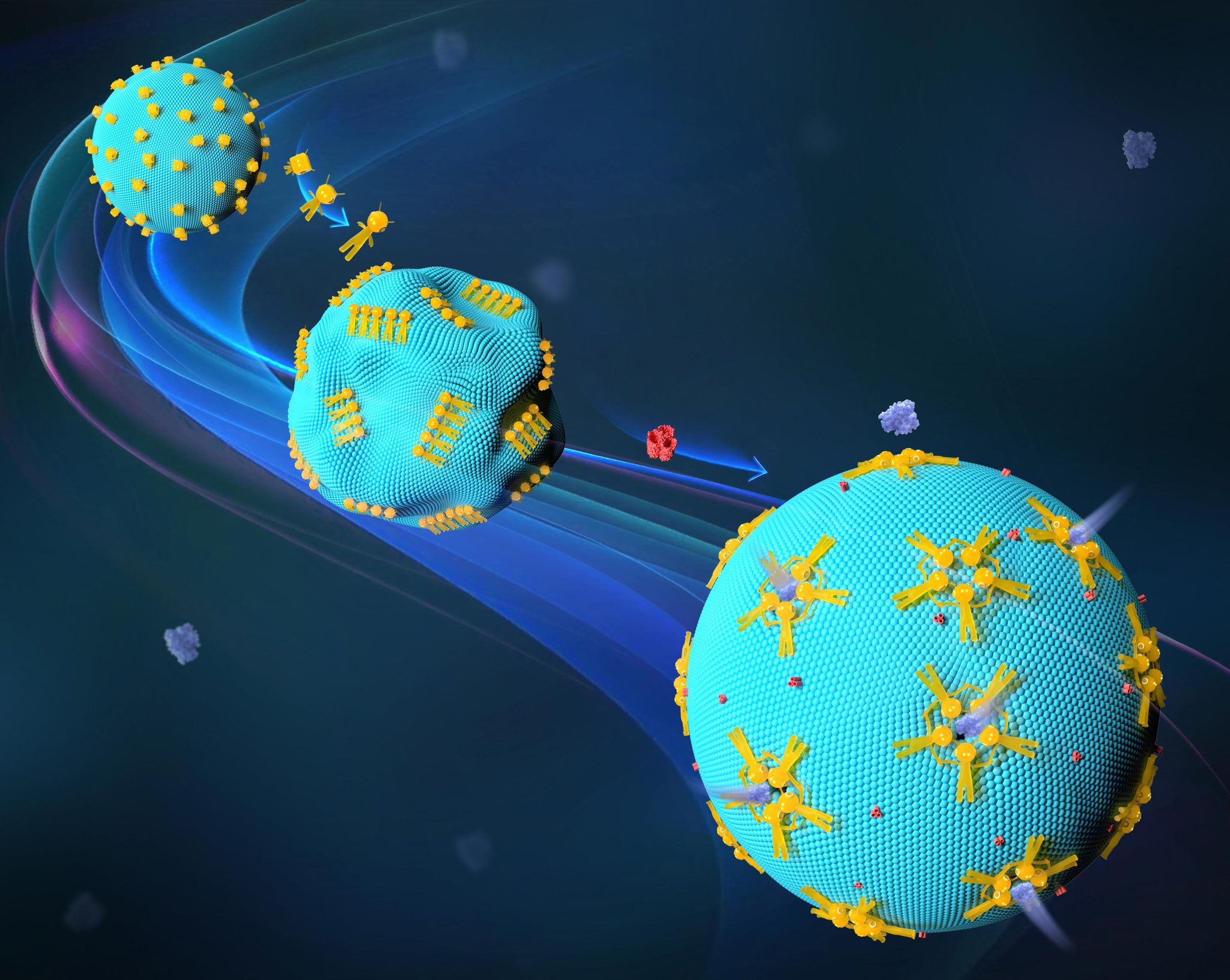
A research team at Northwestern University has achieved a groundbreaking milestone in chemistry by creating the world’s first two-dimensional (2D) mechanically interlocked material. This nanoscale innovation, resembling the interlocking links of chainmail, demonstrates exceptional flexibility and strength, offering great potential for applications in lightweight, high-performance body armor and other advanced uses requiring both toughness and flexibility. The findings, published on January 16 in Science, establish key firsts in the field, including the creation of the first-ever 2D mechanically interlocked polymer and the achievement of an unprecedented density of 100 trillion mechanical bonds per square centimeter.
The new material is a result of an innovative, efficient, and scalable polymerization process, opening the door for large-scale production. “We made a completely new polymer structure,” said William Dichtel, the corresponding author of the study and a professor of chemistry at Northwestern University. “It’s similar to chainmail in that it cannot easily rip because each of the mechanical bonds has a bit of freedom to slide around. If you pull it, it can dissipate the applied force in multiple directions.”
Continue reading… “Breakthrough in Chemistry: First 2D Mechanically Interlocked Material Created by Northwestern Researchers”