Researchers turn 5G networks into wireless power grids for IoT

Shane McGlaun – Mar 26, 2021, 8:08am CDT

Researchers from the Georgia Institute of Technology have come up with a novel method of tapping into the over-capacity of 5G mobile networks. The new technique turns the 5G network into a wireless power grid able to power small Internet of Things (IoT) devices that currently require batteries to operate. In many of these small devices, the battery prevents the miniaturization of the devices to smaller scales.

Georgia Tech researchers developed a flexible Rotman lens-based rectifying antenna system capable of harvesting millimeter-wave in the 28 gigahertz band for the first time. A Rotman lens is critical for beamforming networks and is typically used in radar surveillance systems for viewing targets in multiple directions without physically moving the antenna. To create the system able to harvest enough power to run low-power devices at long ranges, larger aperture antennas are required.

The challenge with larger aperture antennas is that they have a narrow field of view, limiting their operation if the antenna is widely dispersed from the 5G base station. Project researchers solved that problem by looking from only one direction with a system that has a wide-angle of coverage. The team says that current 5G networks were built for high-bandwidth communication. The high-frequency network holds an opportunity to harvest unused power that would otherwise be wasted.

Continue reading… “Researchers turn 5G networks into wireless power grids for IoT”

Samsung Electronics launches drone deliveries in Ireland

By Park Eel-kyung & Kim Tae-gyu, UPI News Korea

SEOUL, March 26 (UPI) — Samsung Electronics has launched drone delivery service of smartphones and other digital gadgets within minutes of an order in Ireland.

The company said Wednesday it launched the new service this week in Oranmore, some 125 miles west of Dublin, through a partnership with Ireland’s Manna Drone Delivery.

When customers make an online order via Samsung’s Irish website, a drone will fly at a speed of 35 mph to reach homes in Oranmore within three minutes, according to Samsung.

Available through the service are such products as the Galaxy S21 Ultra, the Galaxy Buds Pro, the Galaxy Tab S7, the Galaxy Watch 3 and Galaxy A series phones.

Samsung aims to expand the service across Ireland for now.

Continue reading… “Samsung Electronics launches drone deliveries in Ireland”

The clothes we wear are about to undergo a wild digital revolution

BY JARED LINDZON

Imagine an article of clothing that could tell your washing machine how to keep its colors from fading. Imagine a piece of clothing that could warm your body in the winter and cool it down in the summer. Imagine wearing clothes that weren’t designed last year, or last season, but yesterday, in response to that day’s buying patterns. Imagine being able to fully customize every article of clothing in your wardrobe for the same cost as mass-produced items.

And imagine a clothing industry that could do all of this while significantly reducing emissions and retaining most of its workforce.

Thanks to new advancements in manufacturing, you won’t have to imagine forever. While the clothing we wear today is largely designed, manufactured, and sold in the same way it was 100 years ago, what we wear is expected to change dramatically in the not-so-distant future, thanks to advancements in manufacturing technology.

Continue reading… “The clothes we wear are about to undergo a wild digital revolution”

Supercharged soil could pull carbon right out of the air

A simple seed treatment could drastically increase the amount of atmospheric carbon captured by crops, and store it underground for longer

By DELLE CHAN

Fundamentally, two of the world’s most pressing challenges, climate change and soil degradation, boil down to a simple imbalance: there is too much carbon in the air, and not enough in the ground. And for Guy Hudson and Tegan Nock, the solution is patently obvious.

The duo are the co-founders of Soil Carbon Co, an Australian agritech startup specialising in what it terms “microbe-mediated carbon sequestration” ­– a method of removing carbon from the atmosphere via microbial fungi and bacteria. The technology in question? A biological treatment applied to seeds that converts atmospheric carbon into a more stable compound which can then be stored deep in the ground – potentially for centuries.

Continue reading… “Supercharged soil could pull carbon right out of the air”

Robotic Arms Build Roads by Binding Asphalt with Strings

EMPA’s robotic arm laying a string layer

By  Chris Young

The new method sees stacked layers of string and asphalt create more sustainable roads.

A team of researchers in Switzerland has demonstrated how a robotic arm can lay patterns of string to bind asphalt together for a more sustainable roadbuilding process, a New Atlas report explains.

The method would remove the need for environmentally damaging bitumen, and would also make it easier to recycle road materials.

Researchers at the Swiss Federal Laboratories for Materials Science and Technology (Empa) got the idea from an art and science project that created pillars using a mix of gravel and string, an EMPA press release explains.

The pillars were made by interlocking gravel with a thread that held the structures together. They reached heights of 80 cm (2.6 ft), and in pressure testing, they were shown to withstand loads equal to 20 tonnes (22 tons).

The scientists used this project as a starting point. For their research, however, they used string to reinforce layers of road asphalt. If they find a way to scale the method, it could provide a great environmental advantage over the use use of bitumen, which is extracted from crude oil.

Continue reading… “Robotic Arms Build Roads by Binding Asphalt with Strings”

P&G Closer to Customizing Drug Tablets Thanks to 3D Printing

A new study by P&G researchers shows how personalized medicine can leverage 3D printing

By Vanesa Listek

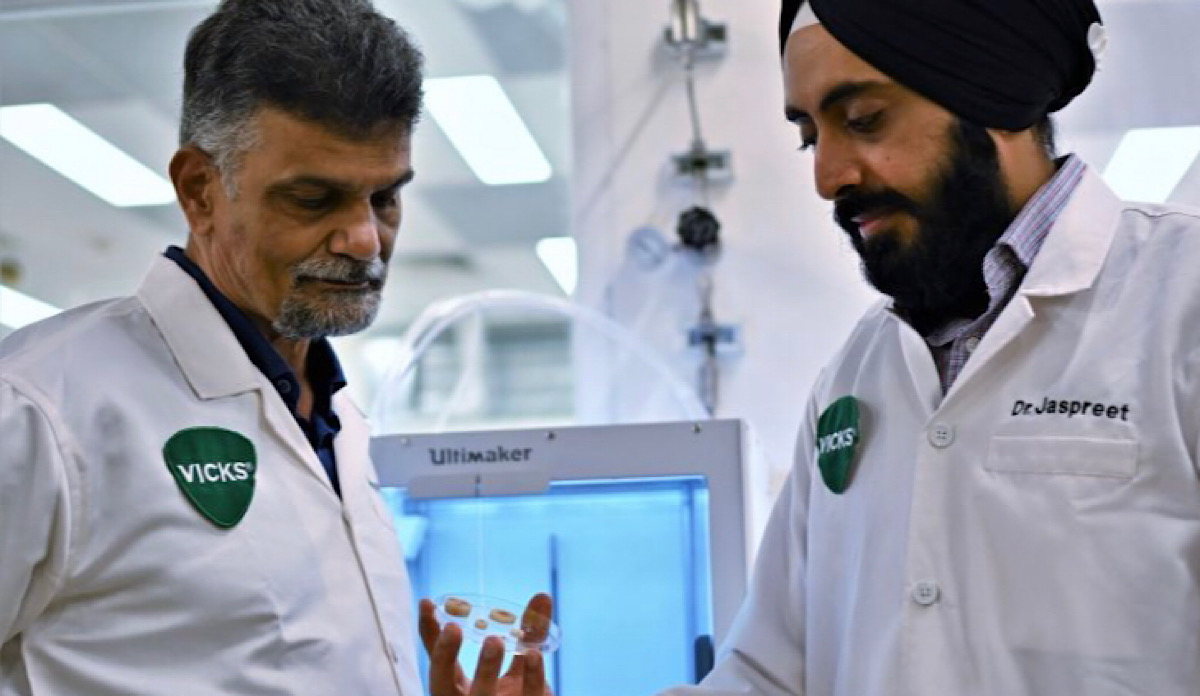
American multinational Procter and Gamble(P&G) is breaking ground in personalized medicine. Committed to delivering consumer-centric creations, researchers at the company’s Singapore Innovation Center (SgIC) have teamed up with the National University of Singapore and the A*STAR – Agency for Science, Technology, and Research, to develop 3D printed customized drug tablets with specific dosages, release durations, and multiple drug combinations. In a new study published in Elsevier’s Journal of Controlled Release, the researchers show a simple, low-cost, and efficient 3D printing method for fabricating bespoke drug pills that are safe for consumption. In the future, this technology could enable broader access to personalized medicine and better treatments for patients, specifically designed for their particular physiology and needs.

For years, there has been growing interest in personalized medicine, which could help overcome the limitations of traditional “trial-and-error” treatment and offer more effective medications for individual patients. In fact, the impressive success of targeted therapies on cancer and several chronic medical conditions is a testament to the possibilities for this emerging healthcare approach. Individualized drug therapies could even disrupt current drug manufacturing protocols for large batch productions and could eventually reduce healthcare costs by addressing the underlying causes of medical problems immediately – in a preventive way.

Continue reading… “P&G Closer to Customizing Drug Tablets Thanks to 3D Printing”

China Turns To Virtual Reality (VR) Technology To Hone Combat Skills Of Its Soldiers

PLA soldiers at a VR-assisted combat training session.

By Mansij Asthana

China has started training its military personnel with the help of virtual reality (VR) technologies to increase their combat capabilities, according to reports.

VR refers to a computer-generated simulation in which a participant can interact within an artificial three-dimensional environment with the help of electronic devices.

VR devices include specially-made goggles that have a screen-display and gloves fitted with sensors.

This enables the participant to have a realistic experience while carrying out activities under a simulated environment.

In virtual reality, the software used by developers creates a virtual or simulated environment that can be experienced by participants who wear the hardware devices like VR goggles, headphones, and gloves.

While the use of virtual reality has been quite common in video games and other recreational activities, there has been an increasing utilization of the technology in the military domain as well.

Continue reading… “China Turns To Virtual Reality (VR) Technology To Hone Combat Skills Of Its Soldiers”

This Y Combinator startup is taking lab-grown meat upscale with elk, lamb and Wagyu beef cell lines

By Jonathan Shieber

Last week a select group of 20 employees and guests gathered at an event space on the San Francisco Bay, and, while looking out at the Bay Bridge, dined on a selection of choice elk sausages, Wagyu meatloaf and lamb burgers — all of which were grown from a petri dish.

The dinner was a coming out party for Orbillion Bio, a new startup pitching today in Y Combinator’s latest demo day, that’s looking to take lab-grown meats from the supermarket to high-end, bespoke butcher shops.

Instead of focusing on pork, chicken and beef, Orbillion is going after so-called heritage meats — the aforementioned elk, lamb and Wagyu beef to start.

By focusing on more expensive-end products, Orbillion doesn’t have as much pressure to slash costs as dramatically as other companies in the cellular meat market, the thinking goes.

But there’s more to the technology than its bougie beef, elite elk and luscious lamb meat.

“Orbillion uses a unique accelerated development process producing thousands of tiny tissue samples, constantly iterating to find the best tissue and media combinations,” according to Holly Jacobus, whose firm, Joyance Partners, is an early investor in Orbillion. “This is much less expensive and more efficient than traditional methods and will enable them to respond quickly to the impressive demand they’re already experiencing.”

Continue reading… “This Y Combinator startup is taking lab-grown meat upscale with elk, lamb and Wagyu beef cell lines”

TINY ROBOTS CAN NOW SMUGGLE DRUGS INTO BRAIN TUMORS

The future of cancer treatment may be robot-delivered.

By Jay Sprogell

THE FUTURE OF MEDICINE is going to be hand-delivered — but not by mail carriers. Instead, life-saving drugs will be parceled, smuggled, and transported in the body via tiny, self-propelled microbots.

In a study published Wednesday in the journal Science Robotics, a research team in China designed a new kind of bio-hybrid microbot that uses clever biological disguises to get even closer to the source of disease in the body in order to provide the most targeted (and effective) treatment.

The target of choice? Hard to treat illness epicenters like brain tumors.

Continue reading… “TINY ROBOTS CAN NOW SMUGGLE DRUGS INTO BRAIN TUMORS”

Scientists will test the world’s first nuclear fusion reactor this summer

The International Thermonuclear Experimental Reactor (ITER) will, if things go according to plan, move one step closer to becoming the world’s first functioning nuclear fusion reactor this summer when scientists conduct its inaugural test runs.

Nuclear fusion has, traditionally, been used as the core scientific principle behind thermonuclear warheads. But the same technology that powers our weapons of mass destruction could, theoretically, be harnessed to power our cities. This would be the first fusion reactor capable of producing more energy than it takes to operate.

If we can build and operate fusion reactors safely, we could almost certainly solve the global energy crisis for good. But that’s a big if.

Continue reading… “Scientists will test the world’s first nuclear fusion reactor this summer”

The Battery That Will Finally Unlock Massless Energy Storage

It could revolutionize electric vehicles and aircraft.

By Caroline Delbert 

  • Scientists have made a massless structural battery 10 times better than before.
  • The battery cell performs well in structural and energy tests, with planned further improvements.
  • Structural batteries reduce weight and could revolutionize electric cars and planes.

In groundbreaking new research, scientists have made a structural battery 10 times better than in any previous experiment. 

What’s a structural battery, and why is it such a big deal? The term refers to an energy storage device that can also bear weight as part of a structure—like if the studs in your home were all batteries, or if an electric fence also held up a wall.

In the new paper, researchers from Chalmers University of Technology and KTH Royal Institute of Technology in Sweden reveal how their “massless” structural battery works.RELATED STORYIs the World Ready for the EV Battery Boom?

The main use case is for electric cars, where a literally massive amount of batteries take up a ton of room and don’t contribute to the actual structure of the car. In fact, these cars must be specially designed to carry the mass of the batteries. But what if the frame of the car could hold energy? “Due to their multifunctionality, structural battery composites are often referred to as ‘massless energy storage’ and have the potential to revolutionize the future design of electric vehicles and devices,” the researchers explain. 

Continue reading… “The Battery That Will Finally Unlock Massless Energy Storage”

Ultrasound Imaging Technique Allows Scientists To Read Minds

The team successfully tested the method on non-human primates and read out their brains’ intentions.

By  Fabienne Lang 

A new type of brain-machine interface (BMI) that’s minimally invasive can read out the brain’s intentions using ultrasound technology. 

A collaborative team of researchers at Caltech developed the system that can read brain activity corresponding to the planning of movement. 

The team’s study was published in the journal Neuron on Monday 22 March.

Neuroscientists working on BMIs in order to map out the brain’s activity to corresponding movements will be having a field day thanks to this new study. Typically, these devices read and interpret brain activity and link it up to a computer or machine. 

However, these devices typically require invasive brain surgery, which many patients aren’t willing to partake in. 

The news of this new technology, which uses functional ultrasound (fUS) technology accurately maps out neural activity from its source deep within the brain at a resolution of 100 micrometers. 

Continue reading… “Ultrasound Imaging Technique Allows Scientists To Read Minds”