Baidu’s Ernie Bot Surpasses 100 Million Users, Igniting AI Chatbot Competition

In a groundbreaking development within the artificial intelligence (AI) realm, Baidu, the Chinese tech giant, proudly announced that its AI creation, Ernie bot, has achieved an extraordinary milestone by attracting over 100 million users. This revelation sparked a 3% surge in Baidu’s U.S. shares, highlighting the increasing significance of AI-driven products in the tech industry. As Ernie bot steps into the ring with its rival, ChatGPT, backed by Microsoft, the competition in the AI chatbot space takes center stage.

Ernie Bot’s Phenomenal Growth

Ernie bot, Baidu’s AI brainchild, has achieved an impressive feat, garnering a user base that has crossed the 100 million mark. Unlike ChatGPT, which reported 100 million weekly active users in November, Baidu did not specify whether Ernie bot’s user numbers represent active users or are cumulative. This ambiguity adds intrigue to Ernie bot’s success story, leaving industry observers eager to unravel the specifics of its user engagement.

Continue reading… “Baidu’s Ernie Bot Surpasses 100 Million Users, Igniting AI Chatbot Competition”


Pluri’s Revolutionary Approach: Transforming the Future of Meat Production and Sustainability

Pluri has successfully navigated obstacles by leveraging two decades of experience in cell expansion, integrating nature’s wisdom into biotechnology to drive innovation beyond limits. Yanay, an expert in the field, emphasizes Pluri’s unique strategy: observing and replicating nature’s wisdom rather than reinventing the wheel. Pluri’s cell scaffolding approach, mimicking the tissue environment, sets it apart from conventional technologies, leading to over 140 granted patents for cell expansion.

The cultivation of meat holds profound implications for sustaining a rapidly growing population and protecting the environment. With global meat consumption reaching 360 million tonnes annually, traditional animal farming’s environmental impact is alarming, consuming a third of habitable land and freshwater. The looming challenge of a forecasted 9.3 billion population by 2050, coupled with climate change exacerbating food insecurity, paints a dire picture. To meet the escalating demand, a 60% increase in food production by 2050 is required, as per the UN Food and Agriculture Organization.

Continue reading… “Pluri’s Revolutionary Approach: Transforming the Future of Meat Production and Sustainability”

Raytheon’s Cutting-Edge Mission: High-Power Microwave Antenna Systems for Rapid Airborne Threat Defense

Raytheon, a subsidiary of RTX, has secured a crucial role in national defense by being tasked with designing, building, and testing advanced high-power microwave antenna directed-energy systems for the Pentagon. The announcement, made by RTX, emphasizes the critical capabilities of these antennae, which are set to track and engage various airborne threats at the speed of light. Notably, these systems are engineered to be rugged and transportable, facilitating swift front-line deployment wherever needed.

Directed Energy Front-line Electromagnetic Neutralization and Defeat (DEFEND)

Under a $31.3 million contract awarded by the Naval Surface Warfare Center Dahlgren Division, Raytheon is committed to delivering prototype equipment to both the U.S. Navy and Air Force. This initiative falls under the umbrella of the Directed Energy Front-line Electromagnetic Neutralization and Defeat (DEFEND) program, spanning a three-year agreement.

Continue reading… “Raytheon’s Cutting-Edge Mission: High-Power Microwave Antenna Systems for Rapid Airborne Threat Defense”

Lenovo’s Latest Innovation: A 27-Inch 4K Monitor Redefining 3D Content Rendering

Lenovo has unveiled its cutting-edge 27-inch 4K monitor, the ThinkVision 27 3D, showcasing an impressive glasses-free 3D rendering capability. Premiered at IFA 2023, this revolutionary monitor leverages a combination of proprietary hardware and software technologies, projecting distinct images to each eye to create a captivating 3D effect that brings visual content to life.

The ThinkVision 27 3D features a switchable lenticular lens and real-time eye-tracking technology, complemented by the accompanying 3D Explorer software. This software includes a 3D player and a Software Development Kit (SDK), providing content creators, particularly 3D graphic designers and developers, with the tools to craft immersive 3D applications.

Continue reading… “Lenovo’s Latest Innovation: A 27-Inch 4K Monitor Redefining 3D Content Rendering”

Jeff Bezos’ Monumental Vision: The 10,000-Year Clock in West Texas

In a visionary endeavor, Jeff Bezos, the founder of Amazon and the world’s wealthiest retailer, is investing $42 million to create a clock that will endure for 10,000 years. Nestled inside a mountain in West Texas, the 10,000-Year Clock is designed to tick once a year, bong once a century, and cuckoo once a millennium, symbolizing long-term thinking and our responsibility to the future.

This mechanical marvel utilizes the Earth’s thermal cycles to power itself, featuring components such as a solar synchronizer, a pendulum, a chime generator, and various gears and dials. Towering at 500 feet, the clock spans the entire height of the mountain and is synchronized with the sun daily, tracking the year, century, and millennium. With a chime generator producing over 3.5 million unique bell chime sequences, the clock guarantees that each day’s soundscape is distinct.

Continue reading… “Jeff Bezos’ Monumental Vision: The 10,000-Year Clock in West Texas”

Honeybee Robotics Proposes LUNARSABER: Illuminating Lunar Outposts with a Towering Innovation

In the ongoing quest for lunar exploration and eventual human settlement, companies and startups are actively contributing ideas for essential facilities on the Moon. U.S.-based Honeybee Robotics has put forth an innovative proposal named LUNARSABER, envisioning a 100-meter-tall (~328-feet) lamp-post-like tower to illuminate the Moon’s outpost surroundings during nighttime. This groundbreaking infrastructure could extend operational hours for both human and robotic missions on the lunar surface.

LUNARSABER, an acronym for Lunar Utility Navigation with Advanced Remote Sensing and Autonomous Beaming for Energy Redistribution, is part of DARPA’s ambitious 10-year Lunar Architecture (LunA-10) effort. DARPA’s program seeks integrated concepts that efficiently transport fewer materials to the Moon, encouraging companies to merge various systems into a single compact technology rather than designing separate systems for specific needs. Fourteen companies, including Honeybee Robotics, have presented inventive concepts addressing challenges in lunar transit, mobility, energy, communications, and infrastructure.

Continue reading… “Honeybee Robotics Proposes LUNARSABER: Illuminating Lunar Outposts with a Towering Innovation”

Carbon Nitrides: A Diamond-Rivaling Discovery with Multifunctional Potential

Scientists from the University of Edinburgh, in collaboration with experts from the University of Bayreuth, Germany, and the University of Linköping, Sweden, have made a groundbreaking discovery of a new ultra-tough material called carbon nitrides. This material has surpassed the hardness of cubic boron nitride, previously the second hardest substance after diamonds.

The team, led by the Centre for Science at Extreme Conditions at the University of Edinburgh, uncovered these carbon nitride materials, exhibiting properties that have been the subject of material science aspirations since the 1980s due to their hardness comparable to diamonds. Dr. Dominique Laniel, a Future Leaders Fellow at the University of Edinburgh, expressed astonishment at producing materials that researchers have been dreaming of for decades and emphasized their potential industrial applications.

Continue reading… “Carbon Nitrides: A Diamond-Rivaling Discovery with Multifunctional Potential”

Brainoware: Human Brain Cell ‘Mini-Brains’ Show Basic Speech Recognition in AI Experiment

In a groundbreaking experiment, researchers at Indiana University Bloomington have demonstrated a basic form of speech recognition using organoids—clusters of human brain cells connected to a computer. The potential advantage of such systems is their anticipated lower energy consumption for AI tasks compared to traditional silicon chips. Feng Guo, leading the study, acknowledges that this is a proof-of-concept and emphasizes the considerable distance yet to be covered.

Organoids: Mini-Brains and Brainoware System: Brain organoids, resembling mini-brains, are created by growing nerve cells from stem cells under specific conditions. The resulting organoids, a few millimeters wide and comprising up to 100 million nerve cells, are placed on a microelectrode array, forming the Brainoware system. This system allows both the transmission of electrical signals to the organoid and the detection of nerve cell firing.

Continue reading… “Brainoware: Human Brain Cell ‘Mini-Brains’ Show Basic Speech Recognition in AI Experiment”

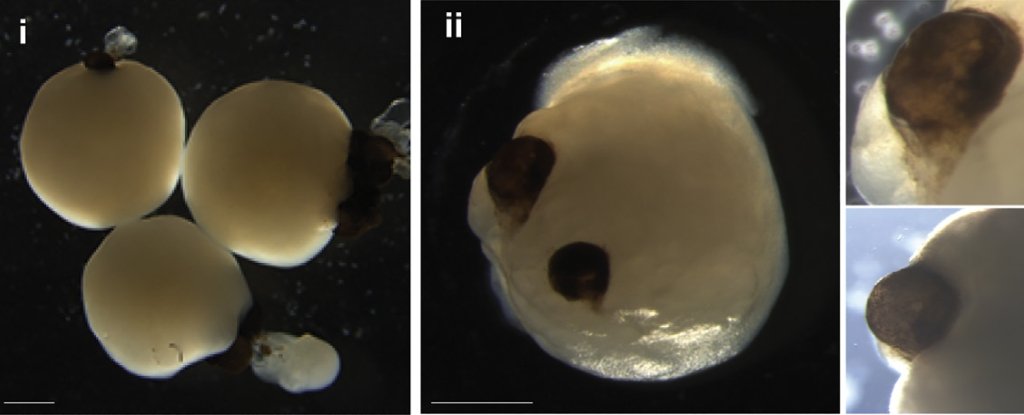
Glimpsing into the Future: Lab-Grown Mini Brains Develop Primitive Eyes”

In a groundbreaking discovery reported in a 2021 paper, miniature brains cultivated in a laboratory from stem cells spontaneously evolved rudimentary eye structures, shedding light on the intricate process of eye differentiation and development. These tiny, human-derived brain organoids, resembling three-dimensional brain tissue blobs, showcased bilateral optic cups, mirroring the developmental patterns observed in human embryos. This astonishing revelation not only deepens our understanding of eye development but also holds significant potential for studying brain-eye interactions, modeling congenital retinal disorders, and advancing personalized drug testing and transplantation therapies.

Neuroscientist Jay Gopalakrishnan from the University Hospital Düsseldorf in Germany emphasized the remarkable capability of brain organoids to generate primitive sensory structures sensitive to light, housing cell types akin to those in the human body. Unlike true brains, these “mini brains” are structured from induced pluripotent stem cells, offering a unique platform for ethical research into drug responses, cell development, and, in this case, eye development.

Continue reading… “Glimpsing into the Future: Lab-Grown Mini Brains Develop Primitive Eyes””

ZTE’s Leap into the Future: A Deep Dive into Smart Glasses Innovation

In the dynamic realm of wearable technology, ZTE is making waves with its revolutionary smart glasses, heralding a new era in user interaction with digital content and the surrounding environment. Packed with features geared towards seamless connectivity, immersive entertainment, and practical applications, ZTE’s smart glasses are poised to redefine the landscape of personal technology.

Understanding Smart Glasses

Smart glasses, blending the familiarity of traditional eyewear with advanced technology, offer users a myriad of intelligent functions. These encompass augmented reality (AR) displays, voice commands, touch controls, and wireless connectivity with other devices, creating a multifaceted user experience.

Continue reading… “ZTE’s Leap into the Future: A Deep Dive into Smart Glasses Innovation”

NeRmo: Rodent-Inspired Robot Breaks New Ground in Spine-Centric Quadrupedal Movement

Robots like Boston Dynamics’ Spot and Cheetah exhibit impressive agility, but their movements largely rely on advanced leg mechanics rather than a biomimetic spine. In a groundbreaking development, a collaborative research team from Germany and China has introduced NeRmo, a four-legged robot inspired by rodents, designed to emphasize the importance of a functional spine in achieving precise maneuverability.

In appearance, NeRmo mirrors a mouse’s skeletal structure, featuring a rigid front half housing electronics and a flexible spine with four lumbar and lateral joints in the latter half. The robot’s unique motor-tendon framework draws inspiration from rodent anatomy, introducing artificial tendons that thread through the spine, elbow, and knee joints.

Continue reading… “NeRmo: Rodent-Inspired Robot Breaks New Ground in Spine-Centric Quadrupedal Movement”

Unraveling the Magnetic Mystery: Diamond-Tipped Needle Reveals Single-Pole Magnets on Hematite Surface

In a groundbreaking discovery, physicists wielding a diamond needle tipped with a single electron have identified seemingly implausible one-sided magnets swirling along the surface of hematite, a mineral composed of iron oxide. This revelation challenges traditional notions of magnetism and may pave the way for advancements in computer memory technology.

The laws of physics, as currently understood, assert the impossibility of magnets possessing only one pole. However, when dealing with particles at the microscopic level, anomalies arise, allowing for unconventional phenomena. Researchers, led by Jani, uncovered magnetic monopoles on the surface of hematite—tiny bits of magnetic matter exhibiting a sole pole, contrary to the usual two.

Continue reading… “Unraveling the Magnetic Mystery: Diamond-Tipped Needle Reveals Single-Pole Magnets on Hematite Surface”