Gene-Edited Chickens Show Promise in Developing Resistance to Bird Flu

Researchers have successfully gene-edited chickens to enhance their resistance to bird flu, presenting a potential strategy for safeguarding poultry flocks against future outbreaks. Amid a severe avian flu outbreak since 2021, scientists at the University of Edinburgh explored the use of CRISPR technology to modify genes in chicken cells, specifically targeting the ANP32A protein used by all subtypes of the bird flu virus for replication.

The researchers altered two amino acids in ANP32A, preventing the virus from replicating in the edited chicken cells. Embryos were then gene-edited, resulting in ten chickens with the modified form of ANP32A. When exposed to the H9N2 subtype of bird flu, known for causing milder illness than H5N1, only one gene-edited chicken out of ten became infected, compared to all non-edited chickens.

Continue reading… “Gene-Edited Chickens Show Promise in Developing Resistance to Bird Flu”

Quantum Leap in Gravitational Measurement: Physicists Record Smallest Gravity Ever

Physicists have achieved a groundbreaking feat by measuring the smallest gravitational pull ever recorded, using a minuscule particle suspended in a magnetic trap. Led by physicist Tim Fuchs from Leiden University and the University of Southampton, the team successfully measured gravitational signals at an unprecedented scale, approaching the quantum realm. This achievement holds the promise of shedding light on the intricate interplay between classical physics and quantum mechanics that has perplexed scientists for a century.

The challenge lies in reconciling the disparities between classical physics, primarily governed by gravity, and the quantum mechanics that dominates at atomic and subatomic scales. While each framework explains different scales effectively, a unified understanding is yet to be realized. To tackle this dilemma, the researchers employed a superconducting magnetic trap—a tantalum chamber cooled to a critical temperature of 4.48 Kelvin.

Continue reading… “Quantum Leap in Gravitational Measurement: Physicists Record Smallest Gravity Ever”

Micro-Bots Inspired by Nature: Fast and Lightweight Actuators Revolutionize Insect-Like Robotics

In the realm of robotics, designing insect-like bots has been a formidable challenge due to their small size. These miniature robots hold potential applications in environmental pollination, search and rescue missions, and beyond. Drawing inspiration from nature, researchers at Washington State University recently unveiled remarkable progress in this field at the IEEE Robotics and Automation Society’s International Conference on Intelligent Robots and Systems.

Presenting two groundbreaking creations—a mini-bug weighing a mere eight milligrams and a water strider tipping the scales at 55 milligrams—the researchers showcased robots that can move at an impressive six millimeters per second. While this speed might seem modest, it marks a significant milestone and positions these robots as some of the fastest of their kind.

Continue reading… “Micro-Bots Inspired by Nature: Fast and Lightweight Actuators Revolutionize Insect-Like Robotics”

Revolutionizing Data Storage: Three-Dimensional Optical Disc with Unprecedented Capacity

A groundbreaking study from Chinese scientists reveals a revolutionary optical disc, the size of a DVD, capable of storing over 1 million gigabits, transcending the limitations of traditional two-dimensional data storage. The innovation involves encoding data in three dimensions on 100 layers of optical discs, setting a new standard for data density.

Traditional optical discs, such as CDs and DVDs, encode data using microscopic pits representing binary code. Prior attempts to increase their capacity involved multiple layers, but the size limitations of optics hindered progress. The Chinese researchers overcame this challenge by developing a disc with 100 layers, utilizing spots as small as 54 nanometers, a significant advancement over the wavelengths of visible light.

Continue reading… “Revolutionizing Data Storage: Three-Dimensional Optical Disc with Unprecedented Capacity”

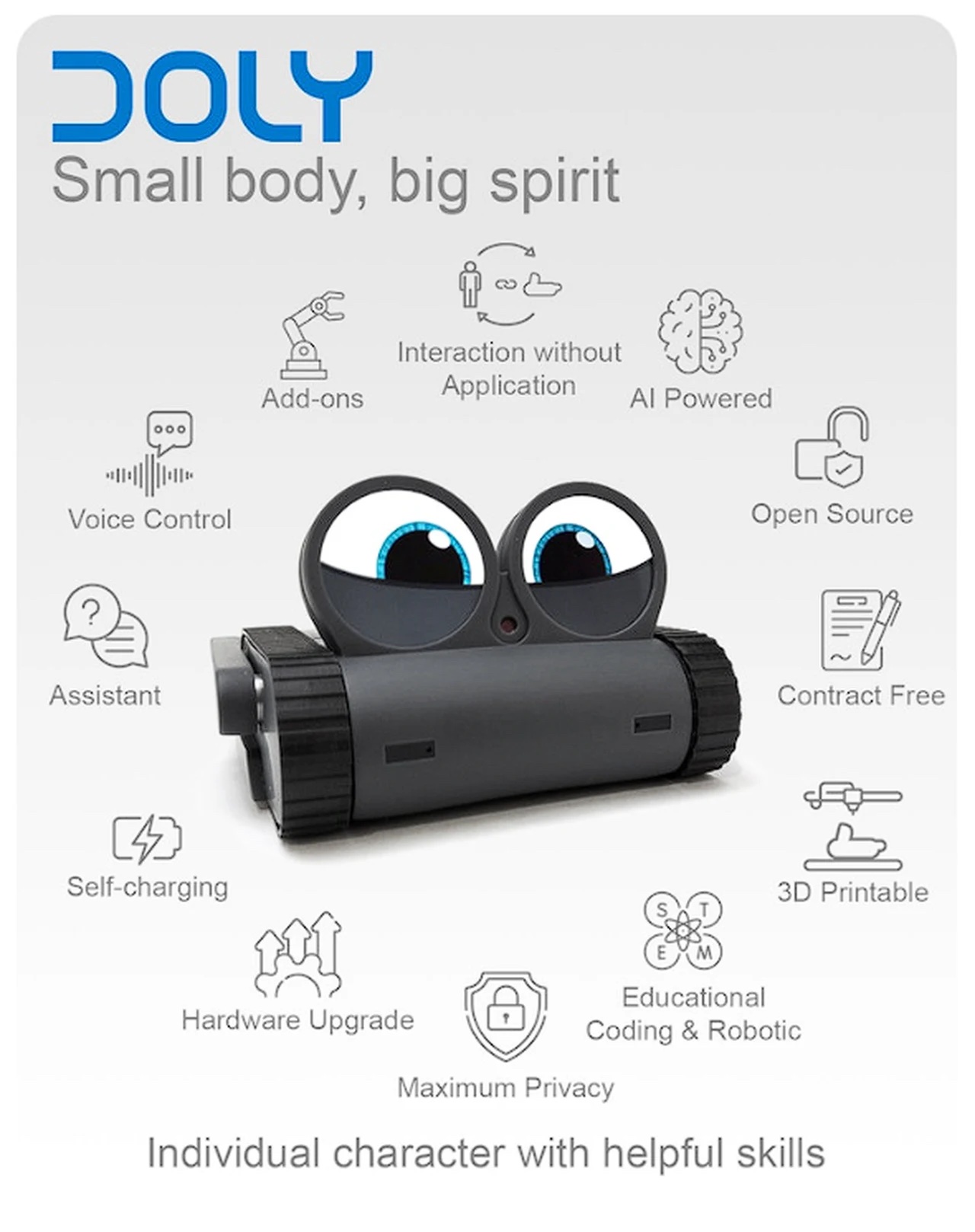
Doly: Your AI Desk Companion Redefining Human-Technology Interaction

Meet Doly, an innovative AI-powered desktop robot poised to redefine the way we engage with technology. This compact yet sophisticated companion leverages the robust Raspberry Pi platform, showcasing the impressive capabilities of open-source hardware and software. Doly is not just a gadget; it’s a dynamic entity designed to connect with you on a personal level, learning from your interactions to assist with daily tasks and serve as a valuable resource for STEM education.

Imagine a companion that not only aids you but also evolves with you. Doly is more than a mere gadget; it’s a being with a developing personality. With advanced voice recognition utilizing Natural Language Understanding, Doly can follow your spoken instructions, display a range of emotions, and customize its behavior based on your preferences. From reminding you of important events to playing your favorite tunes and keeping you updated on the weather, Doly can do it all without you lifting a finger.

Continue reading… “Doly: Your AI Desk Companion Redefining Human-Technology Interaction”

Milestone Unveiled: Japan Inaugurates World’s Largest Experimental Nuclear Fusion Reactor

In a historic stride that holds the promise of transforming the landscape of energy production, Japan has officially inaugurated the JT-60SA reactor, the world’s largest experimental nuclear fusion reactor. This groundbreaking venture signifies a significant leap in the exploration of nuclear fusion technology, which, though in its early stages, is being hailed as a potential solution to humanity’s future energy requirements.

Diverging from the prevalent nuclear fission technique employed in current nuclear power plants, fusion involves the merging of two atomic nuclei, as opposed to their splitting. The JT-60SA reactor aims to scrutinize the feasibility of fusion as a secure, large-scale, and carbon-free source of net energy. The ultimate objective is to produce more energy from fusion than is consumed in the process.

Continue reading… “Milestone Unveiled: Japan Inaugurates World’s Largest Experimental Nuclear Fusion Reactor”

CRISPR-COPIES: A Revolutionary Leap in Genome Editing Technology

Over the past decade, CRISPR/Cas systems have emerged as a revolutionary tool in genome editing, showcasing their potential in applications ranging from improving crop yields to advancing gene therapy. A recent breakthrough by the Center for Advanced Bioenergy and Bioproducts Innovation (CABBI) at the University of Pennsylvania, known as CRISPR-COPIES, marks a significant stride forward, enhancing the flexibility and user-friendliness of CRISPR technology.

Beyond Editing: The Game-Changing CRISPR-COPIES Tool

CRISPR-COPIES is a cutting-edge solution designed to rapidly identify optimal chromosomal sites for genetic modification across various species. According to Huimin Zhao, a prominent figure at CABBI and the University of Illinois, this innovation will accelerate metabolic engineering efforts for cost-effective production of chemicals and biofuels.

Continue reading… “CRISPR-COPIES: A Revolutionary Leap in Genome Editing Technology”

Teledyne FLIR Introduces Revolutionary Thermal Sniper Scope with In-Flight Bullet Visibility

Defense contractor Teledyne FLIR has recently revealed its cutting-edge thermal sniper scope, the ThermoSight HISS-HD, capable of tracking its own bullets in real-time, day or night, at distances of up to 2,200 meters (1.3 miles). Unveiled at the annual SHOT Show in Las Vegas, this groundbreaking technology empowers snipers and machine gunners to engage targets covertly at extended ranges.

While snipers are among the most skilled professionals in the armed forces and law enforcement, their roles have evolved beyond relying solely on keen eyes and steady hands. Modern snipers employ specialized rifles, advanced optics, and computer processors to account for variables such as windage, air pressure, muzzle velocity, and bullet trajectory. Despite these technological advancements, the ThermoSight HISS-HD recognizes the necessity of an old and reliable tool – the tracer round.

Continue reading… “Teledyne FLIR Introduces Revolutionary Thermal Sniper Scope with In-Flight Bullet Visibility”

OpenAI’s Foray into Search: A Potential Challenger to Google’s Dominance

In recent reports from The Information, it has been revealed that OpenAI is actively working on a search app, poised to directly compete with the reigning champion, Google Search. This new AI search engine, potentially integrated into the ChatGPT framework or introduced as a standalone application, could mark a significant challenge for Google’s long-standing dominance in the field.

The speculated service, driven by Microsoft Bing under the leadership of Sam Altman, is touted as perhaps the most formidable threat Google Search has ever encountered. Current AI-enabled search engines, including Google and Perplexity, provide answers to user queries in a concise AI-generated format, typically within one to two sentences. This innovative blend of AI chatbot and search engine then supplies links to the sources below. The distinguishing feature of this potential new search product is its purported speed, aiming to surpass ChatGPT while retaining its robust summarization capabilities.

Continue reading… “OpenAI’s Foray into Search: A Potential Challenger to Google’s Dominance”

Revolutionizing Nutrition: Korean Scientists Develop Hybrid Rice Infused with Lab-Grown Meat Cells

With the global population on the rise, environmental stressors, particularly in food production, continue to escalate. One major challenge lies in the extensive resources required for livestock cultivation. In a pioneering move, Korean scientists have introduced a novel solution—lab-cultured meat embedded within grains of rice.

Led by biomolecular engineer Sohyeon Park from Yonsei University, the research team has created a unique hybrid food that incorporates cells of bovine fat and muscle grown within rice grains. The resulting product resembles a peculiar blend of meat mince and rice, presenting as pink, sticky grains. Despite being currently labor-intensive to produce, the innovation holds promise in alleviating food production pressure.

Continue reading… “Revolutionizing Nutrition: Korean Scientists Develop Hybrid Rice Infused with Lab-Grown Meat Cells”

Minesto’s Dragon 12 Unleashes Innovative Tidal Energy Harvesting with Underwater Kite-Like Technology

Minesto’s Dragon 12, a fully operational and dynamic tidal energy device, is making waves in the renewable energy sector with its innovative approach. Resembling a futuristic military drone, the Dragon 12 behaves like an underwater kite, utilizing tidal flows to fly patterns faster than the currents, effectively harvesting renewable energy. Unlike traditional tidal turbines that remain stationary in the water, Minesto’s Dragon series is anchored to the sea bed and maneuvers like kites, optimizing energy extraction from tidal currents.

Similar to land-based wind energy kites that follow figure-eight patterns to outpace the wind, the Dragon underwater device employs dynamic movements to extract more energy from a given tidal current. This unique approach expands the economic feasibility of harnessing energy from slower tidal flows. Despite its substantial size, with a 12-meter wingspan and a weight of 28 tons, the Dragon 12 offers easier installation using a single boat and a sea bed tether.

Continue reading… “Minesto’s Dragon 12 Unleashes Innovative Tidal Energy Harvesting with Underwater Kite-Like Technology”

Innovative Researchers Develop World’s First Edible Rechargeable Battery

Researchers from the Italian Institute of Technology have achieved a groundbreaking feat by creating the world’s first rechargeable battery entirely composed of food products, making it not only environmentally friendly but also completely edible. This remarkable development opens doors to potential applications in internal gastrointestinal diagnostic instruments, food quality monitoring, and even edible soft robotics.

The team, led by Mario Caironi, coordinator of the Printed and Molecular Electronics laboratory at the IIT Center in Milan, drew inspiration from biochemical reactions in living beings. The battery’s anode is crafted from riboflavin (vitamin B2), found in almonds, dairy products, and meats, while the cathode is made from the plant flavonoid quercetin, present in capers, citrus fruits, and leafy greens.

Continue reading… “Innovative Researchers Develop World’s First Edible Rechargeable Battery”