Embracing Percolation: Rekindling Creativity and Unlocking Ideas

In the nascent stages of my career, a trusty Moleskine notebook became my constant companion, capturing a tapestry of ideas ranging from innovative products to captivating stories. Snippets of overheard conversations during commutes found refuge within its pages, snippets of potential fuel for future creativity. I meticulously transcribed quotes from books and films, meticulously crafting my vision of an “Ideal Day.” The purpose? It was irrelevant. My goal was simple: capture every drop of inspiration through a self-made pact.

Does this sound familiar? Each of us encounters periods of heightened creativity and idea generation. Sometimes, these surges are triggered by deadlines, significant events, or even moments of anxiety. Perhaps the looming sale of your company sparks a flurry of inspiration. Your once-secure job may suddenly appear vulnerable, inducing both frustration and fear. Yet, amidst these emotions, a spark is ignited. You find yourself reaching out to connections, reevaluating your experience, and revamping your resume. A cascade of opportunities materializes, new avenues unfurl, and a palpable shift occurs. Even if the sale doesn’t transpire, your energy is renewed by the prospect of new horizons.

Continue reading… “Embracing Percolation: Rekindling Creativity and Unlocking Ideas”

Revolutionizing Authenticity with A.I.-Powered Fashion Authentication

A Crucial Experience Sparks Innovation

Vidyuth Srinivasan’s personal encounter with counterfeit motorcycle batteries fueled his determination to combat fraud in the fashion industry. Inspired by a desire to prevent others from falling victim to counterfeit scams, Srinivasan embarked on a journey that led to the creation of Entrupy in 2016. This New York-based company harnesses the power of artificial intelligence (A.I.) to revolutionize fashion and apparel authentication, unveiling hidden distinctions between genuine items and their imitations.

Empowering Authenticity in a Counterfeit-Prone Landscape

Entrupy’s innovative technology addresses a pressing global concern, as counterfeit markets reach a staggering value of $1.9 trillion, according to a report by Frontier Economics. The rise of counterfeit scams poses a significant challenge for businesses, especially those sourcing from individual consigners. Such businesses, including consignment and pawn shops, face heightened risks of unknowingly dealing with counterfeit items that are becoming increasingly difficult to distinguish.

Continue reading… “Revolutionizing Authenticity with A.I.-Powered Fashion Authentication”

Michigan State University Researchers Create Home-Compostable Alternative to Petroleum-Based Plastics

A pioneering advancement has emerged from the esteemed School of Packaging at Michigan State University, as researchers unveil a revolutionary approach to enhance the biodegradability of a promising eco-friendly substitute for petroleum-based plastics. Under the leadership of Rafael Auras, a distinguished team has successfully developed a bio-based polymer blend that exhibits compostable properties in both home and industrial composting environments. Their remarkable achievement is detailed in the pages of the prestigious journal ACS Sustainable Chemistry & Engineering.

The Magnitude of Plastic Waste: An Impetus for Change

“In the U.S. and across the globe, the issue of waste, particularly plastic waste, looms large,” reveals Auras, a professor at MSU and the Amcor Endowed Chair in Packaging Sustainability. The alarming fact that less than 10% of plastic waste is recycled in the United States underscores the severity of the problem. This dire scenario results in a substantial portion of plastic waste being consigned to landfills or discarded as litter, igniting multifaceted concerns spanning economic, environmental, and health domains.

A Pathway to Sustainability: Redefining Biodegradability

Auras highlights the pivotal potential of crafting biodegradable and compostable products to alleviate this mounting waste crisis, thereby channeling a portion of the waste stream away from landfills. Notably, this innovation can potentially mitigate a significant challenge faced by plastic recycling: the laborious task of cleansing plastic articles of food residues. This perennial obstacle has compelled recycling facilities to navigate a dilemma—investing resources in cleaning contaminated plastic waste or simply discarding it.

Continue reading… “Michigan State University Researchers Create Home-Compostable Alternative to Petroleum-Based Plastics”

Cyngn’s Autonomous Technology Revolutionizes Logistics with Major Partnership

In the ever-evolving landscape of logistics, the demand for efficient task execution has prompted innovation in autonomous technology. California-based Cyngn is at the forefront of this transformation, offering autonomous solutions that are set to reshape the way goods move within warehouses and distribution centers.

Cyngn recently announced a significant collaboration with Arauco, a global leader in the furniture and construction industry. Arauco, renowned for supplying major brands such as IKEA and Sauder Woodworking, will integrate Cyngn’s autonomous forklifts into its operations. The partnership involves the deployment of 100 autonomous forklifts at Arauco facilities, marking a step toward enhancing operational efficiency and reducing the reliance on human labor.

Continue reading… “Cyngn’s Autonomous Technology Revolutionizes Logistics with Major Partnership”

Rain Panels: A Revolutionary Approach to Capturing Energy from Raindrops

Researchers are exploring a groundbreaking alternative to traditional solar panels – rain panels that can harness energy from falling raindrops. While the concept of capturing energy from rain has been discussed for years, technical limitations have hindered its practical implementation. Existing triboelectric nanogenerators (TENG) have shown promise, but their efficiency remains limited due to the small amount of energy each raindrop produces.

In an effort to overcome these challenges, engineers and researchers are now turning to D-TENGs, a new type of TENG that addresses the coupling capacitance issue observed in regular TENGs. Coupling capacitance, which occurs between lower and upper electrodes in each cell, leads to significant power loss from cell to cell, rendering multiple-cell rain panels inefficient.

Continue reading… “Rain Panels: A Revolutionary Approach to Capturing Energy from Raindrops”

Australian Honeypot Ants Produce Unique Antimicrobial Honey with Medicinal Potential

A fascinating study conducted by scientists at the University of Sydney reveals that a peculiar species of Australian ant produces honey with remarkable antimicrobial properties that can combat bacteria and fungus species. This groundbreaking research marks the first investigation into the medicinal benefits of ant honey, although it is not a novel discovery. Indigenous First Nations people have been utilizing Australian honeypot ants for both food and medicine for thousands of years.

The Australian honeypot ant, scientifically known as Camponotus inflatus, inhabits desert regions in Western Australia and the Northern Territory. The researchers aim to identify the specific antimicrobial compounds present in the ant honey, potentially paving the way for the development of new antibiotics.

Continue reading… “Australian Honeypot Ants Produce Unique Antimicrobial Honey with Medicinal Potential”

DishBrain Breakthrough: Semi-Biological Computer Chip Shows Sentience and Learning Abilities

Last year, scientists from Monash University achieved a groundbreaking milestone by creating the “DishBrain” – a remarkable computer chip incorporating around 800,000 human and mouse brain cells. This semi-biological chip, integrated with electrodes, demonstrated a form of sentience and astoundingly learned to play the classic game Pong within just five minutes.

The DishBrain’s micro-electrode array had the unique capability to read brain cell activity and stimulate them with electrical signals. To test its learning abilities, the researchers designed a version of Pong where the brain cells received electrical stimuli representing the ball’s position on the screen and its distance from the paddle. The brain cells were then allowed to act upon the paddle’s movement. The team implemented a basic reward system, where the cells received predictable stimuli when the paddle hit the ball and unpredictable stimuli when it missed.

Continue reading… “DishBrain Breakthrough: Semi-Biological Computer Chip Shows Sentience and Learning Abilities”

China’s Microgravity Experiment Facility: Pioneering Space Research on Earth

Chinese scientists have successfully built a groundbreaking Microgravity Experiment Facility with Electromagnetic Launch (MEFEL) to conduct cost-effective microgravity experiments on Earth, bolstering the country’s ambitious space research endeavors. The 131-foot tall MEFEL utilizes a linear motor to create a weightless environment for approximately 4 seconds, supporting up to 100 experiments daily, while consuming only 1 kilowatt-hour of electricity per experiment.

Compared to conventional microgravity facilities like drop towers and parabolic flights, MEFEL proves to be a game-changer, saving significant time and resources in pretesting experiments that will eventually be conducted aboard the Tiangong space station. Additionally, the facility can simulate partial gravity to mimic conditions on the moon and Mars.

Continue reading… “China’s Microgravity Experiment Facility: Pioneering Space Research on Earth”

Unveiling Nature’s Microbe Killer: The Cicada Wing’s Antibacterial Secret Unraveled Through Nanoscale Simulations

Over the last decade, collaborative teams of engineers, chemists, and biologists have diligently studied the physical and chemical properties of cicada wings, driven by the quest to unlock the enigmatic ability of these wings to eliminate microbes on contact. The hope is that if science can replicate this natural function, it may lead to the development of products with inherently antibacterial surfaces, surpassing the effectiveness of current chemical treatments.

At Stony Brook University’s Department of Materials Science and Chemical Engineering, researchers made significant progress when they developed a simple technique to replicate the nanostructure of cicada wings. However, they still lacked a crucial piece of information – the exact mechanism by which the nanopillars on the wing’s surface exterminate bacteria. Fortunately, their answer came in the form of assistance from Jan-Michael Carrillo, a researcher at the Center for Nanophase Materials Sciences in the Department of Energy’s Oak Ridge National Laboratory.

Continue reading… “Unveiling Nature’s Microbe Killer: The Cicada Wing’s Antibacterial Secret Unraveled Through Nanoscale Simulations”

Quantum Drum: A Quantum Supersensor Finding Its Way Into Our Devices

Researchers at the University of Copenhagen have developed a groundbreaking “quantum drum,” a thin vibrating membrane capable of measuring various influences with unparalleled precision. Originally requiring extreme cooling with liquid helium, the researchers have now achieved the same accuracy at room temperature, making the quantum drum feasible for practical applications, even potentially in consumer devices like smartphones.

The heart of the quantum drum lies in its ultra-fast vibrations governed by the laws of quantum physics. By reading changes in these vibrations, researchers can detect a wide range of factors, including temperature variations, gas presence, and even the presence of a single virus. Moreover, by adding tiny magnets or pieces of metal to the drum, they can measure electric and magnetic fields with exceptional accuracy.

Continue reading… “Quantum Drum: A Quantum Supersensor Finding Its Way Into Our Devices”

Unraveling the Brain’s Decision-Making with Reinforcement Learning

How does the human brain handle complex situations, like navigating through traffic in busy areas? Psychologists and neuroscientists propose that the brain creates causal models of the world, running mental simulations to plan and execute actions. This idea aligns with the concept of Reinforcement Learning (RL), a system developed by computer scientists to understand human thinking and decision-making.

In a recent study published in Neuron, researchers delved deeper into RL’s neural architecture by employing functional magnetic resonance (fMRI) to compare their algorithmic theory with real-world brain imaging. The goal was to better understand how RL plays out in the brain and potentially improve RL algorithms in artificial intelligence.

Continue reading… “Unraveling the Brain’s Decision-Making with Reinforcement Learning”

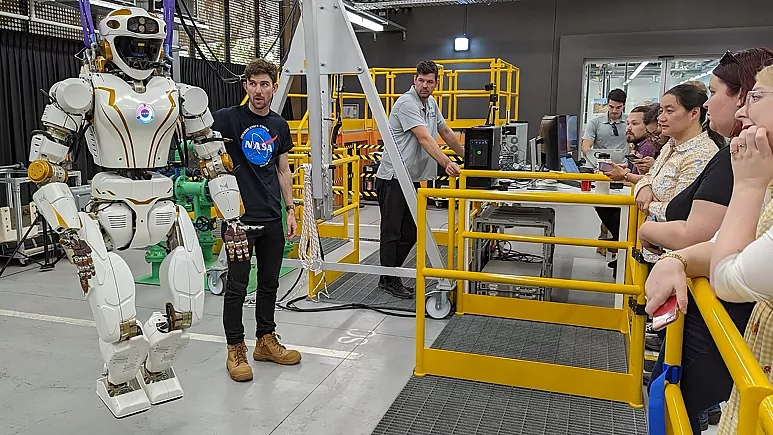
NASA’s Humanoid Robot Valkyrie Embarks on New Mission in Australia

NASA’s humanoid robot, Valkyrie, is embarking on an exciting new mission in Australia. Recently delivered to Western Australia, Valkyrie will be put to the test at Woodside Energy, an Australian energy giant based in Perth. Woodside Energy plans to utilize Valkyrie for remote caretaking of its uncrewed and offshore facilities, enhancing safety for both personnel and the environment.

Shaun Azimi, lead of the dexterous robotics team at NASA Johnson, expressed enthusiasm about the project, stating, “We are pleased to be starting the next phase of development and testing of advanced robotic systems that have the potential to positively impact life on Earth by allowing safer operations in hazardous environments. These demonstrations will evaluate the current potential of advanced robots to extend the reach of humans and help humanity explore and work safely anywhere.”

Continue reading… “NASA’s Humanoid Robot Valkyrie Embarks on New Mission in Australia”