NASA’s ReachBot: A Cutting-Edge Robotic Cave Explorer for Martian Missions

NASA, in collaboration with researchers at Stanford University, has unveiled a groundbreaking robotic cave explorer named ReachBot. This small, lightweight robot features four long, retractable arms with grippers, enabling it to navigate its surroundings with impressive mobility and manipulate its environment. With its unique design and innovative capabilities, ReachBot holds great promise for exploring uncharted Martian caves and potentially other celestial bodies.

The current ReachBot prototype consists of a body section and four rotating joints evenly spaced like the vertices of a tetrahedron. Each shoulder joint boasts a retractable arm with a gripping mechanism at its end. While the final version is likely to use telescopic arms, the prototype utilizes tape measures to demonstrate functionality in a recent video shared by Stanford.

Continue reading… “NASA’s ReachBot: A Cutting-Edge Robotic Cave Explorer for Martian Missions”

Breakthrough Research Unveils CMOS-Compatible Neuromorphic Computing Chip with Potential Impact on Blockchain and AI

Researchers from Technische Universität Dresden in Germany have achieved a significant breakthrough in neuromorphic computing, presenting a new material design that could lead to a CMOS-compatible neuromorphic computing chip. This technology has the potential to revolutionize both blockchain and artificial intelligence (AI) industries.

Using “reservoir computing” technique, the team utilized a vortex of magnons to perform algorithmic functions with remarkable speed. Notably, they not only developed and tested the new reservoir material but also demonstrated its compatibility with standard CMOS chips, which could have transformative effects on blockchain and AI applications.

Continue reading… “Breakthrough Research Unveils CMOS-Compatible Neuromorphic Computing Chip with Potential Impact on Blockchain and AI”

DishBrain Breakthrough: Semi-Biological Computer Chip Shows Sentience and Learning Abilities

Last year, scientists from Monash University achieved a groundbreaking milestone by creating the “DishBrain” – a remarkable computer chip incorporating around 800,000 human and mouse brain cells. This semi-biological chip, integrated with electrodes, demonstrated a form of sentience and astoundingly learned to play the classic game Pong within just five minutes.

The DishBrain’s micro-electrode array had the unique capability to read brain cell activity and stimulate them with electrical signals. To test its learning abilities, the researchers designed a version of Pong where the brain cells received electrical stimuli representing the ball’s position on the screen and its distance from the paddle. The brain cells were then allowed to act upon the paddle’s movement. The team implemented a basic reward system, where the cells received predictable stimuli when the paddle hit the ball and unpredictable stimuli when it missed.

Continue reading… “DishBrain Breakthrough: Semi-Biological Computer Chip Shows Sentience and Learning Abilities”

Toyota Unveils Game-Changing EV Battery with 900-Mile Range

Toyota has recently announced plans for a revolutionary electric vehicle (EV) battery technology that could change the game in the automotive industry. The company’s breakthrough involves new solid-state EV battery tech, which promises to simplify production and significantly extend driving range.

By 2025, Toyota aims to release a model equipped with this solid-state battery technology, offering a 20% increase in cruising range. But the exciting news doesn’t stop there. The company is also researching a higher-performance version that could deliver a staggering 50% more cruising range, equating to over 900 miles on a single charge. With a quick 10-minute charging time, this technology could revolutionize long-distance travel and alleviate range anxiety for EV users.

Continue reading… “Toyota Unveils Game-Changing EV Battery with 900-Mile Range”

Amazon Invests $120 Million in Processing Facility for Kuiper Internet Satellites

Amazon has announced plans to construct a $120 million processing facility at NASA’s Kennedy Space Center in Florida for its ambitious Kuiper internet satellite project. The 1,00,000 square-foot building is just one part of the company’s approximately $10 billion investment in the Kuiper initiative, which aims to deploy a network of 3,200 low Earth-orbiting satellites to provide global broadband internet coverage.

The Kuiper internet network will be a formidable competitor to SpaceX’s Starlink, envisioned by Elon Musk. Additionally, it will complement Amazon’s existing web services powerhouse. The processing facility in Florida will employ 50 staff members and serve as the final stop for Amazon’s Kuiper satellites before they are launched into space. These satellites will be manufactured at the primary Kuiper project plant located in Redmond, Washington. A ten-story-tall room in the facility will facilitate the fitting of satellites into rocket payload fairings, the protective shells surrounding the satellites atop the rockets.

Continue reading… “Amazon Invests $120 Million in Processing Facility for Kuiper Internet Satellites”

AI-Powered X-ray Imaging Revolutionizes Dental Care in the U.S.

Artificial intelligence (AI) is transforming various aspects of our lives, including writing, communication, and art. Now, this rapidly evolving technology is making its way into a more sensitive environment – our mouths.

Dental offices across the United States are embracing AI-powered X-ray imaging technology developed by Boston-based VideaHealth. This advanced software assists dentists in handling routine procedures like cavity identification and also aids in detecting more serious conditions such as periodontal disease and bone loss linked to diseases like diabetes or Alzheimer’s.

Continue reading… “AI-Powered X-ray Imaging Revolutionizes Dental Care in the U.S.”

Toyota’s Lunar Rover to Utilize Regenerative Fuel Cell Technology for Sustainable Moon Exploration

Toyota Motor has unveiled its ambitious plans to power a manned lunar rover, dubbed the Lunar Cruiser, using regenerative fuel cell technology, with the aim of eventually utilizing the moon’s water ice as an energy source. The move comes as Japan ramps up its space ambitions, participating in NASA’s Artemis program and planning to station an astronaut at the lunar space station called Gateway in the latter half of the 2020s.

Since 2019, Toyota has been collaborating with Japan’s space agency to develop the Lunar Cruiser, which they hope to deploy on the moon by 2029. The goal is to conduct long-term and stable research on the lunar surface, sourcing various items on-site over an extended period. NASA expects Japan to contribute a lunar rover to the Artemis program with a targeted launch date in 2029.

Continue reading… “Toyota’s Lunar Rover to Utilize Regenerative Fuel Cell Technology for Sustainable Moon Exploration”

Revolutionary Robotics Technology Enables Remote Medical Treatment in High-Risk Emergencies

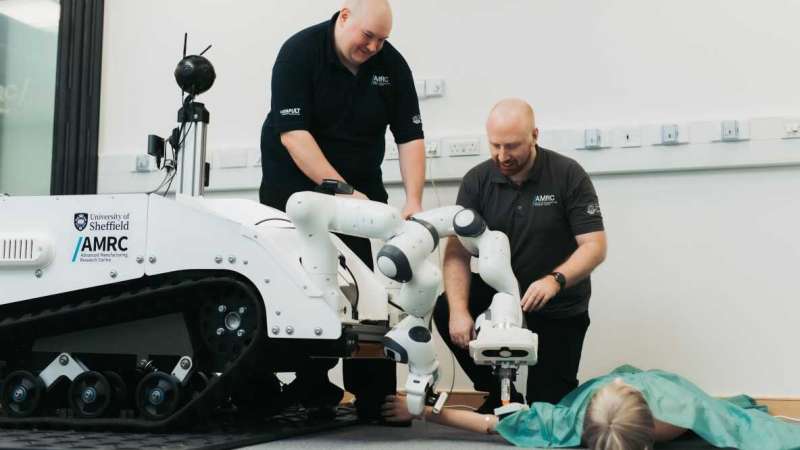
Researchers at the University of Sheffield have developed a groundbreaking robotics technology called medical telexistence (MediTel), which has the potential to provide remote medical treatment to casualties in hazardous emergency environments. Led by the Advanced Manufacturing Research Center (AMRC), Sheffield Robotics, and the Department of Automatic Control and Systems Engineering, the team successfully created a mobile, robotic-controlled uncrewed ground vehicle (UGV) equipped with virtual reality (VR) capabilities.

In a remarkable nine-month development period, the fully integrated MediTel solution features two robotic arms that can remotely operate medical tools to conduct a critical initial assessment of a casualty within 20 minutes. This includes vital checks such as temperature, blood pressure, and heart rate, as well as performing a palpation of the abdomen and administering pain relief through an auto-injector. Real-time data is continuously streamed to the remote operator during the assessment.

Continue reading… “Revolutionary Robotics Technology Enables Remote Medical Treatment in High-Risk Emergencies”

China’s Microgravity Experiment Facility: Pioneering Space Research on Earth

Chinese scientists have successfully built a groundbreaking Microgravity Experiment Facility with Electromagnetic Launch (MEFEL) to conduct cost-effective microgravity experiments on Earth, bolstering the country’s ambitious space research endeavors. The 131-foot tall MEFEL utilizes a linear motor to create a weightless environment for approximately 4 seconds, supporting up to 100 experiments daily, while consuming only 1 kilowatt-hour of electricity per experiment.

Compared to conventional microgravity facilities like drop towers and parabolic flights, MEFEL proves to be a game-changer, saving significant time and resources in pretesting experiments that will eventually be conducted aboard the Tiangong space station. Additionally, the facility can simulate partial gravity to mimic conditions on the moon and Mars.

Continue reading… “China’s Microgravity Experiment Facility: Pioneering Space Research on Earth”

Bridging the Gap: Ohio State Engineers Tackle Memory Loss in Machine Learning for Lifelong Adaptability

Memories can be elusive for both humans and machines, and understanding why artificial agents experience gaps in their cognitive processes is crucial for the advancement of artificial intelligence (AI). Electrical engineers at The Ohio State University have delved into the impact of “continual learning” on overall performance in AI systems. Continual learning involves training computers to continuously learn a sequence of tasks, utilizing past knowledge to improve learning new ones.

However, one major challenge scientists face is overcoming the machine learning equivalent of memory loss, known as “catastrophic forgetting.” As AI agents are trained on successive tasks, they tend to lose information from previous tasks, posing risks as AI becomes more integrated into society. Ness Shroff, an Ohio Eminent Scholar and professor of computer science and engineering at Ohio State, emphasized the importance of preventing these AI systems, such as automated driving applications or robotic systems, from forgetting crucial lessons.

Continue reading… “Bridging the Gap: Ohio State Engineers Tackle Memory Loss in Machine Learning for Lifelong Adaptability”

Tesla Commits Over $1 Billion to Supercomputing Project Dojo for Autonomous Driving

Tesla Inc is determined to make significant strides in the world of supercomputing, with CEO Elon Musk revealing the company’s ambitious plan to invest more than US$1 billion into its Project Dojo by the end of 2024.

During a conference call with investors, Musk explained that Project Dojo involves the development of an in-house supercomputer specifically designed to handle vast amounts of data, including the extensive video footage captured by Tesla cars. This data is crucial for the advancement of autonomous driving software.

Continue reading… “Tesla Commits Over $1 Billion to Supercomputing Project Dojo for Autonomous Driving”

Ex-Google Executive Foresees AI-Powered Sex Robots Redefining Love and Intimacy

Mohammad “Mo” Gawdat, former chief business officer of Google’s secretive research division X, has made intriguing predictions about the future of artificial intelligence (AI) and its impact on human relationships. Gawdat believes that AI-powered sex robots will soon be so advanced that they will appear “alive” and eliminate the need for human partners in the bedroom.

Speaking on the “Impact Theory” podcast hosted by Tom Bilyeu on YouTube, Gawdat shared his vision of a radical “redesign of love and relationships.” He suggested that AI, combined with virtual reality and augmented reality headsets like Apple’s Vision Pro or a Quest 3, will enable people to simulate sexual encounters that are indistinguishable from real-life experiences. The integration of AI-powered bots with these headsets will create a deceptive illusion, making users believe they are interacting with real partners.

Continue reading… “Ex-Google Executive Foresees AI-Powered Sex Robots Redefining Love and Intimacy”
Discover the Hidden Patterns of Tomorrow with Futurist Thomas Frey
Unlock Your Potential, Ignite Your Success.

By delving into the futuring techniques of Futurist Thomas Frey, you’ll embark on an enlightening journey.

Learn More about this exciting program.