World’s First 3D-Printed House Made Of Local Raw Earth – And it Closes the Roof With a Dome

By Andy Corbley 

Inspired by the potter wasp, an Italian architecture firm has used 3D printing to make the domed, beehive-like structure of a house out of zero-emissions clay in the hope of showing what heights of sustainability can be reached with the technology.

Like the industrious wasps, the houses are made using the clay from wherever they are being built, which also means if they have to be knocked down, the only waste is the plumbing, gas, and electrical components.

Continue reading… “World’s First 3D-Printed House Made Of Local Raw Earth – And it Closes the Roof With a Dome”

Quantum computing: Forget about qubits, here come qutrits

Rigetti unveils 80-qubit processor quantum computer consisting of two 40-qubit computers, and experiments with ‘third state’ in quantum processors.

By Liam Tung

US quantum computer outfit Rigetti Computing has announced the Aspen-M, an 80-qubit processor quantum computer that consists of two connected 40-qubit chips. 

The Aspen-M, available in a private beta, is the culmination of Rigetti’s particular take on large-scale quantum computers. 

The firm is pursuing multi-chip quantum processors and announced plans earlier this year to offer it to customers through its Quantum Cloud Services platform.

Instead of scaling up a single quantum processor, it’s been linking smaller chips to create a modular processor with a larger number of qubits – the quantum version of bits in classical computers, characterized by 1s and 0s, which can achieve superposition where a bit can be both 1 and 0 or any combination inbetween those states. 

Continue reading… “Quantum computing: Forget about qubits, here come qutrits”

OF HEMP’S MANY USES, ONE OF THE MOST PROMISING COULD BE IN CONSTRUCTION

Although not a direct replacement for concrete, hempcrete has many benefits as a building material.

By Nate Berg

It has become almost a cliché to discuss the benefits of hemp, the supposed wonder plant with almost endless uses— from woven fibers to edible seeds to bioplastics. “Of course, hemp is that magic crop that does everything,” says Nicholas Carter, an environmental researcher who, along with Tushar Mehta, a Toronto-based doctor, runs the website Plant Based Data. His work involves reading through scientific papers and studies and summarizing the most important work supporting plants as a source of food and other important uses. Given the hype, Carter wondered just how much power hemp really had. “I wanted to see the research out there on it, to see what’s actually real, what’s actually backed by evidence,” he says.

Magic? Not exactly. But Carter came away from his attempted debunking a hemp believer. And one of the most promising of its many uses, he found, is its application as a building material known as hempcrete.

Like its namesake concrete, hempcrete is a material mixed with a binder that hardens it into a solid in the form of blocks and panels. Made from the dried woody core of hemp stalks and a lime-based binder, hempcrete can be cast just like concrete. But unlike concrete and its binding cement, which accounts for about 8% of human-generated carbon dioxide emissions annually, hempcrete actually sequesters CO2. According to a recent study, hempcrete can sequester 307 kilograms of CO2 per cubic meter (19 pounds per cubic foot), roughly the equivalent of the annual carbon emissions of three refrigerators.

Continue reading… “OF HEMP’S MANY USES, ONE OF THE MOST PROMISING COULD BE IN CONSTRUCTION”

FedEx will soon start making deliveries using electric vans from GM

FedEx’s new electric delivery vans from GM’s BrightDrop. 

By Tim Levin 

  • FedEx received the first electric delivery vans from GM’s BrightDrop. 
  • The EV600 goes 250 miles on a charge and has 600 cubic feet of cargo space. 
  • FedEx has ordered 500 of the vehicles, which will start making deliveries soon. 

FedEx received the first electric delivery vans from BrightDrop, a new electric logistics and delivery business out of General Motors. It’s a major milestone in both giants’ efforts to electrify their businesses. 

FedEx took delivery of five BrightDrop EV600 vehicles at a FedEx Express facility in Inglewood, California, where they’ll be housed and operated. The vans are the first of 500 FedEx has ordered from the company.

Continue reading… “FedEx will soon start making deliveries using electric vans from GM”

A new micro aerial robot based on dielectric elastomer actuators

A 0.16 g microscale robot that is powered by a muscle-like soft actuator.

by Ingrid Fadelli

Micro-sized robots could have countless valuable applications, for instance, assisting humans during search-and-rescue missions, conducting precise surgical procedures, and agricultural interventions. Researchers at Massachusetts Institute of Technology (MIT) have recently created a tiny, flying robot based on a class of artificial muscles known as dielectric elastomer actuators (DEAs).

This new robot, presented in a paper published in Wiley’s Advanced Materials journal, significantly outperformed many DEA-based micro-systems developed in the past. Most notably, the robot can operate at low voltages and has high endurance despite its miniature size.

“Our group has a long-term vision of creating a swarm of insect-like robots that can perform complex tasks such as assisted pollination and collective search-and-rescue,” Kevin Chen, one of the researchers who carried out the study, told Tech Xplore. “Since three years ago, we have been working on developing aerial robots that are driven by muscle-like soft actuators.”

In their previous research, Chen and his colleagues presented several micro robots that could fly remarkably well, performing acrobatic movements in the air and quickly recovering after colliding with other objects. Despite these promising results, the soft actuators underpinning these systems required a high driving voltage of 2 kV, which prevented the robots from operating without an external power supply.

“To fly without wires, the soft actuator needs to operate at a lower voltage,” Chen explained. “Therefore, the main goal of our recent study was to reduce the operating voltage of muscle-like DEAs.”

Continue reading… “A new micro aerial robot based on dielectric elastomer actuators”

Neuroscientists are using virtual reality to unlock a whole new world of brain research

A team of scientists from the Max Planck Institute for Human Cognitive and Brain Sciences in Leipzig, Germany is using virtual reality to help us shed some light on one of the world’s greatest mysteries: emotions and our human brains.

For years, researchers have struggled to figure out how human brains process complex emotions. This is because replicating real human emotions within the controlled environment of a laboratory, a necessity for standardizing several variables is extremely difficult. However, the aforementioned team of scientists has circumvented this issue as best they could in a revolutionary way using virtual reality.

The team conducted a study to monitor the neural activity of emotionally charged humans by using the cutting-edge technology of virtual reality. The participants in the study put on VR glasses that made them feel as though they were in the cars of a rollercoaster ride. On this ride, they go through many exhilarating highs and lows. Their journey starts off as a steady roll through picturesque mountain landscapes, then suddenly they are frantically dashing through a raging fire, and lastly, after a tense moment of teetering on the edge, they fall into the depths of an abyss.

Continue reading… “Neuroscientists are using virtual reality to unlock a whole new world of brain research”

Digital twins for cancer patients could be ‘paradigm shift’ for predictive oncology

A proposed framework for Cancer Patient Digital Twins (CPDTs) — virtual representations of cancer patients using real-time data — would combine high performance computing modeling and simulation, model inference and clinical data to make treatment predictions and individualized health care decisions for cancer patients.

by Jeremy Thomas

A multi-institutional team, including a Lawrence Livermore National Laboratory (LLNL) contributor, has proposed a framework for digital twin models of cancer patients that researchers say would create a “paradigm shift” for predictive oncology.

Published online in Nature Medicine on Nov. 25, the proposed framework for Cancer Patient Digital Twins (CPDTs)—virtual representations of cancer patients using real-time data—would combine high performance computing modeling and simulation, model inference and clinical data to make treatment predictions and individualized health care decisions for cancer patients. When fully realized, CDPTs would reflect a patient’s molecular, physiological and lifestyle characteristics as they evolve over time and across different treatments, and help “usher in a new age in medicine” by increasing the probability of optimal care, the authors concluded.

“CPDTs are a grand challenge problem in this growing convergence of high performance computing and oncology,” said contributor Amy Gryshuk, who serves as a lead in LLNL’s Strategic Science Engagements Office. “They have a tremendous potential to advance predictive medicine, but to fulfill that promise we will need to integrate multiscale and multimodal data to then build and test dynamic models at scale.”

Continue reading… “Digital twins for cancer patients could be ‘paradigm shift’ for predictive oncology”

Ford Invents The Ultimate Barbeque Robot

It’s the Terminator of cooked meats.

BY MICHAEL BUTLER

As the world becomes increasingly automated, car manufacturers, who have historically been innovators in the field of automation, are taking things to the next level. Hyundai’s newest employees are all robots, and even Honda plans on employing an army of delivery robots in the near future. Ford has also shown some serious advancement in the world of automation, with its most impressive being this robotic grilling machine, complete with a Ford Ranger front-end. The robot operates from Ford’s Silverton assembly plant in South Africa, and is blowing people away with its ability to flip a burger better than SpongeBob could ever dream of. Welcome to the future ladies and gentleman.

Ford calls this wondrous machine the TCF BBQ (Braai Boerewors Quickly), which refers to a type of South African sausage cooked on open coals. The TCF BBQ was salvaged from decommissioned tooling used in the Silverton Assembly Plant, and was dreamt up by Claude Roux, an area manager from the trim and chassis and final (TCF) line. The robot was programmed as part of a competition held by Ford South Africa to design something unique from decommissioned tools sitting at the plant.

Continue reading… “Ford Invents The Ultimate Barbeque Robot”

Self-healing 3D printed plastic can repair itself using only light

3D printed materials treated with a reversible addition fragmentation chain transfer (RAFT) agent have been shown to self-heal under UV lights.

by Neil Martin

UNSW engineers have demonstrated a way to help 3D printed plastic heal itself at room temperature using only lights.

Professor Cyrille Boyer and his team, Dr. Nathaniel Corrigan and Mr Michael Zhang, in the UNSW School of Chemical Engineering have shown that the addition of “special powder” to the liquid resin used in the printing process can later assist with making quick and easy repairs should the material break.

This can be done very simply by shining standard LED lights on the printed plastic for around one hour which causes a chemical reaction and fusion of the two broken pieces. 

The entire process actually makes the repaired plastic even stronger than it was before it was damaged, and it is hoped that further development and commercialisation of the technique will help to reduce chemical waste in the future.

That is because broken plastic parts would not need to be discarded, or even recycled, and could be mended simply even when remaining embedded in a component including many other materials.

The results of the team’s research have now been published in the journal Angewandte Chemie International Edition.

Continue reading… “Self-healing 3D printed plastic can repair itself using only light”

California’s New Lab-Grown Meat Facility Is the Most Advanced in the World

And it will be open to visitors.

If you weren’t aware of it, the amount of meat that humans consume globally has rapidly risen over the decades and meat production is now at an all-time high. According to the Worldwatch Institute, meat production has tripled over the last forty years, increasing by 20 percent in just the last decade. And more meat production leads to more carbon emissions that feed climate change.

Since the issue has become a major problem, companies around the world have been working on green alternatives to meat products. Perhaps you might remember our previous coverage of Impossible Foods’ Impossible Burgers and how they’re nearly identical to regular patties and Redefine Meat’s 3D-printed steaks. 

One such company is Upside Foods, a cultured meat company that is headquartered in Berkley, California, and it claims that its vast 53,000-sq ft (16,154-m²) facility is the world’s most advanced lab-grown meat facility, so far.

Continue reading… “California’s New Lab-Grown Meat Facility Is the Most Advanced in the World”

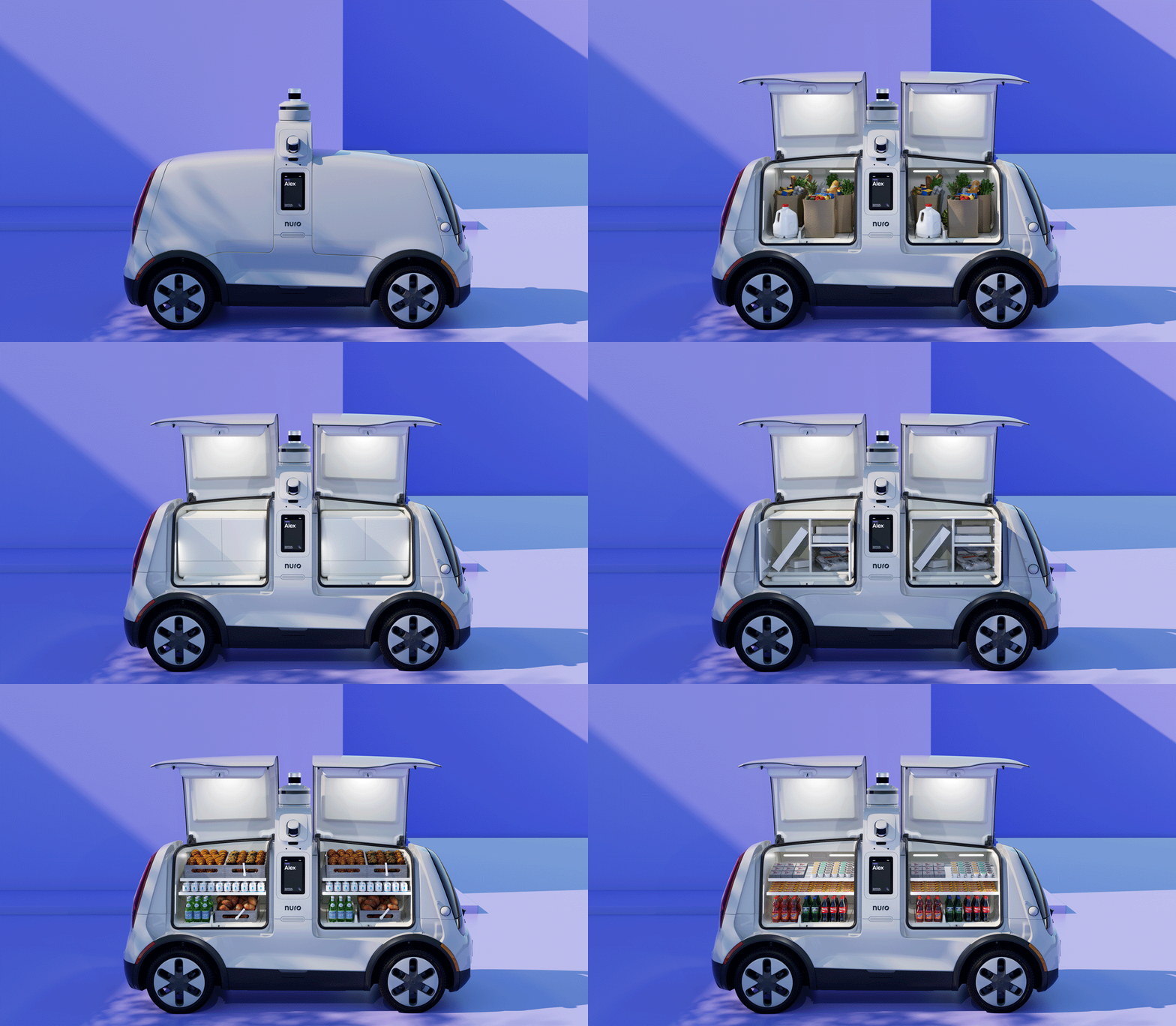
Ford to launch free food delivery program in southwest Detroit using autonomous shuttle

By Jordyn Grzelewski

In a move aimed both at fulfilling a community need and advancing vehicle technologies considered a key part of its future, Ford Motor Co. is launching a fresh food delivery pilot in southwest Detroit using an autonomous vehicle shuttle.

The Dearborn automaker, with its philanthropic arm the Ford Motor Co. Fund, on Tuesday announced a six-month initiative kicking off after the holidays that aims to deliver approximately 10,000 pounds of fresh food to residents of Rio Vista Detroit Co-op Apartments, a senior living center near Ford’s under-construction Michigan Central campus in Corktown. 

The pilot builds on a free food program, called Ford Resource and Engagement Center on the Go, that the Ford Fund and Gleaners Community Food Bank launched earlier this year, doubling the existing food deliveries for more than 20 Rio Vista residents who participate in the service.

“We’re constantly thinking about how to expand our reach in communities for those who don’t have access to the most basic goods, like groceries or warm meals,” Joe Provenzano, mobility director for the Ford Fund, said in a statement. “Bringing Ford’s mobility expertise together with local collaborations allows us to create innovative solutions that make communities stronger and people’s lives better.”

The existing food delivery program operated by the Ford Fund and Gleaners already has distributed roughly 2.4 million pounds of food, according to a news release. Participants receive a mixture of dry and canned goods, plus fresh produce, milk and cheese. The pilot program will bring participants with an additional delivery, containing fresh produce and milk, each month. 

Continue reading… “Ford to launch free food delivery program in southwest Detroit using autonomous shuttle”
Discover the Hidden Patterns of Tomorrow with Futurist Thomas Frey
Unlock Your Potential, Ignite Your Success.

By delving into the futuring techniques of Futurist Thomas Frey, you’ll embark on an enlightening journey.

Learn More about this exciting program.