Overcoming the Limitations of Aqueous Supercapacitors with Hybrid Electrolyte Design

Supercapacitors, also known as ultracapacitors or electric double-layer capacitors, are crucial components in modern electrical systems. They are commonly used in regenerative braking systems for vehicles, power supplies, and various electronic devices. These energy storage devices, unlike batteries that store energy through chemical reactions, use ion separation to store energy.

While traditional capacitors are widely used for their ability to rapidly release energy, supercapacitors offer an advanced solution with much higher energy storage capacity. They achieve this by using high-surface-area electrodes and a liquid electrolyte that contains ions. In essence, supercapacitors are designed to store and discharge electrical energy more efficiently than conventional capacitors.

Continue reading… “Overcoming the Limitations of Aqueous Supercapacitors with Hybrid Electrolyte Design”

Jetson ONE’s First Production Model Soars with Successful Maiden Flight

The Jetson ONE has officially completed its maiden flight, marking a major milestone in the development of electric vertical takeoff and landing (eVTOL) aircraft. Known as SN1, this compact flying car showed exceptional stability during flight and landed smoothly without any issues, as demonstrated in a newly released video.

The SN1 is proving to be a solid foundation for what promises to be the first of many Jetson ONE units to come. “The excitement from our community has been incredible,” the company stated. “Your enthusiasm fuels our drive as we move full speed ahead, with serial production now underway.”

Continue reading… “Jetson ONE’s First Production Model Soars with Successful Maiden Flight”

NASA’s Parker Solar Probe Breaks Records with 23rd Close Flyby of the Sun

NASA’s Parker Solar Probe has once again shattered its own records during its 23rd close approach to the Sun. On March 22, the spacecraft zoomed past our star at an astonishing 430,000 miles per hour (692,000 kilometers per hour), coming within 3.8 million miles (6.1 million kilometers) of the Sun’s surface, matching its previous closest distance. The mission continues to make history, gathering invaluable data about the Sun’s behavior, while solidifying its status as the fastest human-made object ever built.

During this latest perihelion—when the Parker Solar Probe comes closest to the Sun—the spacecraft reached incredible speeds and proximity, surpassing its own previous achievements. At the exact moment of the close approach, which occurred at 22:42 UTC (6:42 p.m. EDT), the probe was racing through space at an unparalleled 430,000 miles per hour, traveling just 3.8 million miles from the Sun’s surface.

Continue reading… “NASA’s Parker Solar Probe Breaks Records with 23rd Close Flyby of the Sun”

Innovative Construction Methods Aim to Tackle America’s Housing Crisis

As housing costs skyrocket and the availability of affordable homes dwindles, millions of Americans are struggling to secure a place to live. To address this escalating crisis, builders are increasingly turning to innovative construction techniques that promise to speed up the building process, cut costs, and boost the housing supply. From 3D printing to modular homes and even hemp-based construction materials, these unconventional methods are paving the way for more affordable and sustainable housing solutions.

The shortage of both homes for sale and rental properties is one of the most pressing challenges facing the United States today. According to Adrianne Todman, former acting secretary of the U.S. Department of Housing and Urban Development, the lack of affordable housing can only be remedied through the adoption of more innovative construction practices. Todman pointed out that had we embraced these methods decades ago, the current housing crisis might have been less severe.

Continue reading… “Innovative Construction Methods Aim to Tackle America’s Housing Crisis”

Breakthrough Stem Cell Therapy Offers New Hope for Spinal Cord Injury Recovery

Paralysis, a condition that abruptly strips individuals of their mobility and independence, is one of the most devastating medical challenges. Spinal cord injuries, in particular, present significant obstacles as the spinal cord plays a critical role in transmitting signals between the brain and the rest of the body. Unfortunately, once the spinal cord is damaged, it has limited capacity to heal, leaving millions of individuals globally with permanent paralysis. However, a groundbreaking clinical trial in Japan is offering hope, suggesting that stem cell therapy could pave the way for recovery in some spinal cord injury patients.

A research team led by Professor Hideyuki Okano at Keio University has achieved a major breakthrough in the treatment of spinal cord injuries. Their clinical trial, which involved the transplant of neural stem cells derived from induced pluripotent stem (iPS) cells, demonstrated that some patients may regain lost functions, providing new hope for recovery.

Continue reading… “Breakthrough Stem Cell Therapy Offers New Hope for Spinal Cord Injury Recovery”

Coral-Inspired Carbon Capture Method Paves the Way for Carbon-Negative Building Materials

A revolutionary new approach, inspired by the natural processes of coral reefs, promises to capture carbon dioxide from the atmosphere and transform it into durable, fire-resistant building materials. Developed by researchers at the University of Southern California (USC), this method provides a promising solution for carbon-negative construction and is detailed in a recent study published in npj Advanced Manufacturing. By mimicking coral’s ability to create robust structures while sequestering carbon, the new approach results in mineral-polymer composites with extraordinary mechanical strength, fracture toughness, and fire resistance.

The idea behind this breakthrough stems from the natural world, particularly the way coral reefs sequester carbon dioxide and form solid, resilient structures. Coral reefs naturally capture carbon dioxide from the atmosphere through photosynthesis, converting it into aragonite, a type of calcium carbonate, which builds the reef’s hard skeletons. This biological process, known as biomineralization, was the key inspiration behind the USC team’s innovation.

Continue reading… “Coral-Inspired Carbon Capture Method Paves the Way for Carbon-Negative Building Materials”

Revolutionizing Weather Forecasting: Aardvark AI Offers Faster, More Accessible Predictions

A groundbreaking AI weather prediction system, Aardvark Weather, has emerged as a game-changer in meteorology, providing forecasts tens of times faster and using a fraction of the computing power required by current AI and physics-based systems. According to a recent study published in Nature, Aardvark promises to significantly transform the way weather predictions are made, potentially revolutionizing practices in both developed and developing countries.

Aardvark was developed by researchers from the University of Cambridge, in collaboration with the Alan Turing InstituteMicrosoft Research, and the European Centre for Medium-Range Weather Forecasting (ECMWF). This new approach offers a fresh blueprint for weather forecasting, moving away from complex, resource-intensive systems towards a streamlined, AI-driven model that could reshape global forecasting methods.

Continue reading… “Revolutionizing Weather Forecasting: Aardvark AI Offers Faster, More Accessible Predictions”

Columbia Engineering Breakthrough: 3D Photonic-Electronic Platform to Revolutionize AI and Computing

Artificial intelligence (AI) is poised to drive groundbreaking technological advancements, but its progress has long been hindered by issues like energy inefficiencies and bottlenecks in data transfer. Now, researchers at Columbia Engineering have unveiled a game-changing solution: a 3D photonic-electronic platform that dramatically improves both energy efficiency and bandwidth density. This innovation represents a critical step toward creating faster, more capable AI hardware.

Published in Nature Photonics, the study, led by Keren Bergman, Charles Batchelor Professor of Electrical Engineering, introduces a novel approach that integrates photonics with advanced complementary metal-oxide-semiconductor (CMOS) electronics. By combining these two technologies, the researchers have developed a high-speed, energy-efficient data communication system that directly addresses one of the biggest hardware challenges in AI—moving large amounts of data quickly without consuming excessive power.

Continue reading… “Columbia Engineering Breakthrough: 3D Photonic-Electronic Platform to Revolutionize AI and Computing”

China Breathes New Life into Elon Musk’s Hyperloop Dream with Revolutionary Test Project

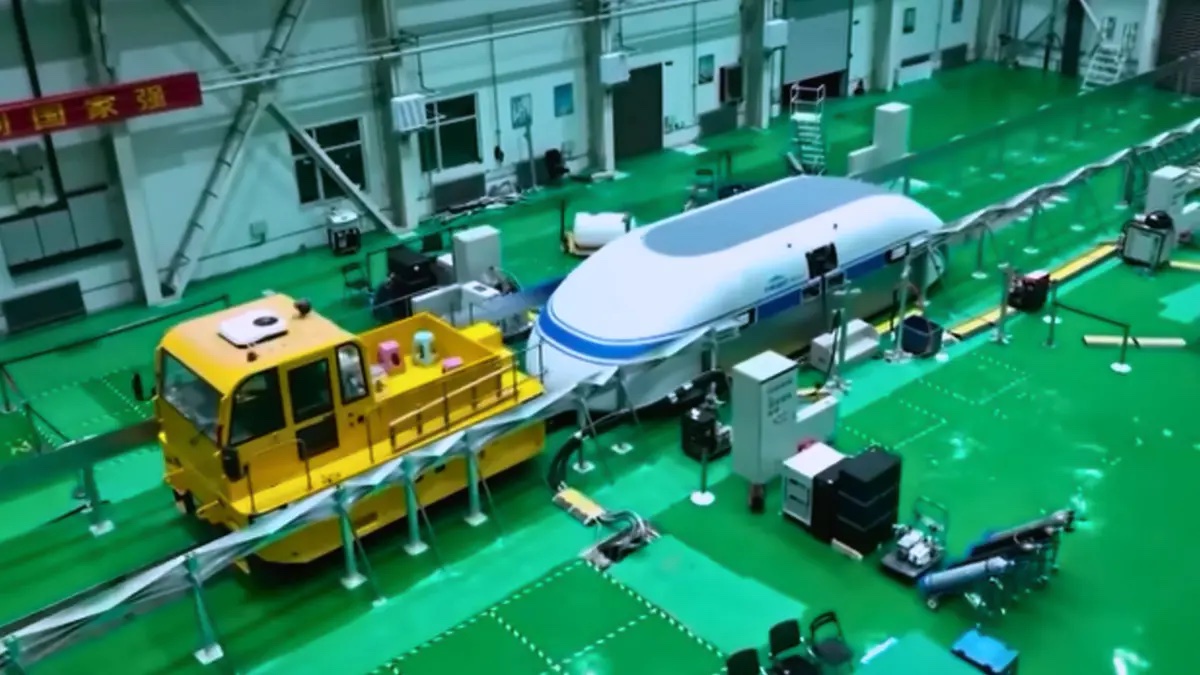
Back in 2013, Elon Musk introduced the world to the Hyperloop, a futuristic transportation system that promised to shuttle passengers between cities at mind-blowing speeds of up to 1,000 km/h (621 mph) through near-vacuum tubes. Despite Musk’s groundbreaking successes with electric cars and reusable rockets, the Hyperloop concept faced significant engineering and financial challenges. Issues like airtight seals, massive temperature fluctuations, and the complexities of integrating high-speed maglev technology into practical infrastructure kept the Hyperloop grounded. However, a remarkable test project in China has now shown that a Hyperloop-like future may indeed be within reach.

In 2024, Chinese engineers successfully constructed a 2-kilometer (1.2-mile) test line in Yanggao County, Shanxi province, to explore near-vacuum maglev technology. Led by master engineer Xu Shengqiao and a team from the China Railway Engineering Consulting Group (CREC), the project aimed to test the feasibility of a near-vacuum transport system similar to Musk’s original Hyperloop concept.

Continue reading… “China Breathes New Life into Elon Musk’s Hyperloop Dream with Revolutionary Test Project”

Robotic Industry Breakthrough: Chrissy Snow Comes to Life Through AI and Humanoid Technology

The world of robotics is evolving at an extraordinary pace, and a new collaboration between two leading firms has demonstrated just how far it’s come. Through a combination of open-source robotics, lip-sync technology, and advanced AI, a humanoid robot has successfully assumed the personality of a beloved TV character: Chrissy Snow, as portrayed by Suzanne Somers in the iconic 70s and 80s TV sitcom Three’s Company.

This remarkable achievement was made possible by Realbotix, a prominent creator of humanoid robots, and Hollo.AI, a conversational AI platform specializing in character-based digital twins and AI personality engines. The partnership brought Chrissy Snow back to life in a way never seen before, combining cutting-edge robotics and AI to create a physical and conversational representation of the character.

Continue reading… “Robotic Industry Breakthrough: Chrissy Snow Comes to Life Through AI and Humanoid Technology”

New Research Sheds Light on Why We Forget Early Childhood Memories

Family gatherings often lead to playful discussions about childhood antics—stories about how mischievous you were as a toddler, stories that everyone remembers except you. Ever wonder why your family seems to have vivid recollections while you have no recollection at all? Recent research may offer an answer: it’s not that the memories are gone, but rather that retrieving them is far more difficult than we realize.

For decades, scientists believed that infants couldn’t form lasting memories because the brain structures required for memory formation, such as the hippocampus, were underdeveloped. However, a groundbreaking study led by Tristan Yates and his team challenges this long-standing assumption.

Continue reading… “New Research Sheds Light on Why We Forget Early Childhood Memories”

Chinese Researchers Create the World’s Smallest LED Displays Using Virus-Sized Pixels

Researchers from Zhejiang University in Hangzhou, China, in collaboration with the University of Cambridge, have achieved a remarkable breakthrough in display technology by creating pixels the size of a virus. These tiny pixels have been used to develop the world’s smallest light-emitting diode (LED) displays, which are smaller than a grain of sand.

This innovation is significant because, as display technology advances, the trend has been to increase pixel density in order to enhance image quality. The more pixels that can fit into a given space, the sharper and more detailed the image. Currently, micro-LEDs, made from II-V semiconductors, are used for creating small pixels, but miniaturizing these components becomes expensive and inefficient as their size decreases. To overcome this, the Zhejiang University team explored a promising alternative: perovskite.

Continue reading… “Chinese Researchers Create the World’s Smallest LED Displays Using Virus-Sized Pixels”