Author: admin

Medical Student Creates Patient-Specific 3D Printed Liver Model for Less Than $150

3d-printed-liver-models

While researchers continue working hard to make readily available 3D printed organs a reality, we know that it likely won’t happen, at least not on a massively available and low-cost scale, for quite some time. However, 3D printing technology is often used in surgery these days, from surgical guides to implants to patient-specific medical models. Recently, a team developed patient-specific, cost-effective 3D printed liver models, to help doctors with their preoperative plans before performing difficult laparoscopic resections.

Continue reading… “Medical Student Creates Patient-Specific 3D Printed Liver Model for Less Than $150”

Robots and drones: Coming soon to a construction site near you

Advancements in the robotics field are helping to transform a number of industries, construction being one of them. Companies that build things can expect to see a host of new machines that perform a variety of tasks — adding efficiency to construction projects as well as reducing injuries to human workers.

Continue reading… “Robots and drones: Coming soon to a construction site near you”

The Lack of Blockchain Talent is Becoming An Industry Concern

The alleged lack of available talent for blockchain industry jobs was high on the agenda at the DTCC’s Fintech Symposium, held at the Grand Hyatt in New York City yesterday.

There, executives from a wide range of companies took turns addressing an audience of several hundred financial industry executives to express their concern about what they believe is a problem preventing wider growth and use of the technology.

Continue reading… “The Lack of Blockchain Talent is Becoming An Industry Concern”

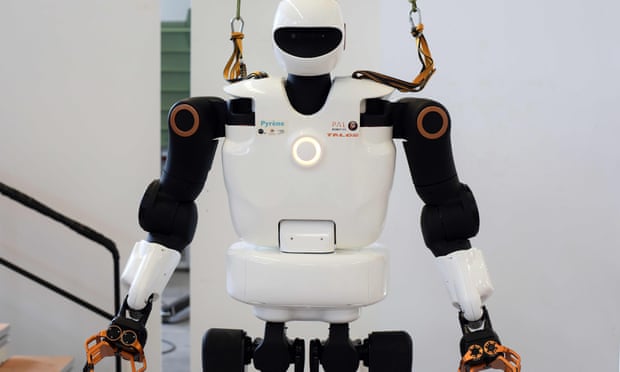
Get ready for robots made with human flesh

Two University of Oxford biomedical researchers are calling for robots to be built with real human tissue, and they say the technology is there if we only choose to develop it. Writing in Science Robotics, Pierre-Alexis Mouthuy and Andrew Carr argue that humanoid robots could be the exact tool we need to create muscle and tendon grafts that actually work.

Right now, tissue engineering relies on bioreactors to grow sheets of cells. These machines often look like large fish tanks, filled with a rich soup of nutrients and chemicals that cells need to grow on a specialized trellis. The problem, explain Mouthuy and Carr, is that bioreactors currently “fail to mimic the real mechanical environment for cells.” In other words, human cells in muscles and tendons grow while being stretched and moved around on our skeletons. Without experiencing these natural stresses, the tissue grafts produced by researchers often have a broad range of structural problems and low cell counts.

Continue reading… “Get ready for robots made with human flesh”

Modern-Day Witchcraft: This Hair Dye Changes Color

Last year, Lauren Bowker was halfway through a nostalgic re-watching of the cult ’90s teen film The Craft when the idea struck. More specifically, it was during the “glamor spells” scene, when Robin Tunney’s character goes from brunette to platinum blond just by combing her fingers through her hair. “It was in that moment that the penny kind of dropped,” says Bowker, “I was like, ‘We could do that.'”

That wasn’t posturing: As a chemist, fashion designer, and the founder of the London-based material design studio, The Unseen, Bowker is something of a high-fashion alchemist. Her color-changing leather purses and otherworldly wearable Air sculptures are a measured mix of stunning aesthetics and seriously complex science.

Continue reading… “Modern-Day Witchcraft: This Hair Dye Changes Color”

Why we must teach morality to robots

Every week comes a new warning that robots are taking over our jobs. People have become troubled by the question of how robots will learn ethics, if they do take over our work and our planet.

As early on as the 1960s Isaac Asimov came up with the ‘Three Laws of Robotics’ outlining moral rules they should abide by. More recently there has been official guidance from the British Standards Institute advising designers how to create ethical robots, which is meant to avoid them taking over the world.

Continue reading… “Why we must teach morality to robots”

Wikipedia bots act more like humans than expected

Benevolent bots

‘Benevolent bots’ or software robots designed to improve articles on Wikipedia sometimes have online ‘fights’ over content that can continue for years, say scientists who warn that artificial intelligence systems may behave more like humans than expected.

Editing bots on Wikipedia undo vandalism, enforce bans, check spelling, create links and import content automatically, whereas other bots (which are non-editing) can mine data, identify data or identify copyright infringements.

Continue reading… “Wikipedia bots act more like humans than expected”

‘Thousands’ of self-driving Bolt EVs to be deployed next year

Chevrolet Bolt EV self-driving prototype

Chevrolet Bolt EV self-driving prototype

The 2017 Chevrolet Bolt EV is a crucial car for General Motors in more ways than one.

With an EPA-rated 238-mile range and $37,495 base price (before federal, state, and local incentives), the Bolt EV considered a groundbreaking electric-car game changer.
Continue reading… “‘Thousands’ of self-driving Bolt EVs to be deployed next year”

AI learns to write its own code by stealing from other programs

OUT of the way, human, I’ve got this covered. A machine learning system has gained the ability to write its own code.

Created by researchers at Microsoft and the University of Cambridge, the system, called DeepCoder, solved basic challenges of the kind set by programming competitions. This kind of approach could make it much easier for people to build simple programs without knowing how to write code.

Continue reading… “AI learns to write its own code by stealing from other programs”

Artificial synapse bridges the gap to brainier computers

The human brain is nature’s most powerful processor, so it’s not surprising that developing computers that mimic it has been a long-term goal. Neural networks, the artificial intelligence systems that learn in a very human-like way, are the closest models we have, and now Stanford scientists have developed an organic artificial synapse, inching us closer to making computers more efficient learners.

Continue reading… “Artificial synapse bridges the gap to brainier computers”

Ikea just launched a DIY flat-pack indoor garden that can feed a whole lot of people at once

Swedish architects Mads-Ulrik Husum and Sine Lindholm collaborated with Space10, Ikea’s innovation lab, to design a piece of living furniture that can feed quite a few people, from the looks of it.

Called the Growroom, it’s a flat-pack spherical garden that grows plants, veggies, and herbs.

“Standing tall as a spherical garden, it empowers people to grow their own food much more locally in a beautiful and sustainable way,” its designers write on Medium.

Though Space10 launched the Growroom in late 2016, the designers just made the plans open-source. You can download the instruction manual on Space10’s site.

Continue reading… “Ikea just launched a DIY flat-pack indoor garden that can feed a whole lot of people at once”

Discover the Hidden Patterns of Tomorrow with Futurist Thomas Frey
Unlock Your Potential, Ignite Your Success.

By delving into the futuring techniques of Futurist Thomas Frey, you’ll embark on an enlightening journey.

Learn More about this exciting program.