The Germany-based automation company, Siemens, is set to unveil the world’s first autonomous tram through its division Siemens Mobility, Global Rail News reports.
Siemens, alongside its development partner Verkehrsbetrieb Potsdam (ViP), will present their findings at InnoTrans 2018 to show how a tram will drive autonomously in real traffic on 18-21 September.
Autonomous trucks have been in the development stage for the last few years.
DETROIT — It’s been long speculated that autonomous driving technology will widely displace one of the most common jobs in the U.S., truck drivers.
Goldman Sachs, for instance, predicts that as autonomous vehicle technology peaks, as many as 25,000 trucker jobs could be eliminated per month or about 300,000 annually. But a new workforce study from the American Center for Mobility in Ypsilanti Township is saying: Hit the brakes.
The study, commissioned by ACM and led by Michigan State University and the Texas A&M Transportation Institute, concludes that automated technology will “largely support truck drivers instead of replacing them” for the next decade.
A research team at City University of Hong Kong (CityU) has achieved a groundbreaking advancement in materials research by successfully developing the world’s first 4-D printing for ceramics, which are mechanically robust and can have complex shapes. This could turn a new page in the structural application of ceramics.
Ceramic has a high melting point, so it is difficult to use conventional laser printing to make ceramics. The existing 3-D-printed ceramic precursors, which are usually difficult to deform, also hinder the production of ceramics with complex shapes. To overcome these challenges, the CityU team has developed a novel “ceramic ink,” which is a mixture of polymers and ceramic nanoparticles. The 3-D-printed ceramic precursors printed with this novel ink are soft and can be stretched three times beyond their initial length. These flexible and stretchable ceramic precursors allow complex shapes, such as origami folding. With proper heat treatment, ceramics with complex shapes can be made.
Letting robots do construction jobs on the battlefield frees Marines to fight.
Forging ahead with plans to have robots do “dull, dangerous and dirty” jobs, the U.S. Marine Corps used a 3D printer to create a barracks building out of concrete. The process, which took less than two days, created a hardened living space capable of resisting enemy fire, a real improvement over canvas and nylon tents.
The U.S. Marine Corps moves around a lot, deploying worldwide, often to dusty, remote locations for months at a time. As a consequence, they tend to build a lot of housing for themselves, and it takes a team of ten Marines five days to build a barracks from wood. Not only is construction dangerous, it also prevents those ten Marines from doing other things during those five days.
A group of seven swimmers was in trouble when an undertow whisked them off to sea. Fortunately, a lifeguard drone was deployed to the rescue.
When a group of seven swimmers found themselves carried off into the ocean by an undertow in Valencia, Spain Wednesday, time was of the essence. Though they successfully managed to alert the lifeguards, rapid response wasn’t guaranteed at 230 feet from the beach. Fortunately, an Auxdron Lifeguard Drone was at the scene and quickly flown to the rescue.
According to New Atlas, Diego Torres remotely piloted the eight-rotor General Drones vehicle. Guided by a lifeguard via radio and assisted by the drone’s camera feed, he managed to reach the swimmers in danger and drop a life jacket which automatically inflated upon deployment. The woman in most immediate need of assistance managed to untether it from the vehicle, and save herself from drowning.
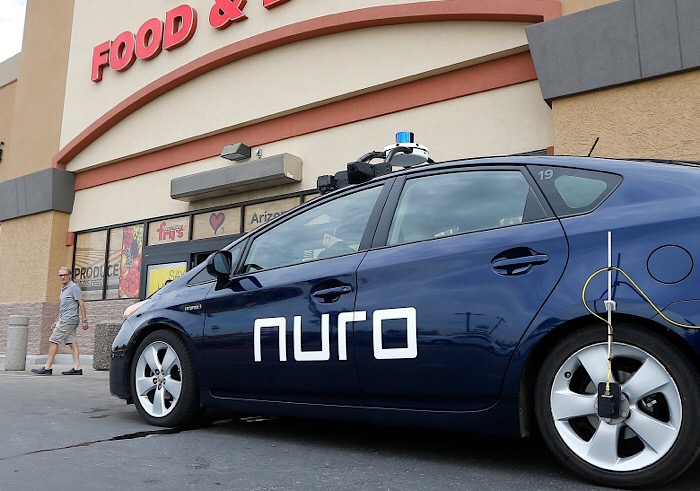
SCOTTSDALE, Ariz. — At a time when big-box retailers are trying to offer the same conveniences as their online competitors, the biggest U.S. grocery chain is testing the use of driverless cars to deliver groceries in a Phoenix suburb.
Kroger’s pilot program launched Thursday morning with a robotic vehicle parked outside one of its own Fry’s supermarkets in Scottsdale. A store clerk loaded the back seat with full grocery bags. A man was in the driver’s seat and another was in the front passenger seat with a laptop. Both were there to monitor the car’s performance.
Three robotic arms move brushes languidly across canvases as the glass eyes of cameras gaze ahead. The robots are painting a still life—lit with a tarnished black standing lamp—of a stuffed fox, a bird perched on a branch, a skull in the center, and a seashell to the side.
This summer in Paris, it is not only the clutch of international travelers filling the museums, but robotic visitors as well. The Grande Palais is hosting an exhibit called “Artistes and Robots” that features works created via artificial intelligence and robotic hosts. Elsewhere, AI-produced art is growing increasingly indistinguishable from the “real thing.” Since 2016, teams of programmers have competed in an annual RobotArt competition (here are this year’s finalists), and robot-made art will go on sale at the Seattle Art Fair this summer, alongside works that came solely from human hands.
This partnership between human and machine is what lies ahead as automation tools permeate our lives at a quickening pace. As many worry about the potential for robots to steal our jobs (or lead a violent overthrow of society), the reality may be more nuanced: They may end up being something more like creative collaborators, much like these robotic artists on display.
Known for its hyperactive toys, the company spent years developing technologies to tackle its greatest challenge yet–subtlety.
If there’s a robot uprising anytime soon, it seems unlikely to start in our living rooms. Robotic vacuums like Roomba sell well because they are so handy. But other types of home robots–pets and companions from Sony’s Aibo robo-pooch to the recently shuttered Kuri (backed by Bosch)–have flopped due to both prices and expectations that have been set unreasonably high.
If any company can eventually bring us a domestic robot like Rosie from The Jetsons, Anki is a good bet. Started by three Carnegie Mellon Robotics Institute graduates in 2010, the company has racked up over $200 million in venture funding. More important, it’s attracted customers. Anki has already sold 1.5 million robots by taking what it sees as the easiest route into the home: toys. The star is a manic little bulldozer-looking bot called Cozmo that drives around a tabletop and plays simple games with light-up cubes it carries about. Cozmo was the best-selling toy (by revenue) on Amazon in the U.S., U.K., and France in 2017, according to one analysis.
Staff will now be augmented by exoskeletons in Ford factories across the world.
Following successful trials, Ford will now offer employees the use of exoskeletons to reduce the strain of factory work.
Despite the emergence of Industry 4.0, smart factories, sensors, and data analytics, much of the heavy-duty operations of today’s industrial and manufacturing still rely heavily on human input.
Over time, the physical demand of such work can cause injury, muscle stress, and accidents.
In 1997, Garry Kasparov, one of the greatest chess players in history, lost a chess match to a supercomputer called Deep Blue. Some years later Kasparov developed “advanced chess,” where a human and a computer team up to play against another human and computer. This mutation of chess is mutually beneficial: the human player has access to the computer’s ability to calculate moves, while the computer benefits from human intuition.
This is the future of work – not just machines replacing humans but also machines augmenting humans. The future is: Human & Machine.
However, our collective imaginations (say for instance in Hollywood) continue to be gripped by dystopian visions of machines replacing humans wholescale. Researchers are paying attention to these ideas. One paper suggests that around 47 percent of US employment is at risk of automation.
Robots, it seems, are everywhere these days. They clean our floors, mow our lawns, make many of our industrial products, and are even being trained to give hugs and serve as pets. As robots increasingly become a part of our daily lives, a growing chorus of commentators warns that they may take away our jobs and further damage the once great Rust Belt cities that once powered the American economy and served as the backbone of the middle class.
But which cities and regions will house the robot revolution? Will the rise of robotics correct or reinforce America’s growing spatial inequality?
Tens of millions of workers could lose their jobs to automation, particularly in southeast Asia, over the next 20 years.
Garment workers among those most at risk of losing their jobs, finding few low-skill alternatives and facing exploitation, according to the Verisk Maplecroft report.
The rise of robot manufacturing will dramatically alter the labor market in southeast Asia and result in a spike in human trafficking, slavery and other labor abuses, according to a report released Thursday.