Every end of the year, Yahoo India releases “The Year in Review lists”. This review list reveals the people, events, and stories that captured the attention of Indians in the last 12 months. Here are the list of most significant technology products in the year 2016.
Tech behemoths Google, Facebook, Microsoft, IBM and Amazon announced this week that they are teaming up to develop new standards for Artificial Intelligence (AI). It’s a much-needed move. Soon AI will change everything from warfare to our bodies. But we don’t want to become slaves to the robots, so how do we stop the Terminators?
Rumors of bitcoin’s demise have been greatly exaggerated. According to a site tracking “bitcoin obituaries,” the media has proclaimed the seven-year-old cryptocurrency dead more than 100 times, yet a recent resurgence has led to a tripling in bitcoin’s price over the last year. It has survived price crashes, cyber heists and community infighting, but bitcoin’s biggest threat may still be lying dormant: quantum computers.
Speaking to attendees at a deep learning conference in London last month, there was one particularly noteworthy recurring theme: humility, or at least, the need for it.
While companies like Google are confidently pronouncing that we live in an “AI-first age,” with machine learning breaking new ground in areas like speech and image recognition, those at the front lines of AI research are keen to point out that there’s still a lot of work to be done. Just because we have digital assistants that sound like the talking computers in movies doesn’t mean we’re much closer to creating true artificial intelligence.
Google has reached a milestone in its DeepMind artificial intelligence (A.I.) project with the successful development of technology that can mimic the sound of human voice.
Dubbed as WaveNet, the breakthrough was described as a deep neural network that can generate raw audio wave forms to generate speech. It can reportedly beat existing Text-to-Speech systems.
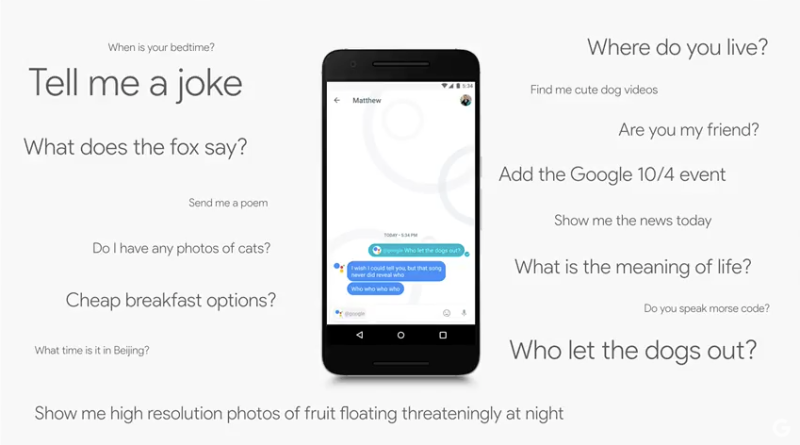
Google CEO Sundar Pichai thinks we are now living in an “artificial intelligence-first world.” He’s probably right. Artificial intelligence is all the rage in Silicon Valley these days, as technology companies race to build the first killer app that utilizes machine learning and image recognition. Today, Google announced an AI-powered assistant built into its new Pixel phones. But there’s a pivotal downside to the company’s latest creation: Because of the very nature of artificial intelligence, our data is less secure than ever before, and technology companies are now collecting even more personal information about each one of us.
Robots haven’t reached human intelligence yet, but Google’s researchers are showing how they’re closing the gap using downloadable intelligence.
Imagine if you could get better at some skill not just by learning and practicing it, but by accessing the brains of others to tap directly into their experiences?
Google is taking the next step in competing with mobile operators by extending its free Wifi alternative for voice and data “in the next few weeks”.
The service, called Wifi Assistant, will be available to all owners of Google Nexus phones in the US, Canada, Mexico, the UK and Nordic countries, said Google in a statement.
By now everyone has heard of Google’s RankBrain. It’s the new artificial intelligence machine learning algorithm that is supposed to be the latest and greatest from Mountain View, California. What you might not realize, however, is just how fast the SEO industry is changing because of it. This article will take you through some clear examples of how some of the old rules of SEO no longer apply, and what steps you can take to stay ahead of the curve in order to continue to provide successful SEO campaigns for your businesses.
Cloud computing and A.I. are now some of the most lucrative technologies in the tech industry. Google has seen huge growth on its search based advertising division, but now profits are starting to slow. Now the company is exploring other options to stay relevant to modern businesses.
Google Fiber, brought to select cites in 2011, was reasonably priced and super fast. It became widely popular in the few cities where it was available. Mainly because Fiber offered a much welcome alternative to most internet providers. Now Google has announced they want to set up a wireless service to “beam” wireless service into homes all across the nation.
Here’s the list of five trends learning professionals should be considering when mapping out strategies for the next five of years. It’s important to note that trends are not isolated developments within the L&D community but are often the culmination, confluence, and convergence of technological innovation, discoveries or rediscoveries of learning science and a reaction to changes within the larger culture in which society operates.